

中华护理杂志 ›› 2025, Vol. 60 ›› Issue (24): 2971-2978.DOI: 10.3761/j.issn.0254-1769.2025.24.004
陆斐( ), 王文霞, 支小燕, 留虹, 王鑫鑫()
收稿日期:2025-03-13
出版日期:2025-12-20
发布日期:2025-12-19
*通讯作者:
王鑫鑫,E-mail:2522084@zju.edu.cn作者简介:陆斐:女,硕士,主管护师,E-mail:2611172@zju.edu.cn
基金资助:
LU Fei(), WANG Wenxia, ZHI Xiaoyan, LIU Hong, WANG Xinxin()
Received:2025-03-13
Online:2025-12-20
Published:2025-12-19
摘要:
目的 综述虚拟现实技术在肩关节功能障碍患者康复中的应用,为规范实践提供参考。 方法 遵循范围综述指南,检索PubMed、Embase、CINAHL、Web of Science、Cochrane Library、Scopus、中国知网、万方数据库、维普数据库和中国生物医学文献数据库等,检索时限为建库至2025年6月30日,对纳入文献汇总、分析。 结果 共纳入16篇文献,包括14篇随机对照试验、1篇类实验研究和1篇混合研究,涉及885例患者。干预形式主要包括虚拟情景训练、游戏训练、身体训练、自测系统训练和增强现实系统训练。干预频次多为每周5次,单次时间为10~30 min,总时长15 min至6个月。结局指标涉及肩关节活动功能、疼痛、肩部肌肉功能、生活能力及生活质量等。 结论 虚拟现实技术在肩关节功能障碍患者康复中的应用广泛,未来应持续优化系统,注重数字公平与卫生经济学评价,以提升患者的康复体验与健康结局。
陆斐, 王文霞, 支小燕, 留虹, 王鑫鑫. 虚拟现实技术在肩关节功能障碍患者康复中应用的范围综述[J]. 中华护理杂志, 2025, 60(24): 2971-2978.
LU Fei, WANG Wenxia, ZHI Xiaoyan, LIU Hong, WANG Xinxin. Application of virtual reality in rehabilitation training for shoulder function:a scoping review[J]. Chinese Journal of Nursing, 2025, 60(24): 2971-2978.
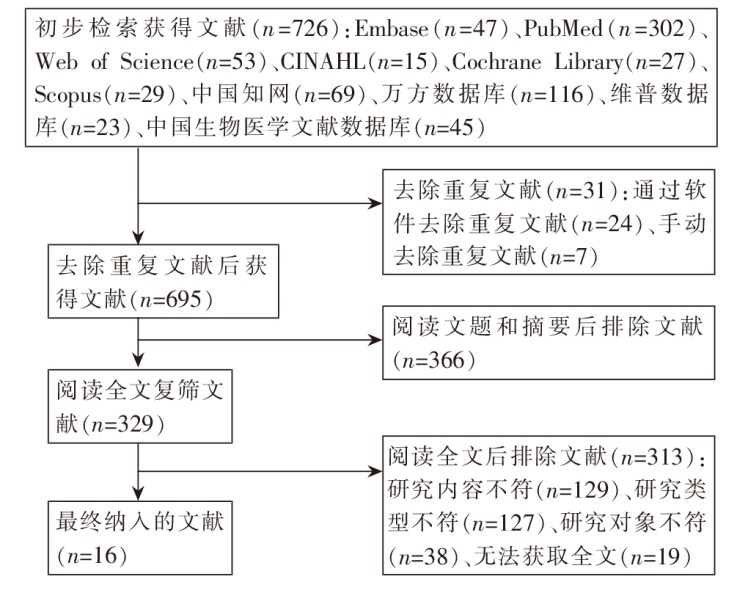
图1 文献筛选流程
Figure 1 Flow chart of literature screening
 |
表1 纳入文献的基本特征(n=16)
Table 1 Characteristics of the included studies(n=16)
|
| [1] | 孟硕, 曹春风, 魏志辉, 等. 氨甲环酸在关节镜下肩袖修补术中应用安全性和有效性的Meta分析[J]. 中国骨与关节杂志, 2024, 13(11):932-943. |
| Meng S, Cao CF, Wei ZH, et al. The safety and efficacy of tranexamic acid on visual clarity in arthroscopic rotator cuff repair:a Meta-analysis[J]. Chin J Bone Jt, 2024, 13(11):932-943. | |
| [2] | 鲁谊, 杨珖, 李岳, 等. 肩袖损伤合并肱二头肌长头腱病变的危险因素及其对肩关节功能的影响[J]. 中华骨科杂志, 2021, 41(8):471-479. |
| Lu Y, Yang G, Li Y, et al. Risk factors for rotator cuff tears with long head of bicep tendon lesions and their effects on preoperative function[J]. Chin J Orthop, 2021, 41(8):471-479. | |
| [3] |
Lu Y, Sun BL, Yang G, et al. Arthroscopic repair benefits reparable rotator cuff tear patients aged 65 years or older with a history of traumatic events[J]. Arthroscopy, 2023, 39(5):1150-1158.
DOI URL |
| [4] | 肖红梅, 张爽, 万巧琴. 肩袖损伤患者术后康复锻炼依从性现状调查及影响因素分析[J]. 中华现代护理杂志, 2020, 26(1):70-75. |
| Xiao HM, Zhang S, Wan QQ. Status quo of postoperative rehabilitation compliance in patients with rotator cuff injury and its influencing factors[J]. Chin J Mod Nurs, 2020, 26(1):70-75. | |
| [5] |
Linaker CH, Walker-Bone K. Shoulder disorders and occupation[J]. Best Pract Res Clin Rheumatol, 2015, 29(3):405-423.
DOI PMID |
| [6] | 徐如燚. 基于人体姿态捕捉与虚拟现实技术的肩关节康复系统[D]. 武汉: 华中科技大学, 2019. |
| Xu RY. Shoulder joint rehabilitation system based on human’s posture capture and virtual reality[D]. Wuhan: Huazhong University of Science and Technology, 2019. | |
| [7] | 毛宁波, 张煜, 侯雨潇, 等. 扩展现实技术在骨科手术实践及教学培训中的应用研究进展[J]. 中华骨与关节外科杂志, 2021, 14(10):890-896. |
| Mao NB, Zhang Y, Hou YX, et al. Applications of extended reality in orthopedic surgery practice and training[J]. Chin J Bone Jt Surg, 2021, 14(10):890-896. | |
| [8] |
Shim GY, Kim EH, Baek YJ, et al. A randomized controlled trial of postoperative rehabilitation using digital healthcare system after rotator cuff repair[J]. NPJ Digit Med, 2023, 6(1):95.
DOI PMID |
| [9] | Gendia A, Rehman M, Cota A, et al. Can virtual reality technology be considered as a part of the surgical care pathway?[J]. J Knee Surg,Ann R Coll Surg Engl, 2023, 105(1):2-6. |
| [10] | Chughtai M, Kelly JJ, Newman JM, et al. The role of virtual rehabilitation in total and unicompartmental knee arthroplasty[J]. 2019, 32(1):105-110. |
| [11] |
Arksey H, O’Malley L. Scoping studies:towards a methodological framework[J]. Int J Soc Res Methodol, 2005, 8(1):19-32.
DOI URL |
| [12] | Daf A, Patil DS. Impact of virtual rehabilitation in adjunct to conventional physical therapy on proximal humerus fracture:a randomized controlled trial[J]. Cureus, 2024, 16(3):e56022. |
| [13] |
Özlü A, Üstündağ S, Özkaya DB, et al. Effect of exergame on pain,function,and quality of life in shoulder impingement syndrome:a prospective randomized controlled study[J]. Games Health J, 2024, 13(2):109-119.
DOI URL |
| [14] | 李飞飞, 蔡晨晨, 吴巧云, 等. 沉浸式虚拟现实技术结合早期康复训练对肩袖损伤术后患者的临床疗效评价[J]. 温州医科大学学报, 2024, 54(5):371-377. |
| Li FF, Cai CC, Wu QY, et al. Clinical efficacy of immersive virtual reality technology combined with early rehabilitation training for postoperative patients with rotator cuff injuries[J]. J Wenzhou Med Univ, 2024, 54(5):371-377. | |
| [15] |
Álvarez de la Campa Crespo M, Donegan T, Amestoy-Alonso B, et al. Virtual embodiment for improving range of motion in patients with movement-related shoulder pain:an experimental study[J]. J Orthop Surg Res, 2023, 18(1):729.
DOI PMID |
| [16] | 黄沙沙, 卢跃伦, 骆国钢, 等. 沉浸式虚拟现实技术下肩关节康复训练联合等速肌力训练对肩袖修补术后患者的疗效[J]. 江苏医药, 2023, 49(10):1048-1052,1056. |
| Huang SS, Lu YL, Luo GG, et al. Efficacy of shoulder rehabilitation training under immersive virtual reality combined with isokinetic strength training in the treatment of patients after rotator cuff repair[J]. Jiangsu Med J, 2023, 49(10):1048-1052,1056. | |
| [17] |
Menek B, Tarakci D, Tarakci E, et al. Investigation on the efficiency of the closed kinetic chain and video-based game exercise programs in the rotator cuff rupture:a randomized trial[J]. Games Health J, 2022, 11(5):298-306.
DOI URL |
| [18] | Naqvi WM, Qureshi MI, Nimbulkar G, et al. Gamification for distal radius fracture rehabilitation:a randomized controlled pilot study[J]. Cureus, 2022, 14(9):e29333. |
| [19] | 吉家日, 孙恒聪, 林道冠, 等. 中频脉冲治疗配合虚拟情景模拟训练对肩周炎患者日常活动能力和活动度的影响[J]. 海军医学杂志, 2022, 43(9):969-972. |
| Ji JR, Sun HC, Lin DG, et al. Effects of intermediate frequency pulse therapy combined with virtual reality simulation training on the daily life ability and range of activity of the patients with periarthritis of shoulder[J]. J Navy Med, 2022, 43(9):969-972. | |
| [20] | 刘欣, 赵婷华. 基于体感交互技术下虚拟训练对肩关节功能的康复护理研究[J]. 国际医药卫生导报, 2021, 27(2):289-292. |
| Liu X, Zhao TH. Research on rehabilitation nursing of shoulder joint function by virtual training based on somatosensory interaction technology[J]. Int Med Health Guid News, 2021, 27(2):289-292. | |
| [21] | Cui JJ, Yeh SC, Lee SH. Wearable sensors integrated with virtual reality:a self-guided healthcare system measuring shoulder joint mobility for frozen shoulder[J]. J Healthc Eng, 2019, 2019:7681237. |
| [22] |
Pekyavas NO, Ergun N. Comparison of virtual reality exergaming and home exercise programs in patients with subacromial impingement syndrome and scapular dyskinesis:short term effect[J]. Acta Orthop Traumatol Turc, 2017, 51(3):238-242.
DOI URL |
| [23] | 卢茜, 周云, 王锋, 等. 虚拟情景结合常规康复疗法治疗肩周炎的临床疗效分析[J]. 生物医学工程与临床, 2017, 21(5):520-524. |
| Lu Q, Zhou Y, Wang F, et al. Therapeutic effect of virtual reality combined with routine rehabilitation therapy in scapulohumeral periarthritis[J]. Biomed Eng Clin Med, 2017, 21(5):520-524. | |
| [24] | 吴宏燕. 虚拟现实技术用于肱骨外科颈骨折手法复位功能锻炼[J]. 护理学杂志, 2015, 30(19):86-89. |
| Wu HY. Applying the virtual reality technology in rehab-training during manual reduction for patients with humerus surgical neck fracture[J]. J Nurs Sci, 2015, 30(19):86-89. | |
| [25] | Wiederhold BK, Wiederhold MD. Evaluation of virtual reality therapy in augmenting the physical and cognitive rehabilitation of war veterans[J]. Int J Disabil Hum Dev, 2006, 5(3):211-215. |
| [26] |
Marley WD, Barratt A, Pigott T, et al. A multicenter randomized controlled trial comparing gamification with remote monitoring against standard rehabilitation for patients after arthroscopic shoulder surgery[J]. J Shoulder Elbow Surg, 2022, 31(1):8-16.
DOI URL |
| [27] |
梁琪, 胡三莲, 韦小梅, 等. 前交叉韧带重建术后患者运动恐惧的研究进展及护理启示[J]. 中华护理杂志, 2024, 59(24):3049-3055.
DOI URL |
|
Liang Q, Hu SL, Wei XM, et al. Research progress on kinesiophobia in patients after anterior cruciate ligament reconstruction and nursing enlightenment[J]. Chin J Nurs, 2024, 59(24):3049-3055.
DOI URL |
|
| [28] |
杨滕, 李雯, 卢楠, 等. 虚拟现实体感运动在老年失智症患者中应用的范围综述[J]. 中华护理杂志, 2024, 59(17):2166-2172.
DOI URL |
| Yang T, Li W, Lu N, et al. Virtual reality motor sensing exercise in the elderly patients with dementia:a scoping review[J]. Chin J Nurs, 2024, 59(17):2166-2172. | |
| [29] |
徐雪芬, 王红燕, 郭萍萍, 等. 人工智能在慢性病患者健康管理中的应用进展[J]. 中华护理杂志, 2023, 58(9):1063-1067.
DOI URL |
|
Xu XF, Wang HY, Guo PP, et al. Progress on the application of artificial intelligence in chronic disease health management[J]. Chin J Nurs, 2023, 58(9):1063-1067.
DOI URL |
|
| [30] | Carson JAS, Lichtenstein AH, Anderson CAM, et al. Dietary cholesterol and cardiovascular risk:a science advisory from the American Heart Association[J]. Circulation, 2020, 141(3):e39-e53. |
| [31] |
卢明, 俞燕娟, 李中东, 等. 基于家庭医护平台延续性护理模式的构建及应用[J]. 中华护理杂志, 2019, 54(12):1851-1855.
DOI URL |
|
Lu M, Yu YJ, Li ZD, et al. Construction and application of continuity nursing model based on family medical platform[J]. Chin J Nurs, 2019, 54(12):1851-1855.
DOI URL |
|
| [32] |
Sassi M, Villa Corta M, Pisani MG, et al. Advanced home-based shoulder rehabilitation:a systematic review of remote monitoring devices and their therapeutic efficacy[J]. Sensors, 2024, 24(9):2936.
DOI URL |
| [1] | 王芸姣, 杨玉金, 郑春艳, 彭菲津, 王淑贞, 蒋喜露, 周为民, 王薇, 张娜. 糖尿病下肢动脉硬化闭塞症患者介入术后康复护理方案的构建及应用研究[J]. 中华护理杂志, 2026, 61(9): 1221-1229. |
| [2] | 李艳桃, 杨连招, 龙秀红, 陈玲, 高慧, 覃文婷, 朱芳慧, 罗雪儿. HIV感染者/AIDS患者创伤后成长体验的Meta整合[J]. 中华护理杂志, 2026, 61(9): 1261-1268. |
| [3] | 冯丽, 郭沛然, 程蓉, 熊楚琴, 张志霞. 基于时机理论的运动康复方案在慢性阻塞性肺疾病患者中的应用效果评价[J]. 中华护理杂志, 2026, 61(8): 1013-1020. |
| [4] | 杜倩, 胡恒瑜, 李珍, 曹静文, 刘星歌, 刘林莉. 作业疗法联合职业康复对结直肠癌患者术后重返工作岗位的效果研究[J]. 中华护理杂志, 2026, 61(8): 1080-1087. |
| [5] | 刘素玲, 蒋伟红, 李晓艳, 唐晓敏. 1例完全型Shone综合征合并重度肺动脉高压患儿的康复护理[J]. 中华护理杂志, 2026, 61(8): 1107-1111. |
| [6] | 黄璇, 郭书萍, カルデナス暁東, 谢云影, 王瀚敏, 张玉美, 刘焘丽, 李莉. 银屑病患者自我报告结局评估工具测量学属性的评价及护理启示[J]. 中华护理杂志, 2026, 61(8): 1117-1124. |
| [7] | 张滢, 刘淑娟, 王婧瑞, 马千蓉. 轻度认知障碍患者对虚拟现实技术使用体验的Meta整合[J]. 中华护理杂志, 2026, 61(8): 1125-1131. |
| [8] | 李秋桦, 傅桂芬, 蒋建华, 尹丹, 左静, 刘艳群. 可穿戴设备在炎症性肠病患者动态监测与管理中应用的范围综述[J]. 中华护理杂志, 2026, 61(8): 1132-1140. |
| [9] | 韩林, 杨丽娟, 李太东, 郑晓丽, 程敏, 郭琛, 郑培培. ICU机械通气清醒患者沟通体验的Meta整合[J]. 中华护理杂志, 2026, 61(7): 901-908. |
| [10] | 曾佳琳, 符冰, 杨泠韵, 江庆华. 头颈癌患者自我报告结局评估工具的评价及护理启示[J]. 中华护理杂志, 2026, 61(7): 986-994. |
| [11] | 王秀丽, 代春豪, 许梓婷, 李昊远, 冷敏敏, 张海博, 李晴, 杨丽娟. 运动干预在老年肌少性肥胖患者中应用的范围综述[J]. 中华护理杂志, 2026, 61(7): 995-1001. |
| [12] | 贺敬婷, 应燕萍, 陆秋芳, 赵慧函, 刘丽颖, 马含章, 张程. 多模态数据在护理领域中应用的范围综述[J]. 中华护理杂志, 2026, 61(7): 1002-1008. |
| [13] | 刘晓, 李丽, 施忠英. 青少年神经性厌食患者及其父母出院准备体验及需求的质性研究[J]. 中华护理杂志, 2026, 61(6): 814-821. |
| [14] | 武玲, 吴波, 陈红, 古晨茜, 刘洋, 张春谨, 陈梦琪, 章青. 基于机器学习算法的成人术中低体温预测模型的范围综述[J]. 中华护理杂志, 2026, 61(6): 844-851. |
| [15] | 陈静, 王君君, 魏晓琼, 何欢, 孙秋怡, 唐莹, 韩莹, 何华云. 运动干预在幼年特发性关节炎患儿中应用的范围综述[J]. 中华护理杂志, 2026, 61(6): 858-864. |
| 阅读次数 | ||||||
|
全文 |
|
|||||
|
摘要 |
|
|||||
