

中华护理杂志 ›› 2025, Vol. 60 ›› Issue (21): 2654-2661.DOI: 10.3761/j.issn.0254-1769.2025.21.014
谢睿( ), 章启秀, 陈丽丽, 李颖, 宁丽()
收稿日期:2025-03-14
出版日期:2025-11-10
发布日期:2025-11-05
*通讯作者:
宁丽,E-mail:nl5401@163.com作者简介:谢睿:女,硕士,主管护师,E-mail:13306513118@163.com
基金资助:
XIE Rui(), ZHANG Qixiu, CHEN Lili, LI Ying, NING Li()
Received:2025-03-14
Online:2025-11-10
Published:2025-11-05
摘要:
目的 探讨择时芳香疗法联合平衡火罐对肾阴虚型围绝经期失眠患者的护理效果,为中医护理临床实践提供参考依据。 方法 选取2023年1—9月就诊于杭州市某三级甲等医院中医妇科门诊的肾阴虚型围绝经期失眠患者132例作为研究对象,采用随机数字表法,分为芳香组、平衡火罐组、联合组和对照组,每组各33例。通过文献研究和专家小组会议确定干预方案,并通过预试验修订干预方案。芳香组在常规护理基础上予择时芳香疗法,平衡火罐组在常规护理基础上予择时平衡火罐,联合组在常规护理基础上予择时芳香疗法联合平衡火罐,对照组予常规护理,疗程均为4周。比较干预前后4组匹兹堡睡眠指数、中医证候积分以及不良反应发生情况的差异。 结果 干预4周后,联合组总有效率为71.87%,高于对照组(P<0.001)和芳香组(P<0.05);联合组痊愈率为31.25%,高于芳香组的12.50%(P<0.001)和平衡火罐组的12.50%(P<0.001)。干预后芳香组中医证候积分为9.00(5.00,10.00)分、平衡火罐组为8.00(4.00,12.00)分、联合组为9.00(4.00,10.00)分,均低于对照组的12.00(9.00,17.00)分(P<0.001)。 结论 择时芳香疗法联合平衡火罐能有效改善围绝经期失眠患者的睡眠状况,缓解肾阴虚证,且干预方案具有良好的科学性和可行性。
谢睿, 章启秀, 陈丽丽, 李颖, 宁丽. 择时芳香疗法联合平衡火罐对围绝经期失眠患者的干预效果研究[J]. 中华护理杂志, 2025, 60(21): 2654-2661.
XIE Rui, ZHANG Qixiu, CHEN Lili, LI Ying, NING Li. Study on the effect of timing aromatherapy combined with balanced cupping on perimenopausal insomnia patients[J]. Chinese Journal of Nursing, 2025, 60(21): 2654-2661.
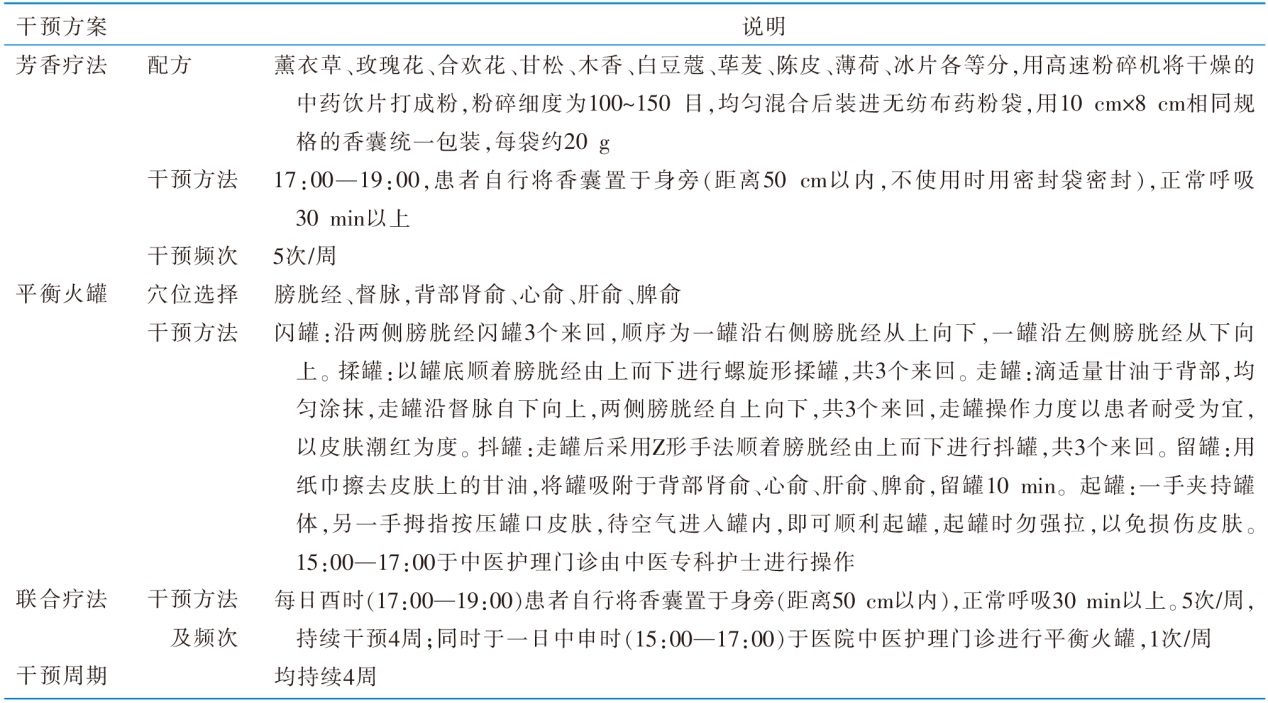 |
表1 择时芳香疗法联合平衡火罐干预方案终稿
Table 1 The final draft of midnight-noon ebb-flow timing aromatherapy combined with balanced cupping intervention program
| |
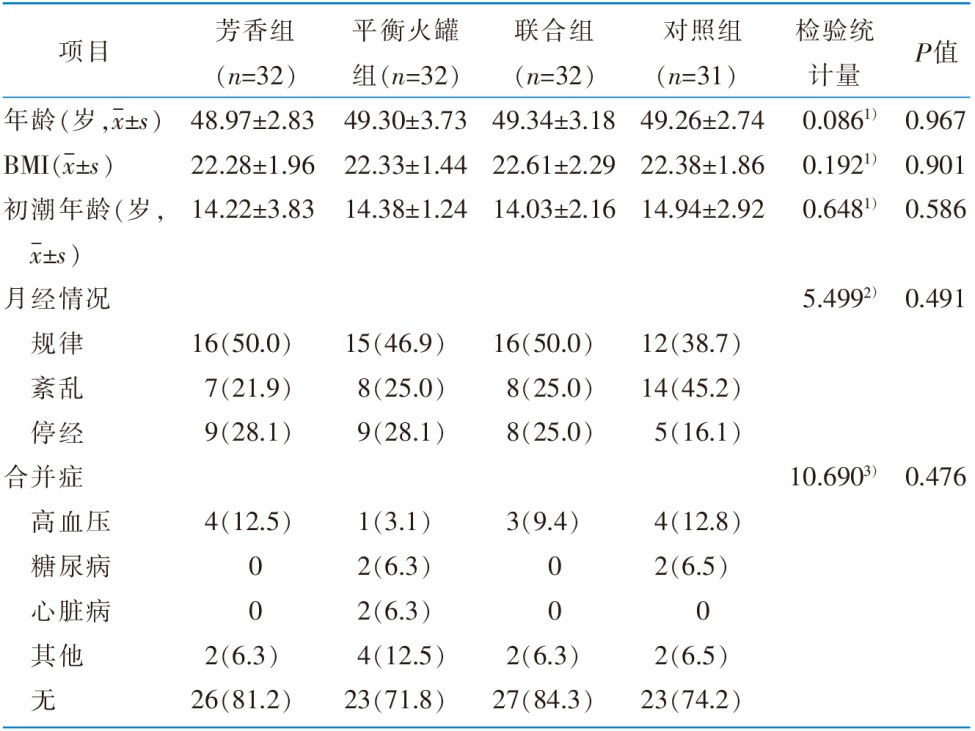 |
表2 四组一般资料的比较
Table 2 Comparison of general data of 4 groups
| |
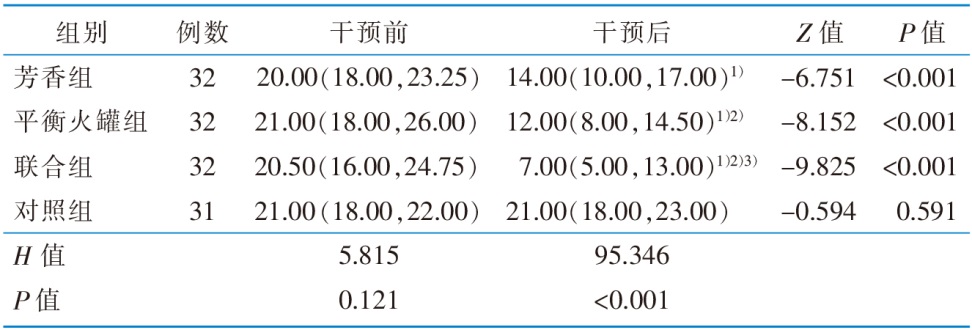 |
表3 四组干预前后匹兹堡睡眠指数得分的比较(分,$\bar{x} \pm s$)
Table 3 Multiple comparison of PSQI scores before and after intervention in 4 groups(score, $\bar{x} \pm s$)
| |
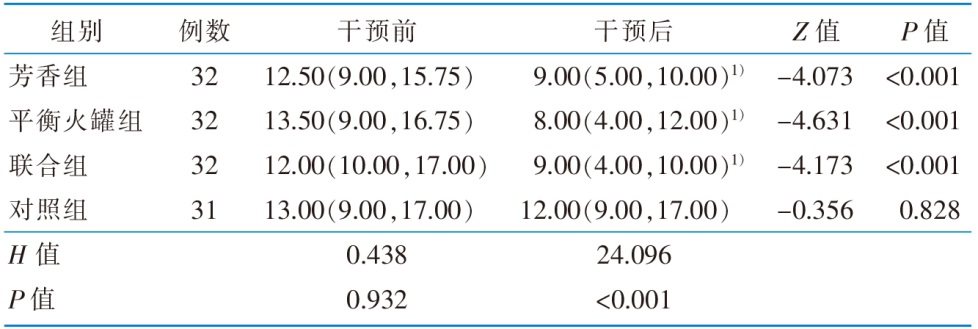 |
表4 四组干预前后中医证候积分的比较(分,$\bar{x} \pm s$)
Table 4 Multiple comparison of TCM syndrome score before and after intervention in 4 groups(score,$\bar{x} \pm s$)
| |
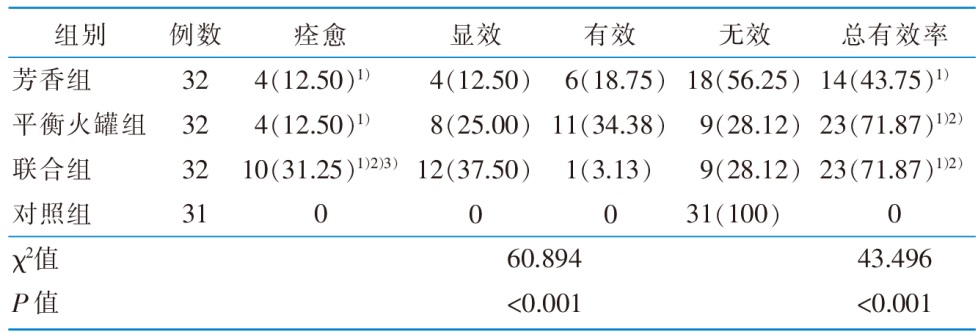 |
表5 4组临床疗效的比较[例(百分比,%)]
Table 5 Comparison of clinical efficacy of 4 groups[cases(percentage,%)]
| |
| [1] | 郑双林. 广州市天河区40岁-60岁女性围绝经期情况调查及相关影响因素分析[D]. 广州: 南方医科大学, 2023. |
| Zheng SL. Investigation on perimenopausal period of women aged 40-60 in Tianhe district of Guangzhou and analysis of related influencing factors[D]. Guangzhou: Southern Medical Uni-versity, 2023. | |
| [2] |
Thurston RC, Chang YF, Kline CE, et al. Trajectories of sleep over midlife and incident cardiovascular disease events in the study of women’s health across the nation[J]. Circulation, 2024, 149(7):545-555.
DOI PMID |
| [3] | Madari S, Golebiowski R, Mansukhani MP, et al. Pharmacologi-cal management of insomnia[J]. Neurotherapeutics, 2021, 18(1):44-52. |
| [4] | 杜萍, 曾丽, 高清梅, 等. 针刺十三鬼穴联合黄连阿胶汤对围绝经期失眠患者神经递质、性激素水平及主客观睡眠质量的影响[J]. 西部中医药, 2025, 38(4):144-148. |
| Du P, Zeng L, Gao QM, et al. Effects of needling at thirteen ghost points combined with Huanglian Ejiao decoction on the levels of neurotransmitter,sex hormone,subjective and objective sleep quality in perimenopausal insomnia patients[J]. West J Tradit Chin Med, 2025, 38(4):144-148. | |
| [5] | 刘敏如. 中医妇科学[M]. 2版. 北京: 人民卫生出版社, 2007. |
| Liu MR. Traditional Chinese gynecology[M]. 2nd ed. Beijing: People’s Medical Publishing House, 2007. | |
| [6] | 吴有艳, 单雪娇, 窦湘芸, 等. 中西医治疗慢性失眠的非药物方法研究进展[J]. 世界睡眠医学杂志, 2021, 8(7):1288-1296. |
| Wu YY, Shan XJ, Dou XY, et al. Research progress on non drug treatment of chronic insomnia with traditional Chinese and western medicine[J]. World J Sleep Med, 2021, 8(7):1288-1296. | |
| [7] | 李玉坤, 刘大胜, 任聪, 等. 中医芳香疗法的研究进展[J]. 中国中医急症, 2020, 29(1):178-181. |
| Li YK, Liu DS, Ren C, et al. Research progress of aromathe-rapy in traditional Chinese medicine[J]. J Emerg Tradit Chin Med, 2020, 29(1):178-181. | |
| [8] | 郑魁山. 子午流注与灵龟八法[M]. 兰州: 甘肃人民出版社,1983. |
| Zheng KS. Meridian Liuzhu and eight methods of Linggui[M]. Lanzhou: Gansu People’s Publishing House,1983. | |
| [9] | 张晶. 子午流注择时芳香疗法联合穴位按摩干预肾阴虚型围绝经期综合征的临床护理观察[D]. 哈尔滨: 黑龙江中医药大学, 2021. |
| Zhang J. Clinical nursing observation on the intervention of meridian flow injection and timed aromatherapy combined with acupoint massage on perimenopausal syndrome of kidney Yin deficiency type[D]. Harbin: Heilongjiang University of Chinese Medicine, 2021. | |
| [10] | 卢亚玲, 邢晓燕, 董朝妮, 等. 子午流注择时耳穴贴压结合中医情志干预对围绝经期失眠患者睡眠质量、情绪状态及神经递质水平的影响[J]. 临床医学研究与实践, 2023, 8(20):138-141. |
| Lu YL, Xing XY, Dong ZN, et al. Effects of midnight-noon ebb-flow timing auricular point sticking combined with traditional Chinese medicine emotional intervention on sleep quality,emotional state and neurotransmitter level of patients with perimenopausal insomnia[J]. Clin Res Pract, 2023, 8(20):138-141. | |
| [11] | 马丁. 妇产科疾病诊疗指南[M]. 3版. 北京: 科学出版社, 2013. |
| Ma D. Guidelines for diagnosis and treatment of gynecological diseases[M]. 3rd ed. Beijing: Science Press, 2013. | |
| [12] | 谢幸, 苟文丽. 妇产科学[M]. 8版. 北京: 人民卫生出版社, 2013. |
| Xie X, Gou WL. Obstetrics and gynecology[M]. 8th ed. Beijing: People’s Medical Publishing House, 2013. | |
| [13] | 中华医学会精神科分会. CCMD-3中国精神障碍分类与诊断标准[M]. 3版. 济南: 山东科学技术出版社, 2001. |
| Psychiatric Branch of Chinese Medical Association. CCMD-3 classification and diagnostic criteria of mental disorders in China[M]. 3rd ed. Jinan: Shandong Science & Technology Press, 2001. | |
| [14] | 郑筱萸. 中药新药临床研究指导原则:试行[M]. 北京: 中国医药科技出版社, 2002. |
| Zheng XY. Guiding principles for clinical research of new Chinese medicine:trial implementation[M]. Beijing: China Medi-cal Science Press, 2002. | |
| [15] | 国家中医药管理局. 中医病证诊断疗效标准[M]. 南京: 南京大学出版社,1994. |
| State Administration of Traditional Chinese Medicine. Diagno-stic efficacy standard of Chinese Medicine[M]. Nanjing: Nan-jing University Press,1994. | |
| [16] |
陈英, 陈晓洁, 王舒洁, 等. 芳香疗法联合情绪释放技术对失眠乳腺癌患者影响的研究[J]. 中华护理杂志, 2022, 57(6):651-658.
DOI |
| Chen Y, Chen XJ, Wang SJ, et al. Effect of lavender aromatic therapy combined with emotional freedom techniques on insomnia cancer breast patients with heart and spleen defi-ciency[J]. Chin J Nurs, 2022, 57(6):651-658. | |
| [17] |
王璇, 胡景贤, 韩舒羽, 等. 中医五音疗法在肝郁脾虚型自身免疫性肝病患者中的应用研究[J]. 中华护理杂志, 2024, 59(7):789-795.
DOI |
|
Wang X, Hu JX, Han SY, et al. Research on the application of Traditional Chinese Medicine’s five-element music therapy in patients with autoimmune liver disease of liver depression and spleen deficiency type[J]. Chin J Nurs, 2024, 59(7):789-795.
DOI |
|
| [18] | 方泽佳, 陈哲子, 范秀英. 平衡火罐联合气交灸改善心肾不交型失眠的临床疗效[J]. 内蒙古中医药, 2022, 41(5):106-108. |
| Fang ZJ, Chen ZZ, Fan XY. Evaluation of the efficacy of balanced cupping combined with Qijiao Moxibustion in treating insomnia patients with heart-kidney incompatibility[J]. Inn Mong J Tradit Chin Med, 2022, 41(5):106-108. | |
| [19] | 张凯华. 芳香疗法治疗肝郁脾虚型失眠的临床疗效观察[D]. 北京: 北京中医药大学, 2019. |
| Zhang KH. Clinical observation of aromatherapy in treating insomnia with liver depression and spleen deficiency[D]. Bei-jing: Beijing University of Chinese Medicine, 2019. | |
| [20] | Buysse DJ, Reynolds CR, Monk TH, et al. The Pittsburgh Sleep Quality Index:a new instrument for psychiatric practice and research[J]. Psychiatry Res, 1989, 28(2):193-213. |
| [21] | 刘贤臣, 唐茂芹, 胡蕾, 等. 匹兹堡睡眠质量指数的信度和效度研究[J]. 中华精神科杂志, 1996(2):103-107. |
| Liu XC, Tang MQ, Hu L, et al. Reliability and validity of the Pittsburgh sleep quality index[J]. Chin J Psychiatry, 1996(2):103-107. | |
| [22] | 路桃影, 李艳, 夏萍, 等. 匹兹堡睡眠质量指数的信度及效度分析[J]. 重庆医学, 2014, 43(3):260-263. |
| Lu TY, Li Y, Xia P, et al. Analysis on reliability and validity of the Pittsburgh sleep quality index[J]. Chongqing Med, 2014, 43(3):260-263. | |
| [23] |
刘美华, 彭剑雄, 罗翠, 等. 机械通气患儿早期活动方案的构建及应用研究[J]. 中华护理杂志, 2022, 57(8):901-907.
DOI |
|
Liu MH, Peng JX, Luo C, et al. Construction and application of an early activity program in children with mechanical ventilation[J]. Chin J Nurs, 2022, 57(8):901-907.
DOI |
|
| [24] | 周瑞娜, 杨莹莹, 程敏. 中药香囊的作用机理与临床应用[J]. 商洛学院学报, 2023, 37(4):69-75. |
| Zhou RN, Yang YY, Cheng M. Mechanism of action and clinical application of traditional Chinese medicine sachets[J]. J Shangluo Univ, 2023, 37(4):69-75 | |
| [25] | 刘梦梅. 芳香疗法联合中药对肾虚肝郁型围绝经期综合征临床疗效的观察[D]. 泸州: 西南医科大学, 2022. |
| Liu MM. Clinical observation of aromatherapy combined with traditional Chinese medicine on perimenopausal syndrome of kidney deficiency and liver depression[D]. Luzhou: Southwest Medical University, 2022. | |
| [26] | 刘盈, 马莹蕊. 基于“经脉当令”理论评价铜砭刮痧联合平衡火罐缓解腰椎间盘突出症引起疼痛临床疗效观察[J]. 辽宁中医药大学学报, 2020, 22(8):155-158. |
| Liu Y, Ma YR. Clinical efficacy of copper sputum scraping combined with balanced cupping in relieving pain caused by lumbar disc herniation based on the theory of meridians dangling[J]. J Liaoning Univ Tradit Chin Med, 2020, 22(8):155-158. | |
| [27] | 罗惠芳, 康幼雯, 仝玉珠. 四物汤加减联合平衡火罐治疗对肾虚血瘀型围绝经期综合征的疗效观察[J]. 淮海医药, 2022, 40(5):499-502. |
| Luo HF, Kang YW, Tong YZ. Observation on the therapeutic effect of Siwu decoction combined with balanced cupping on perimenopausal syndrome of kidney deficiency and blood stasis[J]. J Huaihai Med, 2022, 40(5):499-502. |
| [1] | 刘凤春, 孟茜, 宋晓萌, 穆东帅, 王艳, 王雪, 常红. 择时穴位贴敷对帕金森病患者夜间尿频的护理效果研究[J]. 中华护理杂志, 2026, 61(3): 347-352. |
| [2] | 杨婷, 魏慧, 柳妙妙, 吴旻昊, 童芳芳, 蒋璐亚, 杨红燕. 五音配五色音乐疗法在脑卒中后阈下抑郁患者中的应用研究[J]. 中华护理杂志, 2025, 60(21): 2648-2653. |
| [3] | 邵雪英, 裴晓丹, 李艳娟, 董玉红, 常立阳, 金静芬. 基于脑-肠轴理论的足部推拿在脾肾阳虚型血液透析失眠患者中的应用研究[J]. 中华护理杂志, 2025, 60(18): 2203-2209. |
| [4] | 杜云红, 荣文丽, 孙莉莉, 王玉, 王淑君, 王莉. 结直肠癌患者“互联网+中医护理服务”选择偏好的研究[J]. 中华护理杂志, 2025, 60(12): 1413-1419. |
| [5] | 姚斌莲, 徐敏, 毛小培, 彭敏, 祝瑞, 张晓兰, 叶梦华, 杨丹华. 砭石中药热熨在造血干细胞移植患者预处理期胃肠道反应中的应用研究[J]. 中华护理杂志, 2025, 60(12): 1420-1426. |
| [6] | 侯燕丽, 陆镇涛, 郭敬, 林海青, 唐新宇, 周姣媚, 王坤, 陈扬. 肺癌患者不同证型咳嗽耳穴贴压技术方案构建及效果研究[J]. 中华护理杂志, 2025, 60(12): 1427-1433. |
| [7] | 艾丽娟, 陆姝姝, 施剑剑, 石吉芬, 叶静. 耳部刮痧在慢性肾衰竭伴恶心呕吐患者中的应用研究[J]. 中华护理杂志, 2025, 60(12): 1434-1439. |
| [8] | 姚斌莲, 徐敏, 叶梦华, 陈晓洁, 叶富英, 汪永坚, 林娟英, 倪斐琳, 张晓兰. 浙江省“互联网+中医护理服务”人才培养模式的构建与应用[J]. 中华护理杂志, 2024, 59(8): 980-986. |
| [9] | 王璇, 胡景贤, 韩舒羽, 王颖, 吴璇, 赵艳超, 刘雪娇. 中医五音疗法在肝郁脾虚型自身免疫性肝病患者中的应用研究[J]. 中华护理杂志, 2024, 59(7): 789-795. |
| [10] | 王成龙, 金宁宁, 裴立松, 田媛, 王丽伟, 张仪, 李清萍, 张翠轻, 王彩虹, 韩洋, 郭菊兰, 刘香弟. 7所三级中医院血液透析患者中医健康知识掌握现状及对策[J]. 中华护理杂志, 2024, 59(7): 796-801. |
| [11] | 张媛媛, 龙秀红, 吕婵, 李鲜, 王艺, 黄兰英, 涂惠琼, 覃惠娟. 1例药液外渗致慢性难愈性创面形成患者的中西医结合护理[J]. 中华护理杂志, 2024, 59(7): 808-811. |
| [12] | 黄奕敏, 黄丽君, 翁丹婷, 庄平, 谭益冰. 脑卒中肢体功能障碍患者恢复期中医康复护理的最佳证据总结[J]. 中华护理杂志, 2024, 59(7): 812-819. |
| [13] | 张菁, 张琛, 姜梦媛, 葛燕, 张馨悦, 徐家华. 艾灸改善肿瘤患者血液高凝状态的效果研究[J]. 中华护理杂志, 2024, 59(23): 2873-2877. |
| [14] | 魏佳佳, 冉真榕, 石奥利, 陈丛琳, 杨雪, 杨光静, 李飞丽, 杨婵娟. 省市级中医护理学重点专科建设评估指标的构建及验证[J]. 中华护理杂志, 2024, 59(23): 2878-2886. |
| [15] | 邹炎铃, 李易, 张紫嫣, 李洵, 杨丽华, 王晓庆, 高娟, 管慧芸, 段培蓓. 基于体质特征的胃癌化疗患者核心症状及影响因素研究[J]. 中华护理杂志, 2024, 59(18): 2238-2243. |
| 阅读次数 | ||||||
|
全文 |
|
|||||
|
摘要 |
|
|||||
