

中华护理杂志 ›› 2025, Vol. 60 ›› Issue (12): 1479-1485.DOI: 10.3761/j.issn.0254-1769.2025.12.011
韩冰( ), 李春敏, 郭晨明, 于明明()
收稿日期:2024-08-23
出版日期:2025-06-20
发布日期:2025-06-17
*通讯作者:
于明明,E-mail:yumm@hsc.pku.edu.cn作者简介:韩冰:女,硕士,副主任护师,护理部副主任,E-mail:bjjstyy2023@163.com
基金资助:
HAN Bing(), LI Chunmin, GUO Chenming, YU Mingming()
Received:2024-08-23
Online:2025-06-20
Published:2025-06-17
摘要:
目的 调查骨科护士共情疲劳症状的发生现状,分析其影响因素以及影响因素间的作用路径,为制订针对性的干预方案提供参考。方法 采用便利抽样法,于2024年5月—6月采用一般资料调查表、共情疲劳量表、护士职业认同评定量表、社会支持评定量表、护士心理资本问卷,对14个省(区、市)20所三级甲等综合医院的骨科护士进行问卷调查。采用单因素分析、Spearman相关分析、多元线性回归分析探究护士共情疲劳症状的影响因素,并构建结构方程模型。结果 共发放问卷1 441份,回收有效问卷1 397份,有效问卷回收率为96.94%。护士共情疲劳症状得分为(47.41±12.16)分。多元线性回归分析结果显示,职业认同、社会支持、心理资本、工作时间、每周夜班数是骨科护士共情疲劳症状的影响因素(P<0.05)。路径分析结果显示,模型拟合指标良好,心理资本对共情疲劳症状具有直接作用(β=-0.15,P<0.05);职业认同(β=1.46,P<0.001;β=-0.38,P<0.001)、社会支持(β=0.14,P<0.001;β=-0.99,P<0.001)在心理资本与共情疲劳症状间具有中介作用。结论 骨科护士共情疲劳症状较严重。护理管理者应针对相关影响因素制订有效的预防措施,以减轻骨科护士的共情疲劳症状。
韩冰, 李春敏, 郭晨明, 于明明. 骨科护士共情疲劳症状的影响因素及路径分析[J]. 中华护理杂志, 2025, 60(12): 1479-1485.
HAN Bing, LI Chunmin, GUO Chenming, YU Mingming. Influencing factors and path analysis of compassion fatigue symptoms in orthopedic nurses[J]. Chinese Journal of Nursing, 2025, 60(12): 1479-1485.
 |
表1 调查对象的一般资料及共情疲劳症状的单因素分析结果(n=1 397)
Table 1 The general characteristics of orthopedic nurses and the results of univariate analysis of compassion fatigue symptoms(n=1 397)
| |
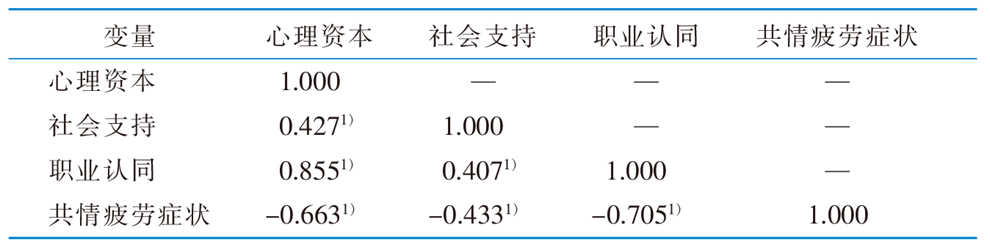 |
表2 骨科护士心理资本、职业认同、社会支持与共情疲劳症状的相关分析 (r 值,n=1 397)
Table 2 Correlations of psychological capital, professional identity,social support and compassion fatigue symptoms in orthopedic nurses(r value,n=1 397)
| |
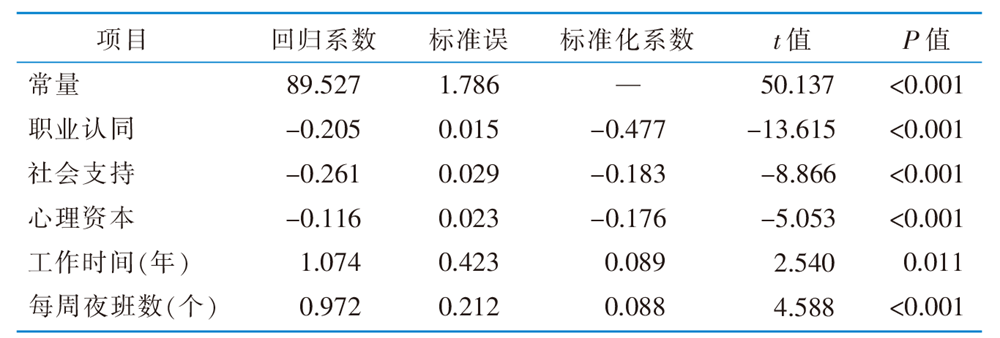 |
表3 骨科护士共情疲劳症状的多元线性回归分析结果(n=1 397)
Table 3 Results of multiple linear regression analysis of compassion fatigue symptoms in orthopedic nurses(n=1 397)
| |
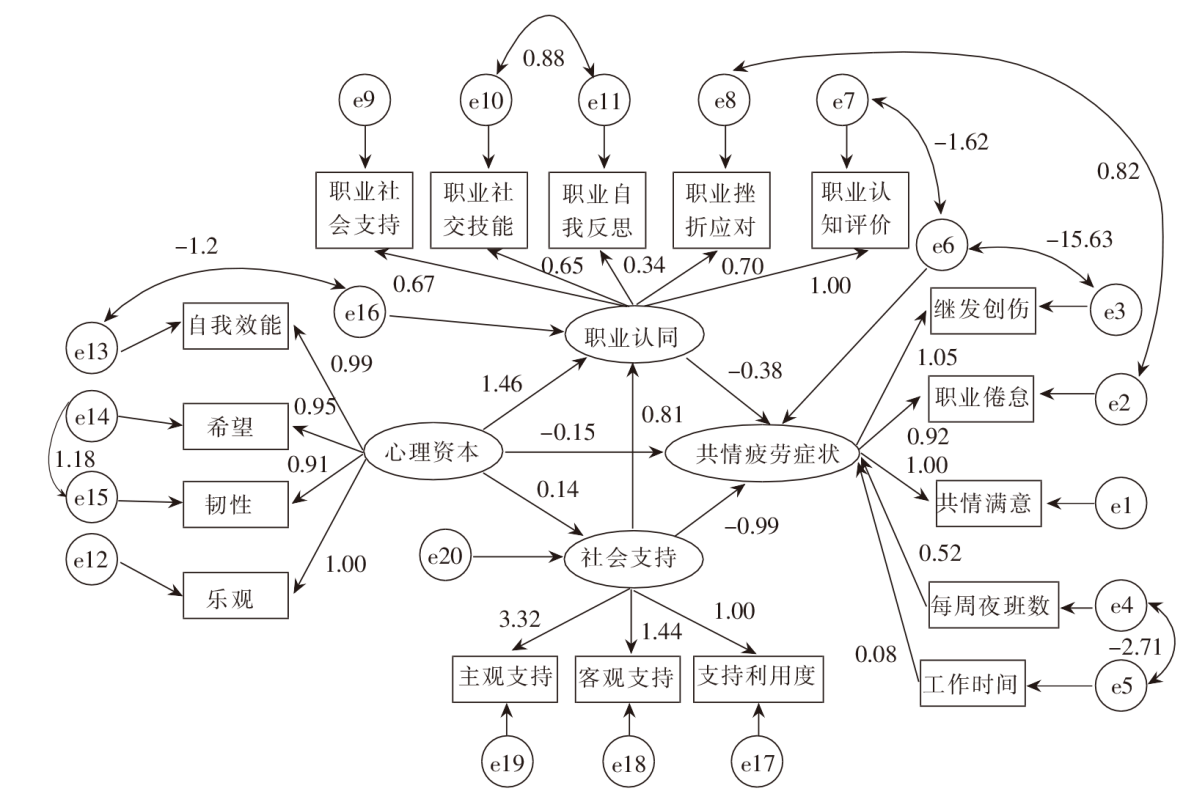
图1 骨科护士心理资本、社会支持和职业认同与共情疲劳症状的结构方程模型
Figure 1 Mediating effect model of psychological capital, social support, professional identity and compassion fatigue symptoms in orthopedic nurses
| [1] | Figley CR. Compassion fatigue:psychotherapists' chronic lack of self care[J]. J Clin Psychol, 2002, 58(11):1433-1441. |
| [2] |
Wijdenes KL, Badger TA, Sheppard KG. Assessing compassion fatigue risk among nurses in a large urban trauma center[J]. J Nurs Adm, 2019, 49(1):19-23.
DOI PMID |
| [3] | Zhang YY, Han WL, Qin W, et al. Extent of compassion sati-sfaction,compassion fatigue and burnout in nursing:a meta-analysis[J]. J Nurs Manag, 2018, 26(7):810-819. |
| [4] |
Demerouti E, Bakker AB, Nachreiner F, et al. The job demands-resources model of burnout[J]. J Appl Psychol, 2001, 86(3):499-512.
PMID |
| [5] |
丛胜楠, 张爱霞, 刘颖, 等. 江苏省妇产专科医院护士共情疲劳的影响因素及路径分析[J]. 中华护理杂志, 2022, 57(8):977-984.
DOI URL |
|
Cong SN, Zhang AX, Liu Y, et al. Analysis of influencing factors and impact path of compassion fatigue in nurses from maternity hospitals in Jiangsu[J]. Chin J Nurs, 2022, 57(8):977-984.
DOI URL |
|
| [6] | 庄琳丽. 三甲医院临床护士共情疲劳现状及其影响因素研究[D]. 成都: 成都中医药大学, 2020. |
| Zhuang LL. Study on the status quo and influencing factors of empathic fatigue among clinical nurses in 3A hospitals[D]. Chengdu: Chengdu University of TCM, 2020. | |
| [7] | 张慧, 许翠萍, 薛秀娟, 等. ICU护士同情心疲乏对其职业认同的影响[J]. 中国护理管理, 2014, 14(3):246-249. |
| Zhang H, Xu CP, Xue XJ, et al. Impact of compassion fatigue on professional identity in intensive care unit nurses[J]. Chin Nurs Manag, 2014, 14(3):246-249. | |
| [8] | 王建华. 实用医学科研方法[M]. 北京: 人民卫生出版社, 2003:56-57. |
| Wang JH. Practical medical research methods[M]. Beijing: Peo-ple's Medical Publishing House, 2003:56-57. | |
| [9] | 吴明隆. 结构方程模型:AMOS的操作与应用[M]. 重庆: 重庆大学出版社, 2009. |
| Wu ML. Structural equation modeling:operation and application with AMOS[M]. Chongqing: Chongqing University Press, 2009. | |
| [10] | Stamm B. The concise ProQOL manual:the concise manual for the Professional Quality of Life Scale,2nd edition[M/OL].(2010)[2024-08-01]. https://www.researchgate.net/publication/340033923_The_Concise_ProQOL_Manual_The_concise_manual_for_the_Professional_Quality_of_Life_Scale_2_nd_Edition. |
| [11] | 陈华英, 王卫红. 中文版同情疲劳量表的信度、效度研究[J]. 中国护理管理, 2013, 13(4):39-41. |
| Chen HY, Wang WH. Reliability and validity of the Chinese version of the Compassion Fatigue Scale[J]. Chin Nurs Manag, 2013, 13(4):39-41. | |
| [12] | 刘玲, 郝玉芳, 刘晓虹. 护士职业认同评定量表的研制[J]. 解放军护理杂志, 2011, 28(3):18-20. |
| Liu L, Hao YF, Liu XH. Development of Professional Identity Scale for Nurses[J]. Nurs J Chin PLA, 2011, 28(3):18-20. | |
| [13] | 肖水源. 《社会支持评定量表》的理论基础与研究应用[J]. 临床精神医学杂志, 1994, 4(2):98-100. |
| Xiao SY. Theoretical basis and research application of Social Support Rating Scale[J]. J Clin Psychiatry, 1994, 4(2):98-100. | |
| [14] | Luthans F, Youssef CM, Avolio BJ. Psychological capital deve-loping the human competitive edge[M]. Oxford: Oxford Univer-sity Press, 2007. |
| [15] | 骆宏, 赫中华. 466名护士心理资本与职业倦怠及离职意愿的关系[J]. 中华护理杂志, 2010, 45(10):933-935. |
| Luo H, He ZH. The relationships among psychological capital,job burnout and turnover intention in 466 nurses[J]. Chin J Nurs, 2010, 45(10):933-935. | |
| [16] | 修晓萍. 急诊儿科护士共情疲乏的现状调查及认知重评干预研究[D]. 青岛: 青岛大学, 2020. |
| Xiu XP. Investigation on the current situation of empathy fatigue of emergency pediatric nurses and intervention study on cognitive reappraisal[D]. Qingdao: Qingdao University, 2020. | |
| [17] | Kwon J, Coimbra R. Fat embolism syndrome after trauma:what you need to know[J]. J Trauma Acute Care Surg, 2024, 97(4):505-513. |
| [18] |
肖万莲, 李娜, 陈晓玲, 等. 集束化护理在高龄髋部骨折患者围手术期的应用[J]. 中华护理杂志, 2023, 58(22):2734-2740.
DOI URL |
|
Xiao WL, Li N, Chen XL, et al. Application of cluster nursing mode in perioperative period of elderly patients with hip fracture[J]. Chin J Nurs, 2023, 58(22):2734-2740.
DOI URL |
|
| [19] | Luthans F, Avolio BJ, Avey JB, et al. Positive psychological capital:measurement and relationship with performance and satisfaction[J]. Pers Psychol, 2007, 60(3):541-572. |
| [20] | 田梅梅, 范霖, 施雁, 等. 临床护士共情疲劳的现状及其影响因素分析[J]. 中华护理杂志, 2018, 53(1):76-82. |
| Tian MM, Fan L, Shi Y, et al. The current status and in-fluencing factors of compassion fatigue in clinical nurses[J]. Chin J Nurs, 2018, 53(1):76-82. | |
| [21] |
O'Mahony S, Ziadni M, Hoerger M, et al. Compassion fatigue among palliative care clinicians:findings on personality factors and years of service[J]. Am J Hosp Palliat Care, 2018, 35(2):343-347.
DOI PMID |
| [22] | 陈莉, 陈松, 梅俊华, 等. 新冠肺炎疫情下医护人员共情疲劳干预策略研究[J]. 医学与哲学, 2020, 41(16):50-53. |
| Chen L, Chen S, Mei JH, et al. Study on the interventional strategy of empathy fatigue of medical staff in the epidemic of COVID19[J]. Med Philos, 2020, 41(16):50-53. | |
| [23] | Yazdankhahfard M, Haghani F, Omid A. The Balint group and its application in medical education:a systematic review[J]. J Educ Health Promot, 2019,8:124. |
| [24] | 徐永娟, 刘志梅, 位兰玲, 等. 急诊护士工作压力源和心理资本对共情疲劳影响的路径分析[J]. 中华现代护理杂志, 2020, 26(16):2162-2167. |
| Xu YJ, Liu ZM, Wei LL, et al. Path analysis of the influence of work stressors and psychological capital on compassion fatigue in emergency nurses[J]. Chin J Mod Nurs, 2020, 26(16):2162-2167. | |
| [25] | 魏华, 董越娟, 邹涛, 等. 新入职院前急救护士职业应激、心理资本与共情疲劳感的关系分析[J]. 中华现代护理杂志, 2015, 21(15):1798-1801,1802. |
| Wei H, Dong YJ, Zou T, et al. Relationship of compassion fatigue,occupational stress and psychological capital among new graduate ambulance nurses[J]. Chin J Mod Nurs, 2015, 21(15):1798-1801,1802. | |
| [26] | 张菊花. 护士心理资本、组织支持及工作满意度的相关性研究[D]. 延吉: 延边大学, 2016. |
| Zhang JH. Study on the correlation among psychological capi-tal,organizational support and job satisfaction of nurses[D]. Yanji: Yanbian University, 2016. | |
| [27] | Yu HR, Jiang AL, Shen J. Prevalence and predictors of com-passion fatigue,burnout and compassion satisfaction among oncology nurses:a cross-sectional survey[J]. Int J Nurs Stud, 2016,57:28-38. |
| [28] | Hunsaker S, Chen HC, Maughan D, et al. Factors that influen-ce the development of compassion fatigue,burnout,and compas-sion satisfaction in emergency department nurses[J]. J Nurs Scholarsh, 2015, 47(2):186-194. |
| [1] | 郑煜琳, 刘晋宁, 张静, 郭会敏, 谷艳梅, 张莉莉. 酒精性肝病患者肝移植术后再饮酒现状及其影响因素分析[J]. 中华护理杂志, 2026, 61(9): 1208-1214. |
| [2] | 张诗阳, 刘荞瑀, 林小灵, 艾星星, 陈慈端, 黄洁微. 症状科学模型在2型糖尿病患者症状管理中的应用进展[J]. 中华护理杂志, 2026, 61(9): 1284-1290. |
| [3] | 于云龙, 李双, 罗瑶, 张遂乐, 彭粤铭. 慢性阻塞性肺疾病急性加重期患者症状负担与疾病感知的相关性研究[J]. 中华护理杂志, 2026, 61(8): 1036-1042. |
| [4] | 张莹, 杜若飞, 杨惠敏, 杜亚婷. 非霍奇金淋巴瘤患者化疗期衰弱轨迹的潜在类别及影响因素研究[J]. 中华护理杂志, 2026, 61(8): 1051-1058. |
| [5] | 李珊, 邵梦琪, 邱晨, 苏清清, 高远. 4 907例老年髋部骨折患者术后并发症发生现状及影响因素研究[J]. 中华护理杂志, 2026, 61(8): 1059-1065. |
| [6] | 张晴, 赵恺, 厉春林, 胡娜, 陆小燕. 神经外科肠内营养患者腹内压变化轨迹的潜在类别及影响因素研究[J]. 中华护理杂志, 2026, 61(7): 924-931. |
| [7] | 史金瑞, 占婷婷, 郝文杰, 屠文洁, 朱艺航, 张杏杏. 肝豆状核变性患者的症状网络分析及护理启示[J]. 中华护理杂志, 2026, 61(7): 956-963. |
| [8] | 王丹丹, 吕会力, 李付华, 李慧, 张侠, 史小艳, 张苇. 三级医院硕士学历护士工作重塑的影响因素及路径分析[J]. 中华护理杂志, 2026, 61(7): 973-978. |
| [9] | 李春秀, 修红, 刘敏, 邹晓君, 王晴, 丁书凡, 赵志平, 李晓娟. 血液肿瘤患者营养不良风险预测模型的构建及验证[J]. 中华护理杂志, 2026, 61(6): 733-740. |
| [10] | 朱静, 孙艳, 司惠芳, 李秀娟, 加米娜·瓦合甫, 常海霞. 成人急性白血病患者化疗期间心理弹性的变化轨迹及影响因素研究[J]. 中华护理杂志, 2026, 61(6): 741-748. |
| [11] | 张莹, 杜若飞, 杨惠敏, 徐晓霞, 李黎明, 杜亚婷. 初诊血液肿瘤老年患者的衰弱现状及影响因素研究[J]. 中华护理杂志, 2026, 61(6): 749-756. |
| [12] | 王敏, 纪亚楠, 曹芳, 聂臣聪, 陈瑶, 张继权, 陈志美, 杜金磊. 危重症患者管饲依赖症状变化轨迹及影响因素研究[J]. 中华护理杂志, 2026, 61(6): 761-767. |
| [13] | 付海炜, 朱晓菊, 毕建静, 黎美娴, 张小迪, 王宗华. 肺癌患者癌症相关认知障碍核心症状与生活质量的相关性研究[J]. 中华护理杂志, 2026, 61(6): 783-789. |
| [14] | 顾培培, 王衍蝶, 曾妃, 梁江淑渊, 蔡凌云, 朱岩, 赵淑华. 肺移植等候期患者肌少症影响因素分析及护理对策[J]. 中华护理杂志, 2026, 61(6): 790-796. |
| [15] | 覃文婷, 杨连招, 龙秀红, 陈玲, 高慧, 桑树林. 老年HIV感染者心理社会适应的潜在剖面分析及影响因素研究[J]. 中华护理杂志, 2026, 61(6): 797-805. |
| 阅读次数 | ||||||
|
全文 |
|
|||||
|
摘要 |
|
|||||
