

中华护理杂志 ›› 2025, Vol. 60 ›› Issue (3): 364-372.DOI: 10.3761/j.issn.0254-1769.2025.03.015
况嘉茜( ), 陈淳(), 张倩
收稿日期:2024-06-24
出版日期:2025-02-10
发布日期:2025-01-22
*通讯作者:
陈淳,E-mail:993929263@qq.com作者简介:况嘉茜:女,本科(硕士在读),E-mail:1060408675@qq.com
KUANG Jiaqian(), CHEN Chun(), ZHANG Qian
Received:2024-06-24
Online:2025-02-10
Published:2025-01-22
摘要:
目的 对脑卒中患者功能预后预测模型进行范围综述,为临床护理实践及研究提供借鉴和启示。方法 检索PubMed、Web of Science、Embase、CINAHL、Cochrane Library、中国知网、万方数据库、维普数据库及中国生物医学文献数据库中与运动功能预后主题相关的文献,检索时限为建库至2024年4月1日。由2名研究者独立筛选文献及提取数据,并对文献进行质量评价及内容总结分析。结果 纳入19篇脑卒中患者功能预后预测模型构建研究。共57个预测模型,其受试者工作特征曲线下面积为0.730~0.974。其中3个模型进行了外部验证。年龄、性别、美国国立卫生研究院脑卒中量表评分、脑卒中病史为脑卒中患者功能预后预测模型中的主要预测因子。结论 脑卒中患者运动功能预后预测模型研究仍处于初步发展阶段,模型预测能力较好,但偏倚风险较高。未来研究应对模型的开发及验证做进一步的规范,开发预测性能良好、使用简便的预测模型,为医护人员提供高质量的临床决策依据。
况嘉茜, 陈淳, 张倩. 脑卒中患者运动功能预后预测模型的范围综述及护理启示[J]. 中华护理杂志, 2025, 60(3): 364-372.
KUANG Jiaqian, CHEN Chun, ZHANG Qian. A scoping review of functional prognosis prediction models for stroke patients[J]. Chinese Journal of Nursing, 2025, 60(3): 364-372.
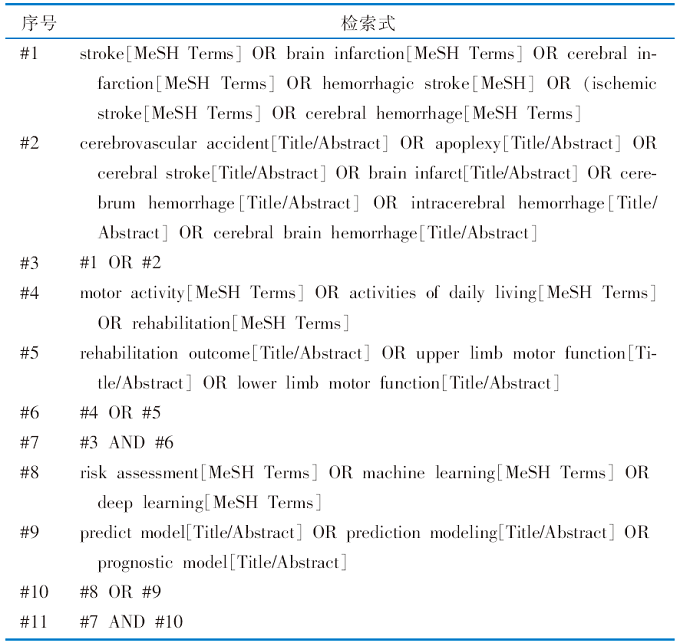 |
表1 PubMed检索策略
Table 1 PubMed search strategies
| |
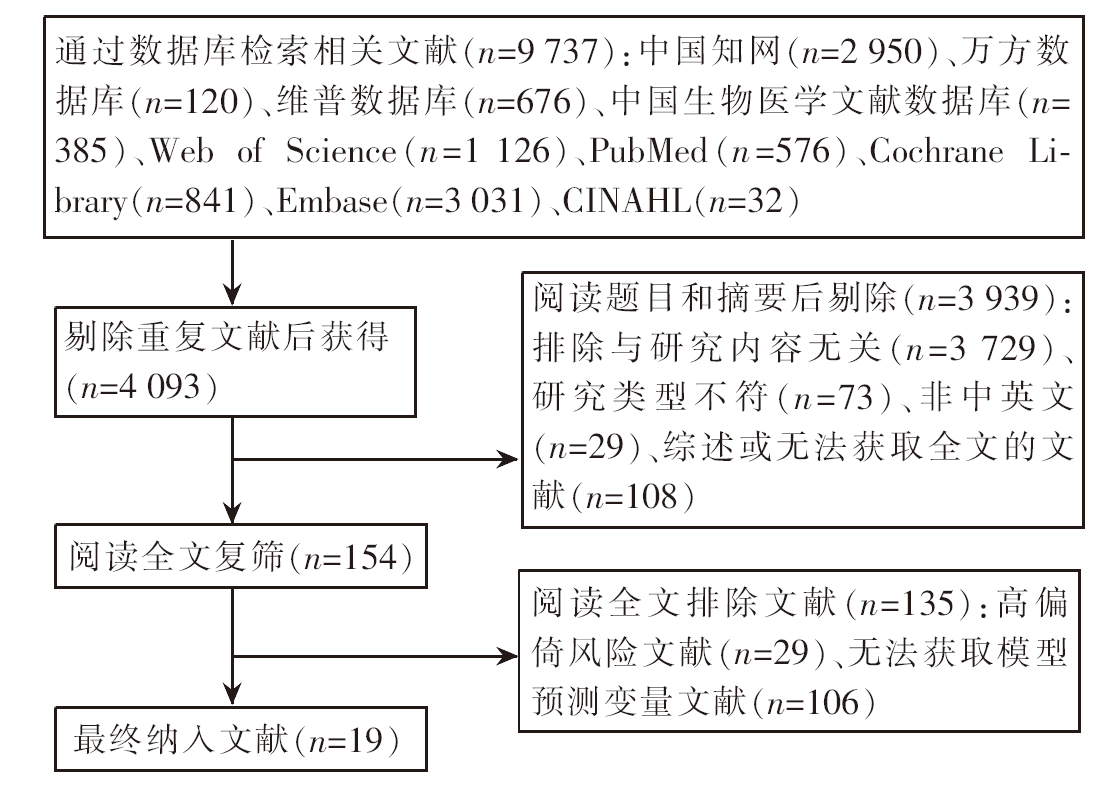
图1 文献筛选流程
Figure 1 Literature screening process
 |
表2 纳入文献的基本特征(n=19)
Table 2 Basic characteristics of the included literature(n=19)
| |
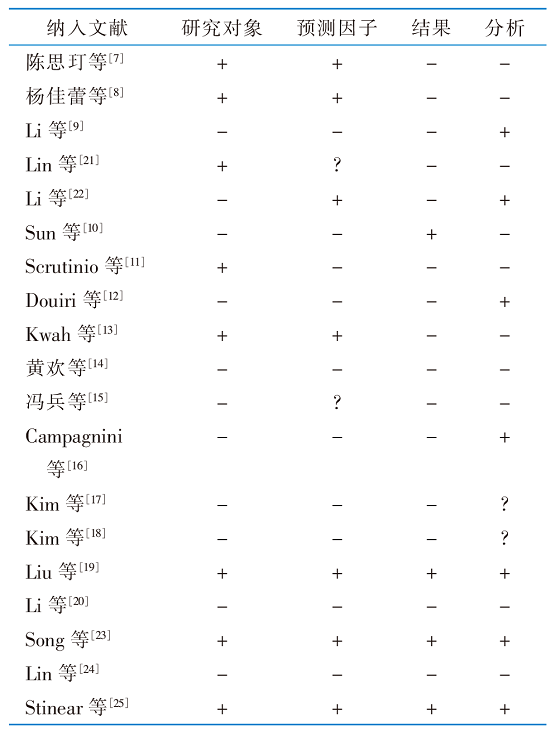 |
表3 纳入研究的偏倚风险评价(n=19)
Table 3 Risk of bias assessment of included studies (n=19)
| |
 |
表4 模型预测因子及性能(n=19)
Table 4 Performance and predictors of models(n=19)
| |
| [1] | 中国心血管健康与疾病报告2021概要[J]. 心脑血管病防治, 2022, 22(4):20-36,40. |
| Summary of the China cardiovascular health and disease report 2021[J]. Cardio-Cerebrovasc Dis Prev Treat, 2022, 22(4):20-36,40. | |
| [2] |
朱金凤, 张远星, 王芳, 等. 脑卒中患者远程康复运动管理有效性及安全性的系统评价再评价[J]. 中华护理杂志, 2022, 57(12):1447-1455.
DOI URL |
| Zhu JF, Zhang YX, Wang F, et al. The effectiveness and safety of telerehabilitation management in stroke patients:an overview of systematic reviews[J]. Chin J Nurs, 2022, 57(12):1447-1455. | |
| [3] |
邢路瑶, 余文静, 胡娟娟, 等. 患者术中获得性压力性损伤风险预测模型的研究进展[J]. 中华护理杂志, 2023, 58(24):3054-3059.
DOI URL |
|
Xing LY, Yu WJ, Hu JJ, et al. Research progress on risk prediction models of intraoperative acquired pressure injury in surgical patients[J]. Chin J Nurs, 2023, 58(24):3054-3059.
DOI URL |
|
| [4] | 国务院. “健康中国2030”规划纲要[EB/OL].(2016-10-25)[2024-06-24]. https://www.gov.cn/zhengce/2016-10/25/content_51-2-4174.htm. |
| The CPC Central Committee and The State Council. The State Council of the CPC Central Committee issued the outline of the “Healthy China 2030” plan[EB/OL].(2016-10-25)[2024-06-24]. https://www.gov.cn/zhengce/2016-10/25/content_5124174.htm. | |
| [5] | Moons KG, de Groot JA, Bouwmeester W, Vergouwe Y, Mallett S, Altman DG, Reitsma JB, Collins GS. Critical appraisal and data extraction for systematic reviews of prediction modelling studies:the CHARMS checklist[J]. PLoS Med, 2014, 11(10):e1001744. |
| [6] | 陈香萍, 张奕, 庄一渝, 等. PROBAST:诊断或预后多因素预测模型研究偏倚风险的评估工具[J]. 中国循证医学杂志, 2020, 20(6):737-744. |
| Chen XP, Zhang Y, Zhuang YY, et al. PRO-BAST:a tool for assessing risk of bias in the study of diagnostic or prognostic multifactorial predictive models[J]. Chin J Evid Based Med, 2020, 20(6):737-744. | |
| [7] | 陈思玎, 俞蔚然, 黄馨莹, 等. 基于机器学习的新发急性缺血性卒中患者1年功能预后预测研究[J]. 中国卒中杂志, 2022, 17(3):265-271. |
| Chen SD, Yu WR, Huang XY, et al. 1-Year functional outcome prediction of newonset acute ischemic stroke patients based on machine learning[J]. Chin J Stroke, 2022, 17(3):265-271. | |
| [8] | 杨佳蕾, 陈思玎, 孟霞, 等. 基于机器学习预测血糖异常急性缺血性卒中患者预后模型研究[J]. 中国卒中杂志, 2022, 17(7):730-736. |
| Yang JL, Chen SD, Meng X, et al. Prediction of clinical out-come of acute ischemic stroke patients with hyperglycemia based on machine learning model[J]. China J Stroke, 2022, 17(7):730-736. | |
| [9] |
Li J, Luo D, Peng F, et al. ANAID-ICH nomogram for predicting unfavorable outcome after intracerebral hemorrhage[J]. CNS Neurosci Ther, 2022, 28(12):2066-2075.
DOI PMID |
| [10] | Sun C, Li X, Song B, et al. A NADE nomogram to predict the probability of 6-month unfavorable outcome in Chinese pa-tients with ischemic stroke[J]. BMC Neurol, 2019, 19(1):274. |
| [11] |
Scrutinio D, Lanzillo B, Guida P, et al. Development and vali-dation of a predictive model for functional outcome after stroke rehabilitation:the Maugeri model[J]. Stroke, 2017, 48(12):3308-3315.
DOI PMID |
| [12] |
Douiri A, Grace J, Sarker SJ, et al. Patient-specific prediction of functional recovery after stroke[J]. Int J Stroke, 2017, 12(5):539-548.
DOI PMID |
| [13] | Kwah LK, Harvey LA, Diong J, et al. Models containing age and NIHSS predict recovery of ambulation and upper limb function six months after stroke:an observational study[J]. J Phy-siother, 2013, 59(3):189-197. |
| [14] | 黄欢, 田丽, 方丽. 脑卒中患者发生运动功能障碍列线图风险预测模型的构建及验证[J]. 中国急救复苏与灾害医学杂志, 2024, 19(1):47-50,55. |
| Huang H, Tian L, Fang L. Establishment and validation of a nomogram risk prediction model for motor dysfunction in stroke patients[J]. Chin J Emerg Resusc Disaster Med, 2024, 19(1):47-50,55. | |
| [15] | 冯兵, 杨培全, 周辉. 老年脑卒中后偏瘫患者康复训练效果影响因素分析及列线图预测模型构建[J]. 河北医学, 2023, 29(9):1532-1538. |
| Feng B, Yang PQ, Zhou H. Analysis of influencing factors of rehabilitation training effect and construction of nomogram prediction model in elderly post-stroke hemiplegia patients[J]. Hebei Med, 2023, 29(9):1532-1538. | |
| [16] |
Campagnini S, Liuzzi P, Mannini A, et al. Cross-validation of predictive models for functional recovery after post-stroke rehabilitation[J]. J Neuroeng Rehabil, 2022, 19(1):96.
DOI PMID |
| [17] | Kim JK, Lv Z, Park D, Chang MC. Practical machine learning model to predict the recovery of motor function in patients with stroke[J]. Eur Neurol, 2022, 85(4):273-279. |
| [18] | Kim JK, Choo YJ, Chang MC. Prediction of motor function in stroke patients using machine learning algorithm:develop-ment of practical models[J]. J Stroke Cerebrovasc Dis, 2021, 30(8):105856. |
| [19] | Liu M, Wang Z, Meng X, et al. Predictive nomogram for unfa-vorable outcome of spontaneous intracerebral hemorrhage[J]. World Neurosurg, 2022, 164:e1111-e1122. |
| [20] | Li X, Pan X, Jiang C, et al. Predicting 6-month unfavorable outcome of acute ischemic stroke using machine learning[J]. Front Neurol, 2020, 11:539509. |
| [21] | Lin CH, Hsu KC, Johnson KR, et al. Evaluation of machine learning methods to stroke outcome prediction using a na-tionwide disease registry[J]. Comput Methods Programs Biomed, 2020, 190:105381. |
| [22] | Li X, Wang F, Zhao Z, et al. Corrigendum:a SCANO nomo-gram for individualized prediction of the probability of 1-year unfavorable outcomes in Chinese acute ischemic stroke pa-tients[J]. Front Neurol, 2020, 11:837. |
| [23] |
Song B, Liu Y, Nyame L, et al. A COACHS Nomogram to predict the probability of three-month unfavorable outcome after acute ischemic stroke in Chinese patients[J]. Cerebrovasc Dis, 2019, 47(1-2):80-87.
DOI PMID |
| [24] | Lin WY, Chen CH, Tseng YJ, et al. Predicting post-stroke acti-vities of daily living through a machine learning-based ap-proach on initiating rehabilitation[J]. Int J Med Inform, 2018, 111:159-164. |
| [25] | Stinear CM, Byblow WD, Ackerley SJ, et al. PREP2:a biomar-ker-based algorithm for predicting upper limb function after stroke[J]. Ann Clin Transl Neurol, 2017, 4(11):811-820. |
| [26] |
李静, 侯云霞, 强万敏. 癌症患者非计划性再入院风险预测模型的范围综述[J]. 中华护理杂志, 2022, 57(9):1079-1087.
DOI URL |
|
Li J, Hou YX, Qiang WM. A scoping review of models for predicting the risk of unplanned readmission in cancer patients[J]. Chin J Nurs, 2022, 57(9):1079-1087.
DOI URL |
|
| [27] |
岳岚, 任英, 岳德方, 等. 中心静脉导管相关血流感染风险预测模型的系统评价[J]. 中华护理杂志, 2024, 59(20):2472-2479.
DOI URL |
|
Yue L, Ren Y, Yue DF, et al. Systematic evaluation of a risk prediction model for catheter-related bloodstream infections in patients with central venous catheterization[J]. Chin J Nurs, 2024, 59(20):2472-2479.
DOI URL |
|
| [28] | 朱浩宇, 候琳琳, 蒋秋焕, 等. 缺血性脑卒中后患者认知障碍风险预测模型的系统评价[J]. 军事护理, 2024, 41(8):8-12. |
| Zhu HY, Hou LL, Jiang QH, et al. Risk prediction model of cogni-tive impairment after ischemic stroke:a systematic review[J]. Mil Nurs, 2024, 41(8):8-12. | |
| [29] |
杜羿霏, 钟月欢, 包旭平, 等. ICU转出患者心理障碍风险预测工具的范围综述[J]. 中华护理杂志, 2022, 57(3):284-289.
DOI URL |
| Du YF, Zhong YH, Bao XP, et al. Instruments for predicting the risk of psychological disorder of ICU discharged pa-tients:a scoping review[J]. Chin J Nurs, 2022, 57(3):284-289. | |
| [30] |
邱雪斌, 繆小红, 夏敏棋, 等. 脑卒中患者疲劳轨迹的潜在类别及影响因素分析[J]. 中华护理杂志, 2024, 59(19):2375-2381.
DOI URL |
|
Qiu XB, Miao XH, Xia MQ, et al. Potential categories and influencing factors of fatigue trajectories in stroke patients[J]. Chin J Nurs, 2024, 59(19):2375-2381.
DOI URL |
|
| [31] | 徐菲, 李鸿艳, 党一凡, 等. 缺血性脑卒中患者残疾水平预测模型的系统评价[J]. 护理学杂志, 2022, 37(21):46-50. |
| Xu F, Li HY, Dang YF, et al. Prognostic models for disability in ischemic stroke:a systematic review[J]. J Nurs Sci, 2022, 37(21):46-50. | |
| [32] | 张杰, 席崇程, 孔云, 等. 脑卒中后认知障碍风险预测模型的系统评价[J]. 护理研究, 2024, 38(10):1726-1733. |
| Zhang J, Xi CC, Kong Yet al. Risk prediction models for poststroke cognitive impairment:a systematic review[J]. Chin Nurs Res, 2024, 38(10):1726-1733. | |
| [33] | 杨嘉伟, 柳琳, 刘瑞, 等. 脑卒中患者30天非计划再入院风险预测模型的系统评价[J]. 中国护理管理, 2024, 24(11):1683-1688. |
| Yang JW, Liu L, Liu R, et al. Risk prediction model for 30-day unplanned readmission of stroke patients:a systematic review[J]. Chin Nurs Manag, 2024, 24(11):1683-1688. | |
| [34] | 毛怡君, 范惠, 张维, 等. 脑卒中患者吞咽障碍风险预测模型的系统评价[J]. 军事护理, 2023, 40(10):96-100,106. |
| Mao YJ, Fan H, Zhang W, et al. Risk prediction models for dysphagia in stroke patients:a systematic review[J]. Mil Nurs, 2023, 40(10):96-100,106. |
| [1] | 中华护理学会静脉输液治疗专业委员会, 北京护理学会, (执笔:李佳, 李旭英, 覃惠英, 陈利芬, 吴珍明, 胡泽吟, 罗梦娜, 范育英, 吴嘉慧, 林宇萍, 王蕾, 孙文彦, 冯毕龙, 高伟, 李亚南, 侯罗娅, 李春燕. 中心静脉通路装置拔除护理专家共识[J]. 中华护理杂志, 2026, 61(9): 1157-1162. |
| [2] | 周霞, 马艳艳, 师正坤, 于海霞, 周艳, 胡红玲, 李莜, 陈思思, 张京慧. 隧道式经股静脉PICC置入术在困难静脉通路婴幼儿中的应用研究[J]. 中华护理杂志, 2026, 61(9): 1163-1170. |
| [3] | 黄萍, 李黎, 郭骊莉, 徐莹, 叶赟, 江淑芳. 与无针输液接头相关的导管相关性血流感染风险评估工具的构建与初步应用[J]. 中华护理杂志, 2026, 61(9): 1171-1179. |
| [4] | 李佳, 张玉玲, 邢乐, 张利峰, 牛秀峰, 许莉. 早产儿经上肢置入PICC尖端继发性异位风险预测模型的建立与验证[J]. 中华护理杂志, 2026, 61(9): 1180-1186. |
| [5] | 何娟, 赵蕾蕾, 叶冠军, 余艳芬, 傅晓君, 周琴. 1例双侧无名静脉及上腔静脉人工血管置换术后患者经上肢置入PICC的护理[J]. 中华护理杂志, 2026, 61(9): 1187-1191. |
| [6] | 梁江淑渊, 曾妃, 何鹏, 谢梦珊, 江悦, 蒋宗恒, 王建茗. 静脉-静脉体外膜肺氧合患者早期活动风险等级评估系统的构建及应用研究[J]. 中华护理杂志, 2026, 61(9): 1192-1199. |
| [7] | 陈晨, 顾肖, 郭凡, 王敏, 倪兴梅, 黄琴, 程念开. 3种衰弱评估工具对急诊老年创伤患者不良结局的预测价值[J]. 中华护理杂志, 2026, 61(9): 1200-1207. |
| [8] | 郑煜琳, 刘晋宁, 张静, 郭会敏, 谷艳梅, 张莉莉. 酒精性肝病患者肝移植术后再饮酒现状及其影响因素分析[J]. 中华护理杂志, 2026, 61(9): 1208-1214. |
| [9] | 叶俊霜, 沈丽佳, 孟霞靓, 张玉姣, 蔡根莲, 邵碧云, 周亚辉, 张柳倩, 应金萍. 维持性血液透析患者对口腔衰弱认知和体验的质性研究[J]. 中华护理杂志, 2026, 61(9): 1215-1220. |
| [10] | 王芸姣, 杨玉金, 郑春艳, 彭菲津, 王淑贞, 蒋喜露, 周为民, 王薇, 张娜. 糖尿病下肢动脉硬化闭塞症患者介入术后康复护理方案的构建及应用研究[J]. 中华护理杂志, 2026, 61(9): 1221-1229. |
| [11] | 杨明霞, 安冉, 臧金凤, 李春梅. 老年慢性病共病患者及照护者老老照护能力与自我忽视的相关性分析[J]. 中华护理杂志, 2026, 61(9): 1230-1236. |
| [12] | 梁和静, 许鹊, 史云霞, 祖金美, 黄文静, 杨春旭, 郭明华, 王磊. 颈动脉内膜剥脱术围手术期护理质量评价指标的构建[J]. 中华护理杂志, 2026, 61(9): 1237-1244. |
| [13] | 韩媛媛, 石玉竹, 尚文涵, 么莉. 870所三级甲等医院老年住院患者跌倒伤害发生现状与影响因素分析[J]. 中华护理杂志, 2026, 61(9): 1245-1252. |
| [14] | 夏云芳, 王洪, 崔岱, 付真真, 朱敏. 1例弥漫性毒性甲状腺肿合并超敏反应综合征青少年患者的护理[J]. 中华护理杂志, 2026, 61(9): 1253-1256. |
| [15] | 周益飞, 王海苹, 胡益环, 应莉, 罗松娜. 1例氢氟酸中毒并发呼吸心搏骤停患者的急救护理[J]. 中华护理杂志, 2026, 61(9): 1257-1260. |
| 阅读次数 | ||||||
|
全文 |
|
|||||
|
摘要 |
|
|||||
