

中华护理杂志 ›› 2025, Vol. 60 ›› Issue (23): 2887-2894.DOI: 10.3761/j.issn.0254-1769.2025.23.010
杨范家一( ), 卫佳宁, 李晨霜, 孙长青, 刘延锦, 董小方()
收稿日期:2025-04-18
出版日期:2025-12-10
发布日期:2025-12-15
*通讯作者:
董小方,E-mail:dongxiaofang1210@126.com作者简介:杨范家一:女,本科(硕士在读),E-mail:yangfanjiayi@163.com
基金资助:
YANG Fanjiayi(), WEI Jianing, LI Chenshuang, SUN Changqing, LIU Yanjin, DONG Xiaofang()
Received:2025-04-18
Online:2025-12-10
Published:2025-12-15
摘要:
目的 探讨脑卒中患者客观睡眠质量轨迹及其与神经功能恢复之间的关系,为临床医护人员针对性开展睡眠干预提供依据。方法 采用多中心整群抽样方法,选取2023年11月—2024年7月河南省5所三级甲等医院神经内科362例脑卒中患者为调查对象,通过病历和问卷收集基线资料,三轴加速度计调查不同时间点睡眠质量,使用改良Rankin量表评估后遗症期神经功能恢复情况。采用并行潜类别增长模型识别睡眠质量轨迹,通过二元Logistic回归分析探讨不同轨迹对神经功能的影响。结果 共306例患者完成随访。睡眠质量轨迹分为睡眠质量持续良好组(34.31%)、短睡眠延长-效率升高-片段化改善组(49.02%)、长睡眠持续-效率降低-片段化加重组(7.84%)和睡眠质量持续不良组(8.83%)。多因素分析结果显示,工作状态、脑卒中类型、合并症、自理能力、社会支持、疲劳和抑郁是脑卒中患者睡眠质量轨迹的影响因素(P<0.05)。与睡眠质量持续良好组相比,长睡眠持续-效率降低-片段化加重组(OR=5.077)和睡眠质量持续不良组(OR=6.462)患者神经功能恢复不良的风险增加。结论 脑卒中患者睡眠质量轨迹存在异质性,不同轨迹对神经功能影响不同,医护人员应实施个性化睡眠管理以改善患者的神经功能。
杨范家一, 卫佳宁, 李晨霜, 孙长青, 刘延锦, 董小方. 脑卒中患者睡眠质量轨迹与神经功能恢复的关系研究及护理启示[J]. 中华护理杂志, 2025, 60(23): 2887-2894.
YANG Fanjiayi, WEI Jianing, LI Chenshuang, SUN Changqing, LIU Yanjin, DONG Xiaofang. Study on the relationship between sleep quality trajectories and neurological function recovery in stroke patients and its nursing implications[J]. Chinese Journal of Nursing, 2025, 60(23): 2887-2894.
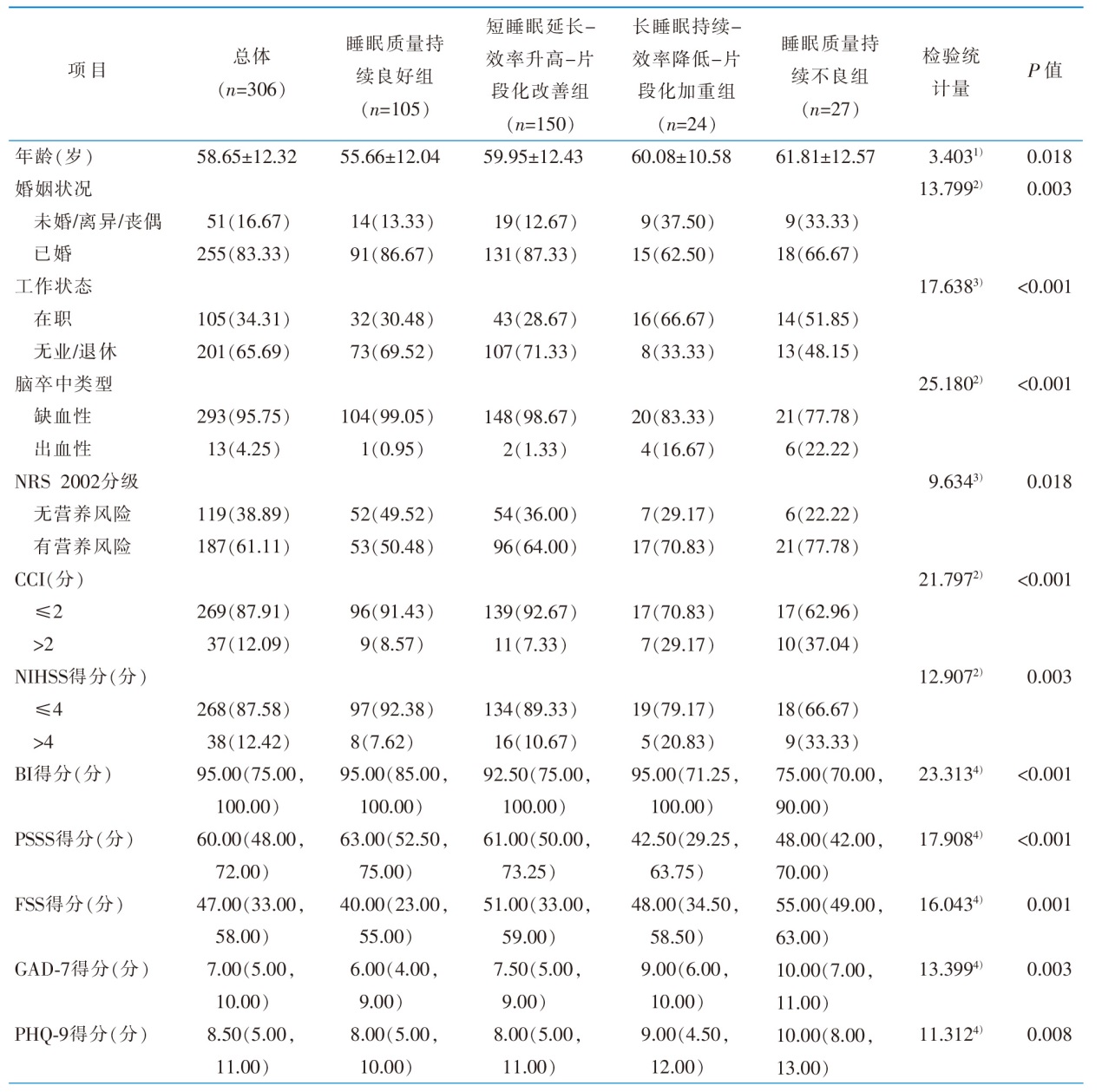 |
表1 脑卒中患者的一般资料及客观睡眠质量轨迹的单因素分析结果(n=306)
Table 1 Univariate analysis of general data and objective sleep quality trajectories in stroke patients(n=306)
| |
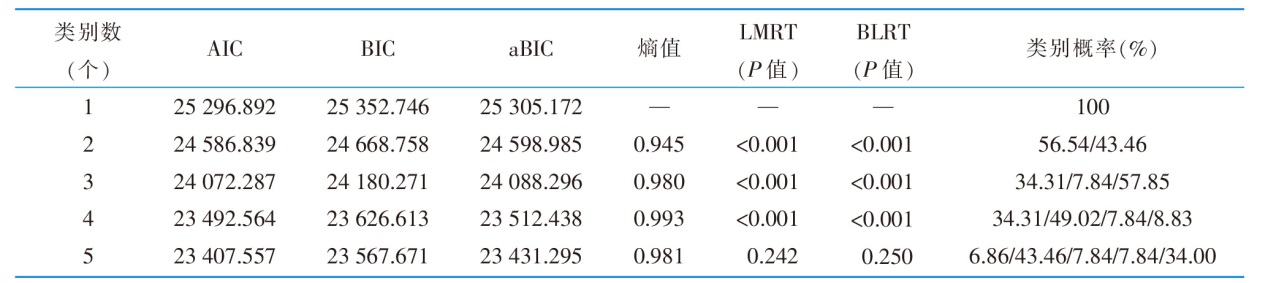 |
表2 脑卒中患者客观睡眠质量轨迹并行潜类别增长模型拟合指标(n=306)
Table 2 Objective sleep quality trajectory of stroke patients parallel latent class growth model fitting index(n=306)
| |
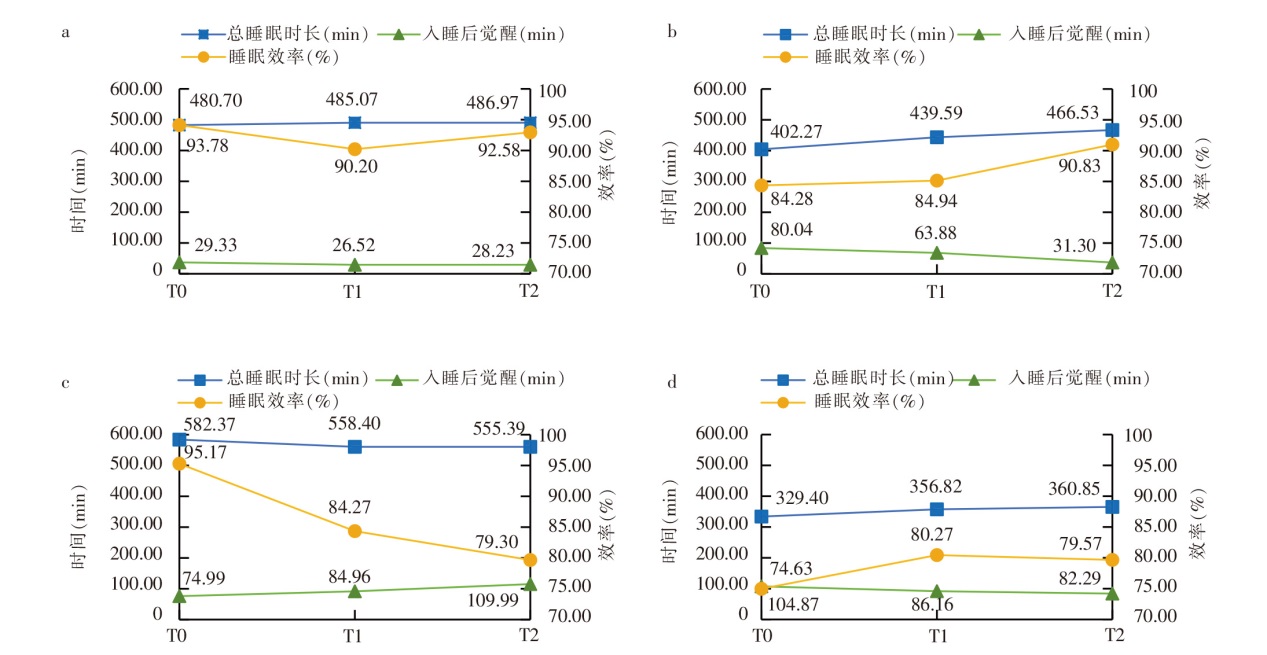
图1 脑卒中患者客观睡眠质量潜在类别发展轨迹 注:a为类别1:睡眠质量持续良好组。b为类别2:短睡眠延长-效率升高-片段化改善组。c为类别3:长睡眠持续-效率降低-片段化加重组。d为类别4:睡眠质量持续不良组。T0为发病1个月内,T1为发病后3个月,T2为发病后6个月。
Figure 1 The latent class development trajectory map of objective sleep quality in stroke patients
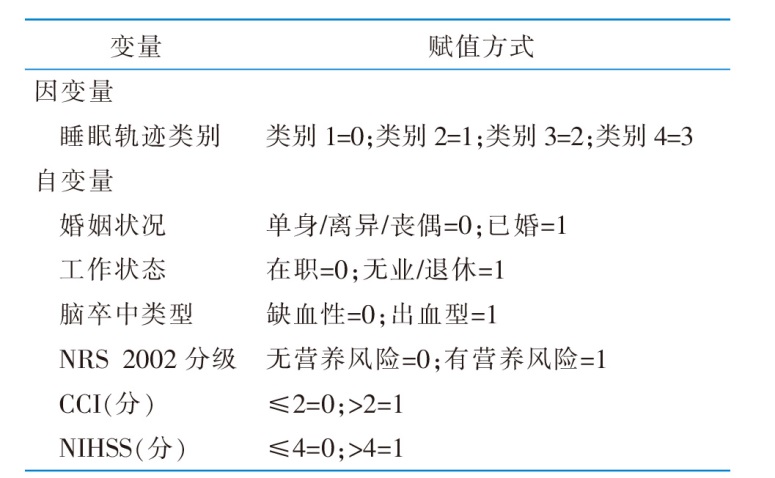 |
表3 分类变量赋值方式
Table 3 Assignment methods of categorical variables
| |
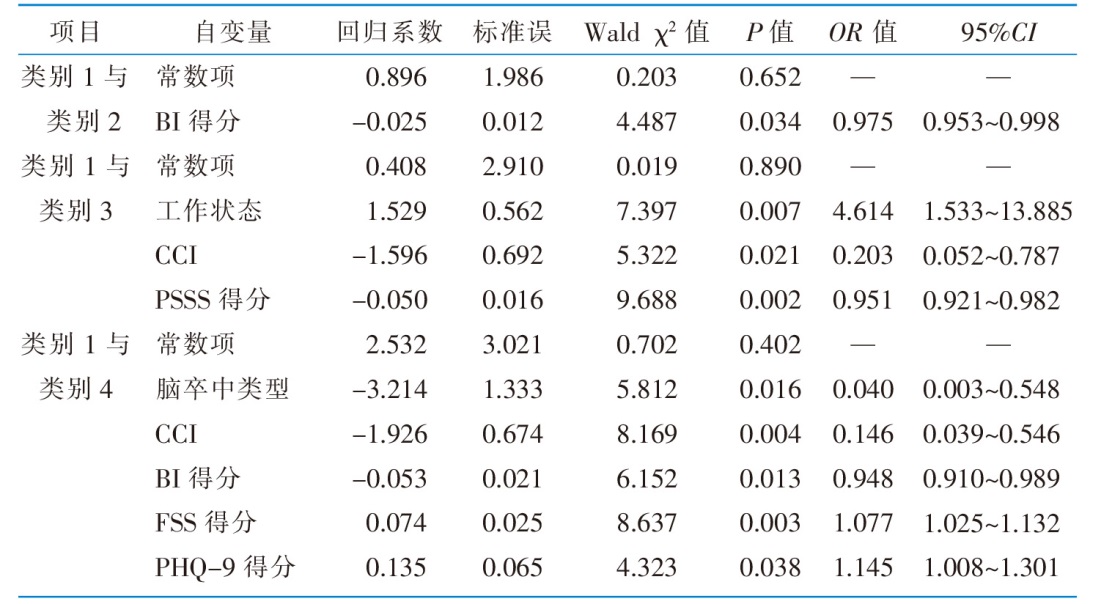 |
表4 脑卒中患者客观睡眠质量轨迹多因素分析结果(n=306)
Table 4 Multivariate analysis results of objective sleep quality trajectory in stroke patients(n=306)
| |
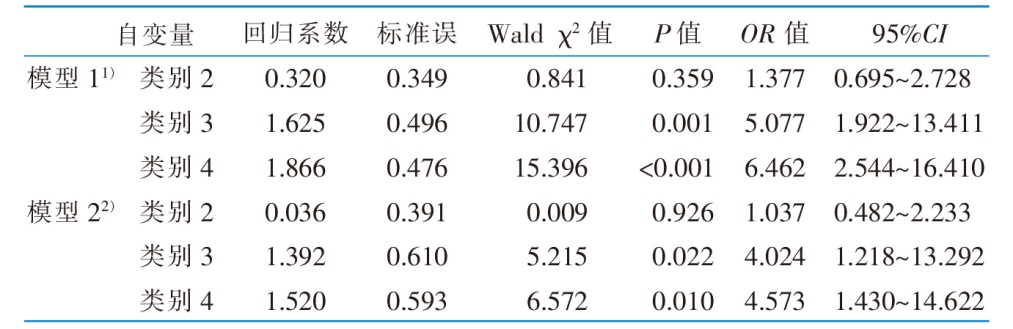 |
表5 脑卒中患者客观睡眠质量轨迹类别与神经功能恢复的二元Logistic回归分析(n=306)
Table 5 Binary logistic regression analysis of objective sleep quality trajectory and neurological recovery(n=306)
| |
| [1] | 中国脑卒中防治报告编写组. 《中国脑卒中防治报告2021》概要[J]. 中国脑血管病杂志, 2023, 20(11):783-793. |
| Report on Stroke Prevention and Treatment in China Writing Group. Brief report on stroke prevention and treatment in China,2021[J]. Chin J Cerebrovasc Dis, 2023, 20(11):783-793. | |
| [2] | Jeffers MS, Pittman AC, Kendzerska T, et al. Self-reported sleep disturbances among people who have had a stroke:a cross-sectional analysis[J]. CMAJ, 2023, 195(10):E354-E362. |
| [3] | Gottesman RF, Lutsey PL, Benveniste H, et al. Impact of sleep disorders and disturbed sleep on brain health:a scientific statement from the American heart association[J]. Stroke, 2024, 55(3):e61-e76. |
| [4] |
Schutte-Rodin S, Broch L, Buysse D, et al. Clinical guideline for the evaluation and management of chronic insomnia in adults[J]. J Clin Sleep Med, 2008, 4(5):487-504.
PMID |
| [5] |
Consensus Conference Panel, Watson NF, Badr MS, et al. Joint consensus statement of the American academy of sleep medicine and sleep research society on the recommended amount of sleep for a healthy adult:methodology and discussion[J]. J Clin Sleep Med, 2015, 11(8):931-952.
DOI URL |
| [6] | 中华医学会神经病学分会, 中华医学会神经病学分会脑血管病学组. 中国各类主要脑血管病诊断要点2019[J]. 中华神经科杂志, 2019, 52(9):710-715. |
| Chinese Society of Neurology,Chinese Medical Association; Cere-brovascular Diseases Study Group,Chinese Society of Neurology,Chinese Medical Association. Diagnostic criteria of major cerebrovascular diseases in China 2019[J]. Chin J Neurol, 2019, 52(9):710-715. | |
| [7] | 倪平, 陈京立, 刘娜. 护理研究中量性研究的样本量估计[J]. 中华护理杂志, 2010, 45(4):378-380. |
| Ni P, Chen JL, Liu N. The sample size estimation in quantitative nursing research[J]. Chin J Nurs, 2010, 45(4):378-380. | |
| [8] |
Kondrup J, Rasmussen HH, Hamberg O, et al. Nutritional risk screening(NRS 2002):a new method based on an analysis of controlled clinical trials[J]. Clin Nutr, 2003, 22(3):321-336.
DOI PMID |
| [9] |
Charlson ME, Pompei P, Ales KL, et al. A new method of classifying prognostic comorbidity in longitudinal studies:development and validation[J]. J Chronic Dis, 1987, 40(5):373-383.
DOI PMID |
| [10] |
Kwah LK, Diong J. National Institutes of Health Stroke Scale(NIHSS)[J]. J Physiother, 2014, 60(1):61.
DOI URL |
| [11] |
Quinn TJ, Langhorne P, Stott DJ. Barthel index for stroke trials:development,properties,and application[J]. Stroke, 2011, 42(4):1146-1151.
DOI URL |
| [12] |
Cole RJ, Kripke DF, Gruen W, et al. Automatic sleep/wake identification from wrist activity[J]. Sleep, 1992, 15(5):461-469.
DOI PMID |
| [13] |
Podsiadlo D, Richardson S. The timed “up & go”:a test of basic functional mobility for frail elderly persons[J]. J Am Geriatr Soc, 1991, 39(2):142-148.
DOI PMID |
| [14] | 姜乾金. 领悟社会支持量表[J]. 中国行为医学科学, 2001, 10(10):41-43 |
| Jiang QJ. Perceived Social Support Scale[J]. Chin J Behav Med Sci, 2001, 10(10):41-43. | |
| [15] |
Dong XF, Liu YJ, Wang AX, et al. The psychometric properties of Chinese version of SCI Exercise Self-Efficacy Scale in patients with stroke[J]. Patient Prefer Adherence, 2016, 10:1235-1241.
DOI URL |
| [16] | 吴春薇, 王得新. 疲劳严重度量表中译本应用于脑梗死患者的临床与评价[J]. 中华物理医学与康复杂志, 2007, 29(9):608-611. |
| Wu CW, Wang DX. Clinical application and assessment of the Chinese version of Fatigue Severity Scale in stroke patients[J]. Chin J Phys Med Rehabil, 2007, 29(9):608-611. | |
| [17] | 何筱衍, 李春波, 钱洁, 等. 广泛性焦虑量表在综合性医院的信度和效度研究[J]. 上海精神医学, 2010, 22(4):200-203. |
| He XY, Li CB, Qian J, et al. Reliability and validity of a Generalized Anxiety Disorder Scale in general hospital outpatients[J]. Shanghai Arch Psychiatry, 2010, 22(4):200-203. | |
| [18] | 徐勇, 吴海苏, 徐一峰. 病人健康问卷抑郁量表(PHQ-9)在社区老年人群中的应用:信度与效度分析[J]. 上海精神医学, 2007, 19(5):257-259,276. |
| Xu Y, Wu HS, Xu YF. The reliability and validity of Patient Health Questionnaire Depression Module(PHQ-9) in Chinese elderly[J]. Shanghai Arch Psychiatry, 2007, 19(5):257-259, 276. | |
| [19] |
Banks JL, Marotta CA. Outcomes validity and reliability of the modified Rankin Scale:implications for stroke clinical trials:a literature review and synthesis[J]. Stroke, 2007, 38(3):1091-1096.
DOI URL |
| [20] | Zhou YY, Zheng H, Liang YM, et al. Joint developmental trajectories of bullying and victimization from childhood to adolescence:a parallel-process latent class growth analysis[J]. J Interpers Violence, 2022, 37(3/4):NP1759-NP1783. |
| [21] |
Ozkan H, Ambler G, Esmail T, et al. Prevalence,trajectory,and factors associated with patient-reported nonmotor outcomes after stroke:a systematic review and meta-analysis[J]. JAMA Netw Open, 2025, 8(2):e2457447.
DOI URL |
| [22] | 管士侠, 潘飞, 任韦宁, 等. 中青年缺血性脑卒中病人健康行为与睡眠质量的相关性研究[J]. 蚌埠医学院学报, 2021, 46(9):1316-1318. |
| Guan SX, Pan F, Ren WN, et al. Correlation between health behavior and sleep quality in young and middle-aged patients with ischemic stroke[J]. J Bengbu Med Coll, 2021, 46(9):1316-1318. | |
| [23] |
周柯冰, 黄晓娇, 闫凤侠. 首发脑卒中恢复期患者症状负担及其影响因素的网络分析[J]. 中华护理杂志, 2025, 60(7):792-798.
DOI |
|
Zhou KB, Huang XJ, Yan FX. Network analysis of symptom burden and its influencing factors in first-ever subacute stroke patients[J]. Chin J Nurs, 2025, 60(7):792-798.
DOI |
|
| [24] |
Guo LN, Zhang M, Namassevayam G, et al. Identification of sleep quality clusters among stroke patients:a multi-center latent profile analysis study[J]. Sleep Med, 2023, 112:203-208.
DOI URL |
| [25] |
邱雪斌, 繆小红, 夏敏棋, 等. 脑卒中患者疲劳轨迹的潜在类别及影响因素分析[J]. 中华护理杂志, 2024, 59(19):2375-2381.
DOI |
|
Qiu XB, Miao XH, Xia MQ, et al. Potential categories and influencing factors of fatigue trajectories in stroke patients[J]. Chin J Nurs, 2024, 59(19):2375-2381.
DOI |
|
| [26] |
Cabrera Y, Koymans KJ, Poe GR, et al. Overnight neuronal plasticity and adaptation to emotional distress[J]. Nat Rev Neurosci, 2024, 25(4):253-271.
DOI PMID |
| [27] |
Baranwal N, Yu PK, Siegel NS. Sleep physiology,pathophysiology,and sleep hygiene[J]. Prog Cardiovasc Dis, 2023, 77:59-69.
DOI PMID |
| [1] | 中华护理学会静脉输液治疗专业委员会, 北京护理学会, (执笔:李佳, 李旭英, 覃惠英, 陈利芬, 吴珍明, 胡泽吟, 罗梦娜, 范育英, 吴嘉慧, 林宇萍, 王蕾, 孙文彦, 冯毕龙, 高伟, 李亚南, 侯罗娅, 李春燕. 中心静脉通路装置拔除护理专家共识[J]. 中华护理杂志, 2026, 61(9): 1157-1162. |
| [2] | 周霞, 马艳艳, 师正坤, 于海霞, 周艳, 胡红玲, 李莜, 陈思思, 张京慧. 隧道式经股静脉PICC置入术在困难静脉通路婴幼儿中的应用研究[J]. 中华护理杂志, 2026, 61(9): 1163-1170. |
| [3] | 黄萍, 李黎, 郭骊莉, 徐莹, 叶赟, 江淑芳. 与无针输液接头相关的导管相关性血流感染风险评估工具的构建与初步应用[J]. 中华护理杂志, 2026, 61(9): 1171-1179. |
| [4] | 李佳, 张玉玲, 邢乐, 张利峰, 牛秀峰, 许莉. 早产儿经上肢置入PICC尖端继发性异位风险预测模型的建立与验证[J]. 中华护理杂志, 2026, 61(9): 1180-1186. |
| [5] | 何娟, 赵蕾蕾, 叶冠军, 余艳芬, 傅晓君, 周琴. 1例双侧无名静脉及上腔静脉人工血管置换术后患者经上肢置入PICC的护理[J]. 中华护理杂志, 2026, 61(9): 1187-1191. |
| [6] | 梁江淑渊, 曾妃, 何鹏, 谢梦珊, 江悦, 蒋宗恒, 王建茗. 静脉-静脉体外膜肺氧合患者早期活动风险等级评估系统的构建及应用研究[J]. 中华护理杂志, 2026, 61(9): 1192-1199. |
| [7] | 陈晨, 顾肖, 郭凡, 王敏, 倪兴梅, 黄琴, 程念开. 3种衰弱评估工具对急诊老年创伤患者不良结局的预测价值[J]. 中华护理杂志, 2026, 61(9): 1200-1207. |
| [8] | 郑煜琳, 刘晋宁, 张静, 郭会敏, 谷艳梅, 张莉莉. 酒精性肝病患者肝移植术后再饮酒现状及其影响因素分析[J]. 中华护理杂志, 2026, 61(9): 1208-1214. |
| [9] | 叶俊霜, 沈丽佳, 孟霞靓, 张玉姣, 蔡根莲, 邵碧云, 周亚辉, 张柳倩, 应金萍. 维持性血液透析患者对口腔衰弱认知和体验的质性研究[J]. 中华护理杂志, 2026, 61(9): 1215-1220. |
| [10] | 王芸姣, 杨玉金, 郑春艳, 彭菲津, 王淑贞, 蒋喜露, 周为民, 王薇, 张娜. 糖尿病下肢动脉硬化闭塞症患者介入术后康复护理方案的构建及应用研究[J]. 中华护理杂志, 2026, 61(9): 1221-1229. |
| [11] | 杨明霞, 安冉, 臧金凤, 李春梅. 老年慢性病共病患者及照护者老老照护能力与自我忽视的相关性分析[J]. 中华护理杂志, 2026, 61(9): 1230-1236. |
| [12] | 梁和静, 许鹊, 史云霞, 祖金美, 黄文静, 杨春旭, 郭明华, 王磊. 颈动脉内膜剥脱术围手术期护理质量评价指标的构建[J]. 中华护理杂志, 2026, 61(9): 1237-1244. |
| [13] | 韩媛媛, 石玉竹, 尚文涵, 么莉. 870所三级甲等医院老年住院患者跌倒伤害发生现状与影响因素分析[J]. 中华护理杂志, 2026, 61(9): 1245-1252. |
| [14] | 夏云芳, 王洪, 崔岱, 付真真, 朱敏. 1例弥漫性毒性甲状腺肿合并超敏反应综合征青少年患者的护理[J]. 中华护理杂志, 2026, 61(9): 1253-1256. |
| [15] | 周益飞, 王海苹, 胡益环, 应莉, 罗松娜. 1例氢氟酸中毒并发呼吸心搏骤停患者的急救护理[J]. 中华护理杂志, 2026, 61(9): 1257-1260. |
| 阅读次数 | ||||||
|
全文 |
|
|||||
|
摘要 |
|
|||||
