

中华护理杂志 ›› 2025, Vol. 60 ›› Issue (23): 2872-2879.DOI: 10.3761/j.issn.0254-1769.2025.23.008
陆沁怡( ), 陆程倩, 聂奕轩, 金学勤()
收稿日期:2025-07-12
出版日期:2025-12-10
发布日期:2025-12-15
*通讯作者:
金学勤,E-mail:653993023@qq.com作者简介:陆沁怡:女,本科(硕士在读),护士,E-mail:2283566726@qq.com
基金资助:
LU Qinyi(), LU Chengqian, NIE Yixuan, JIN Xueqin()
Received:2025-07-12
Online:2025-12-10
Published:2025-12-15
摘要:
目的 探讨老年维持性血液透析患者习得性无助感的潜在剖面及影响因素,为临床护理实践提供参考。方法 便利选取2024年10月—2025年2月昆山市3所综合医院血液透析中心的440例老年维持性血液透析患者作为调查对象。采用一般资料调查表、习得性无助量表、国际体力活动问卷简表及透析后疲乏量表进行调查,通过潜在剖面分析和Logistic回归分析老年维持性血液透析患者习得性无助感潜在剖面的影响因素。结果 回收有效问卷432份,有效问卷回收率为98.18%。432例老年维持性血液透析患者习得性无助得分为(37.34±12.76)分,可分为3个潜在剖面,分别是低无助-低绝望组(59.72%)、高无助-低绝望组(25.92%)、高无助-高绝望组(14.35%)。Logistic回归分析显示,年龄、原发疾病、久坐行为、透析后疲乏是老年维持性血液透析患者习得性无助感潜在剖面的影响因素(P<0.05)。结论 老年维持性血液透析患者习得性无助感存在异质性,医护人员可根据不同的潜在剖面影响因素进行个体化干预,以降低其无助感。
陆沁怡, 陆程倩, 聂奕轩, 金学勤. 老年维持性血液透析患者习得性无助感潜在剖面及影响因素分析[J]. 中华护理杂志, 2025, 60(23): 2872-2879.
LU Qinyi, LU Chengqian, NIE Yixuan, JIN Xueqin. Latent profiles of learned helplessness and its influencing factors in elderly patients on maintenance hemodialysis[J]. Chinese Journal of Nursing, 2025, 60(23): 2872-2879.
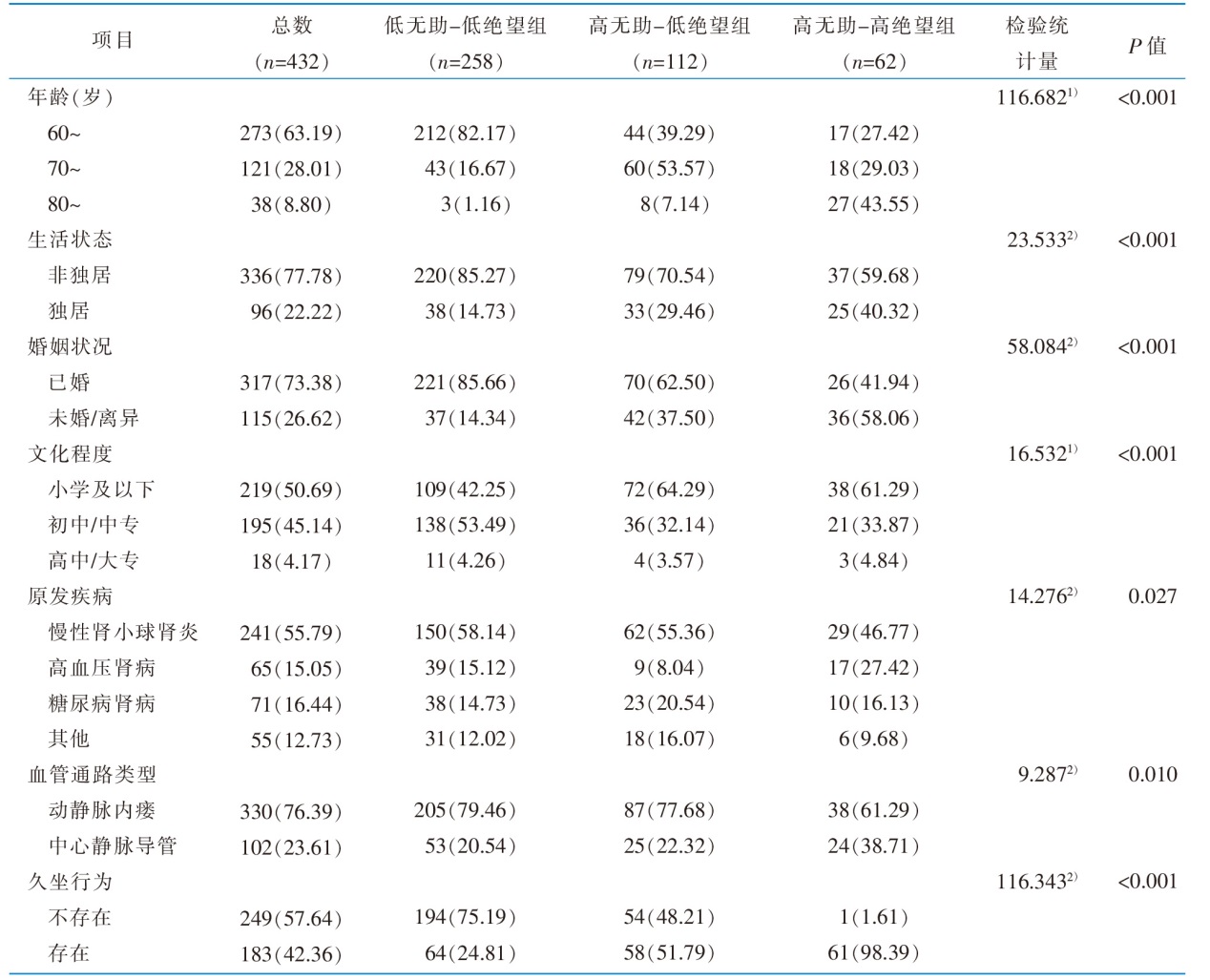 |
表1 老年维持性血液透析患者的一般资料及习得性无助感潜在剖面的单因素分析[例(百分比,%)]
Table 1 Univariate analysis of general information and latent profiles of learned helplessness among elderly patients on maintenance hemodialysis[cases(percentage,%)]
| |
 |
表2 老年维持性血液透析患者习得性无助感潜在剖面分析模型拟合结果(n=432)
Table 2 Model fit results of latent profile analysis for learned helplessness in elderly patients on maintenance hemodialysis(n=432)
| |

图1 老年维持性血液透析患者习得性无助感3个潜在剖面的特征分布
Figure 1 Characteristics and distribution of 3 potential profiles of learned helplessness among elderly patients on maintenance hemodialysis
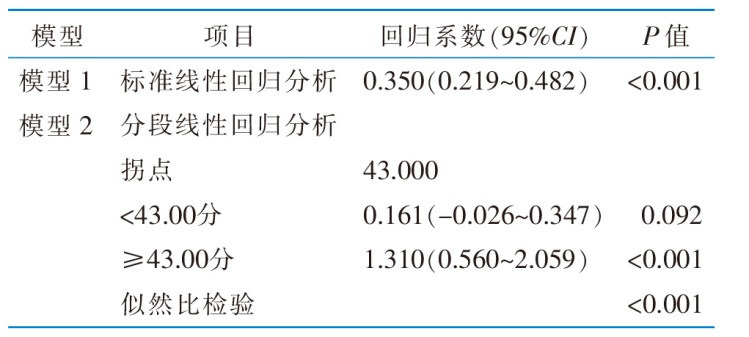 |
表3 透析后疲乏与习得性无助的阈值效应分析结果(n=432)
Table 3 Threshold effect analysis results of post-dialysis fatigue and learned helplessness(n=432)
| |
 |
表4 自变量赋值方式
Table 4 Assignment of independent variables
| |
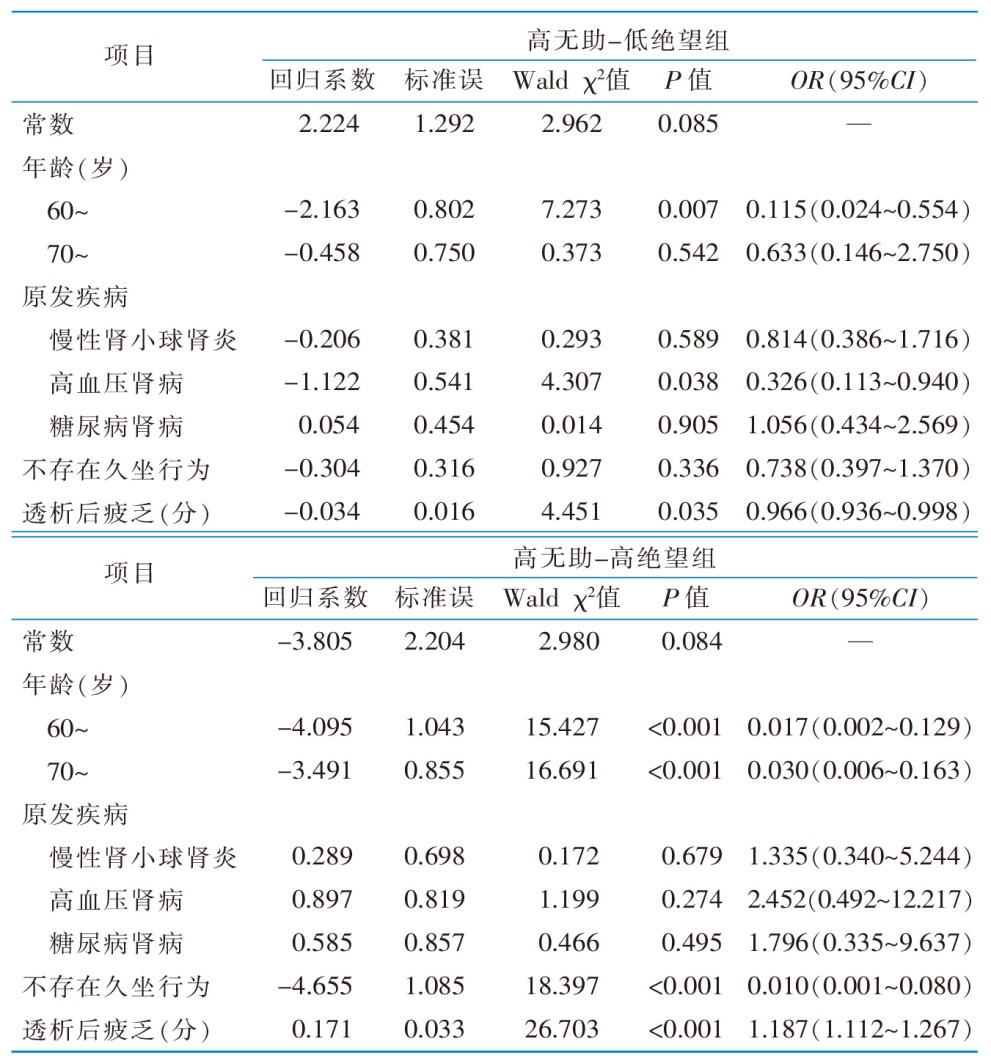 |
表5 老年维持性血液透析患者习得性无助感潜在剖面的多因素Logistic回归分析(n=432)
Table 5 Multivariate logistic regression analysis of latent profiles of learned helplessness in elderly patients undergoing maintenance hemodialysis(n=432)
| |
| [1] |
曾豪洁, 赵莉, 张陈, 等. 维持性血液透析患者自我调节疲劳的影响因素及路径分析[J]. 中华护理杂志, 2024, 59(2):156-164.
DOI |
|
Zeng HJ, Zhao L, Zhang C, et al. Analysis of influencing factors and pathway of self-regulatory fatigue in maintenance hemodialysis patients[J]. Chin J Nurs, 2024, 59(2):156-164.
DOI |
|
| [2] | Xie CY, Li L, Li YM. Learned helplessness in renal dialysis patients:concept analysis with an evolutionary approach[J]. Pa-tient Prefer Adherence, 2022, 16:2301-2312. |
| [3] |
Xie CY, Li L, Li YM. “Alive day is the day”:a qualitative study of experiences of learned helplessness in maintenance haemodialysis patients[J]. Risk Manag Healthc Policy, 2023, 16:231-245.
DOI URL |
| [4] |
尹奎, 彭坚, 张君. 潜在剖面分析在组织行为领域中的应用[J]. 心理科学进展, 2020, 28(7):1056-1070.
DOI |
|
Yin K, Peng J, Zhang J. The application of latent profile analysis in organizational behavior research[J]. Adv Psychol Sci, 2020, 28(7):1056-1070.
DOI |
|
| [5] | 中华预防医学会肾脏病预防与控制专业委员会, 张路霞, 赵明辉. 中国慢性肾脏病早期评价与管理指南[J]. 中华内科杂志, 2023, 62(8):902-930. |
| Chinese Preventive Medicine Association,Kidney Disease Prevention and Control Professional Committee, Zhang LX, Zhao MH. Guidelines for the early evaluation and management of chronic kidney disease in China[J]. Chin J Intern Med, 2023, 62(8):902-930. | |
| [6] | 倪平, 陈京立, 刘娜. 护理研究中量性研究的样本量估计[J]. 中华护理杂志, 2010, 45(4):378-380. |
| Ni P, Chen JL, Liu N. The sample size estimation in quantitative nursing research[J]. Chin J Nurs, 2010, 45(4):378-380. | |
| [7] | 武晓艳, 曾红, 马绍斌, 等. 习得性无助量表研制及其与人格相关研究[J]. 中山大学学报(医学科学版), 2009, 30(3):357-361. |
| Wu XY, Zeng H, Ma SB, et al. Development of learned helplessness scale and its relationship with personality[J]. J Sun Yat Sen Univ Med Sci, 2009, 30(3):357-361. | |
| [8] | 屈宁宁, 李可基. 国际体力活动问卷中文版的信度和效度研究[J]. 中华流行病学杂志, 2004, 25(3):265-268. |
| Qu NN, Li KJ. Study on the reliability and validity of International Physical Activity Questionnaire(Chinese Version,IPAQ)[J]. Chin J Epidemiol, 2004, 25(3):265-268. | |
| [9] | 曹提, 陈辉, 秦金雪, 等. 老年维持性血液透析患者久坐行为现状及影响因素分析[J]. 护理学杂志, 2023, 38(9):35-39. |
| Cao T, Chen H, Qin JX, et al. Sedentary behavior and determinants in elderly patients on maintenance hemodialysis[J]. J Nurs Sci, 2023, 38(9):35-39. | |
| [10] |
Kodama H, Togari T, Konno Y, et al. A new assessment scale for post-dialysis fatigue in hemodialysis patients[J]. Ren Replace Ther, 2020, 6(1):1.
DOI |
| [11] | 张帆, 杨雪, 李杰, 等. 维持性血液透析患者透析后疲乏评估量表汉化及信效度检验[J]. 护士进修杂志, 2024, 39(22):2416-2420. |
| Zhang F, Yang X, Li J, et al. The Chinesization of the Fatigue Assessment Scale for Maintenance Hemodialysis Patients and its test of reliability and validity[J]. J Nurses Train, 2024, 39(22):2416-2420. | |
| [12] | 李春玉, 周丽, 张书溢. 慢性伤口老年患者习得性无助感与成功老龄化的关系研究[J]. 解放军护理杂志, 2021, 38(4):1-4. |
| Li CY, Zhou L, Zhang SY. Relationship between learned helplessness and successful aging in elderly patients with chronic wounds[J]. Nurs J Chin PLA, 2021, 38(4):1-4. | |
| [13] | 梁莉. 老年糖尿病病人习得性无助感现状调查及影响因素分析[J]. 全科护理, 2022, 20(13):1862-1865. |
| Liang L. Investigation and analysis of learned helplessness’s feeling in elderly diabetic patients and its influencing factors[J]. Chin Gen Pract Nurs, 2022, 20(13):1862-1865. | |
| [14] | 阎佳蓉, 霍明姝, 于倩, 等. 慢性阻塞性肺疾病病人习得性无助感现状及影响因素分析[J]. 全科护理, 2024, 22(12):2226-2229. |
| Yan JR, Huo MS, Yu Q, et al. Analysis of learned helplessness’s feeling and its influencing factors in patients with chronic obstructive pulmonary disease[J]. Chin Gen Pract Nurs, 2024, 22(12):2226-2229. | |
| [15] |
刘芮, 吴敏, 赵云凤, 等. 参与生产性活动对老年慢性病患者失志综合征的影响及护理启示[J]. 中华护理杂志, 2025, 60(13):1610-1616.
DOI |
|
Liu R, Wu M, Zhao YF, et al. Impact of productive engagement on demoralization syndrome and its threshold effect in elderly patients with chronic diseases and nursing enlightenment[J]. Chin J Nurs, 2025, 60(13):1610-1616.
DOI |
|
| [16] | 郑志贵, 何东元, 陈宜方, 等. 高龄老年血液透析患者的生存分析[J]. 中华老年医学杂志, 2020, 39(5):559-563. |
| Zheng ZG, He DY, Chen YF, et al. Survival analysis of hemodialysis patients aged 80 years and over[J]. Chin J Geriatr, 2020, 39(5):559-563. | |
| [17] |
Wang L, Wang JY, Zhang YM, et al. Current perspectives and trends of the research on hypertensive nephropathy:a bibliometric analysis from 2000 to 2023[J]. Ren Fail, 2024, 46(1):2310122.
DOI URL |
| [18] | 庞慧, 程焕焕, 李燕, 等. 社区高血压老年人积极度现状及影响因素研究[J]. 护理管理杂志, 2025, 25(5):449-454. |
| Pang H, Cheng HH, Li Y, et al. A study on the status and influencing factors on the patient activation levels of elderly people with hypertension in the community[J]. J Nurs Adm, 2025, 25(5):449-454. | |
| [19] | 邹伟能, 王旸, 朱珍珍, 等. 与健康相关的互联网使用行为对中老年高血压患者自我管理行为的影响[J]. 中华高血压杂志(中英文), 2025, 33(8):766-772. |
| Zou WN, Wang Y, Zhu ZZ, et al. Effectiveness of health-related Internet use on self-management behavior in middle-aged and elderly patients with hypertension[J]. Chin J Hypertens, 2025, 33(8):766-772. | |
| [20] | 曾维玲, 栾中佼, 吴私, 等. 维持性血液透析患者透析后疲劳的影响因素分析[J]. 中国医科大学学报, 2020, 49(10):943-948. |
| Zeng WL, Luan ZJ, Wu S, et al. Influencing factors of post-dialysis fatigue in patients under maintenance hemodialysis[J]. J China Med Univ, 2020, 49(10):943-948. | |
| [21] | 张颖, 刘晓辉. 血液透析后疲乏的概念分析[J]. 护理研究, 2023, 37(19):3423-3427. |
| Zhang Y, Liu XH. Concept analysis of post-dialysis fatigue[J]. Chin Nurs Res, 2023, 37(19):3423-3427. | |
| [22] |
尹艳茹, 周洪昌, 刘梦如, 等. 老年维持性血液透析患者社会隔离现状的调查研究[J]. 中华护理杂志, 2023, 58(7):822-829.
DOI |
|
Yin YR, Zhou HC, Liu MR, et al. Status and influencing factors of social isolation in elderly patients with maintenance hemodialysis[J]. Chin J Nurs, 2023, 58(7):822-829.
DOI |
|
| [23] |
Ju A, Teixeira-Pinto A, Tong A, et al. Validation of a core patient-reported outcome measure for fatigue in patients receiving hemodialysis:the SONG-HD fatigue instrument[J]. Clin J Am Soc Nephrol, 2020, 15(11):1614-1621.
DOI URL |
| [24] | 王慧敏, 孙建萍, 吴红霞. 老年慢性病病人久坐行为的研究进展[J]. 护理研究, 2021, 35(1):110-114. |
| Wang HM, Sun JP, Wu HX. Research progress on sedentary behavior in elderly patients with chronic disease[J]. Chin Nurs Res, 2021, 35(1):110-114. | |
| [25] | 李珂, 常颖. 维持性血液透析病人习得性无助感的研究进展[J]. 护理研究, 2025, 39(11):1935-1940. |
| Li K, Chang Y. Research progress on learned helplessness in maintenance hemodialysis patients[J]. Chin Nurs Res, 2025, 39(11):1935-1940. | |
| [26] | 李东泽, 李芳卉, 刘怡, 等. 《2020年世界卫生组织运动和久坐行为指南》解读[J]. 中国胸心血管外科临床杂志, 2021, 28(4):376-383. |
| Li DZ, Li FH, Liu Y, et al. Interpretation of the World Health Organization 2020 guidelines on physical activity and sedentary behaviour[J]. Chin J Clin Thorac Cardiovasc Surg, 2021, 28(4):376-383. |
| [1] | 中华护理学会静脉输液治疗专业委员会, 北京护理学会, (执笔:李佳, 李旭英, 覃惠英, 陈利芬, 吴珍明, 胡泽吟, 罗梦娜, 范育英, 吴嘉慧, 林宇萍, 王蕾, 孙文彦, 冯毕龙, 高伟, 李亚南, 侯罗娅, 李春燕. 中心静脉通路装置拔除护理专家共识[J]. 中华护理杂志, 2026, 61(9): 1157-1162. |
| [2] | 周霞, 马艳艳, 师正坤, 于海霞, 周艳, 胡红玲, 李莜, 陈思思, 张京慧. 隧道式经股静脉PICC置入术在困难静脉通路婴幼儿中的应用研究[J]. 中华护理杂志, 2026, 61(9): 1163-1170. |
| [3] | 黄萍, 李黎, 郭骊莉, 徐莹, 叶赟, 江淑芳. 与无针输液接头相关的导管相关性血流感染风险评估工具的构建与初步应用[J]. 中华护理杂志, 2026, 61(9): 1171-1179. |
| [4] | 李佳, 张玉玲, 邢乐, 张利峰, 牛秀峰, 许莉. 早产儿经上肢置入PICC尖端继发性异位风险预测模型的建立与验证[J]. 中华护理杂志, 2026, 61(9): 1180-1186. |
| [5] | 何娟, 赵蕾蕾, 叶冠军, 余艳芬, 傅晓君, 周琴. 1例双侧无名静脉及上腔静脉人工血管置换术后患者经上肢置入PICC的护理[J]. 中华护理杂志, 2026, 61(9): 1187-1191. |
| [6] | 梁江淑渊, 曾妃, 何鹏, 谢梦珊, 江悦, 蒋宗恒, 王建茗. 静脉-静脉体外膜肺氧合患者早期活动风险等级评估系统的构建及应用研究[J]. 中华护理杂志, 2026, 61(9): 1192-1199. |
| [7] | 陈晨, 顾肖, 郭凡, 王敏, 倪兴梅, 黄琴, 程念开. 3种衰弱评估工具对急诊老年创伤患者不良结局的预测价值[J]. 中华护理杂志, 2026, 61(9): 1200-1207. |
| [8] | 郑煜琳, 刘晋宁, 张静, 郭会敏, 谷艳梅, 张莉莉. 酒精性肝病患者肝移植术后再饮酒现状及其影响因素分析[J]. 中华护理杂志, 2026, 61(9): 1208-1214. |
| [9] | 叶俊霜, 沈丽佳, 孟霞靓, 张玉姣, 蔡根莲, 邵碧云, 周亚辉, 张柳倩, 应金萍. 维持性血液透析患者对口腔衰弱认知和体验的质性研究[J]. 中华护理杂志, 2026, 61(9): 1215-1220. |
| [10] | 王芸姣, 杨玉金, 郑春艳, 彭菲津, 王淑贞, 蒋喜露, 周为民, 王薇, 张娜. 糖尿病下肢动脉硬化闭塞症患者介入术后康复护理方案的构建及应用研究[J]. 中华护理杂志, 2026, 61(9): 1221-1229. |
| [11] | 杨明霞, 安冉, 臧金凤, 李春梅. 老年慢性病共病患者及照护者老老照护能力与自我忽视的相关性分析[J]. 中华护理杂志, 2026, 61(9): 1230-1236. |
| [12] | 梁和静, 许鹊, 史云霞, 祖金美, 黄文静, 杨春旭, 郭明华, 王磊. 颈动脉内膜剥脱术围手术期护理质量评价指标的构建[J]. 中华护理杂志, 2026, 61(9): 1237-1244. |
| [13] | 韩媛媛, 石玉竹, 尚文涵, 么莉. 870所三级甲等医院老年住院患者跌倒伤害发生现状与影响因素分析[J]. 中华护理杂志, 2026, 61(9): 1245-1252. |
| [14] | 夏云芳, 王洪, 崔岱, 付真真, 朱敏. 1例弥漫性毒性甲状腺肿合并超敏反应综合征青少年患者的护理[J]. 中华护理杂志, 2026, 61(9): 1253-1256. |
| [15] | 周益飞, 王海苹, 胡益环, 应莉, 罗松娜. 1例氢氟酸中毒并发呼吸心搏骤停患者的急救护理[J]. 中华护理杂志, 2026, 61(9): 1257-1260. |
| 阅读次数 | ||||||
|
全文 |
|
|||||
|
摘要 |
|
|||||
