

中华护理杂志 ›› 2026, Vol. 61 ›› Issue (22): 3134-3141.DOI: 10.3761/j.issn.0254-1769.2026.22.016
曹利利( ), 陈丹琦, 李志茹, 王华芬*()
收稿日期:2026-06-17
出版日期:2026-11-20
发布日期:2026-11-16
*通讯作者:
王华芬,E-mail:2185015@zju.edu.cn作者简介:曹利利:女,本科(硕士在读),主管护师,E-mail:982379568@qq.com曹利利:选题设计、文献检索、论文撰写;陈丹琦:文献整理及分析、论文审阅和修改;李志茹:核心概念确定、论文审阅和修改;王华芬:研究指导、论文审阅和修改
CAO Lili(), CHEN Danqi, LI Zhiru, WANG Huafen*()
Received:2026-06-17
Online:2026-11-20
Published:2026-11-16
* Corresponding author:
WANG Huafen,E-mail:2185015@zju.edu.cn摘要:
目的 对数字健康干预在创伤性颅脑损伤患者延续性护理中的应用进行范围综述,为相关研究提供参考。方法 系统检索PubMed、Web of Science、Embase、Cochrane Library、CINAHL、中国知网、万方数据库、维普数据库及中国生物医学文献数据库等中英文数据库中相关的文献,检索时限为建库至2026年4月24日,基于世界卫生组织“数字健康干预、服务和应用分类”第2版框架对纳入研究进行功能编码与整合分析。 结果 共纳入24篇文献,干预以移动应用程序、视频会议平台为主要载体;核心干预功能以靶向信息与远程会诊为主;结局指标集中于患者躯体、认知功能和系统、应用指标,照护者相关结局2篇;护士参与的研究5篇,内容以健康教育、随访提醒为主。 结论 创伤性颅脑损伤患者数字延续性护理存在护理职能局限、缺乏对患者与照护者的整体关注、多学科协作机制不完善等问题。未来应强化护士数字干预的核心作用,推动角色转型,构建兼顾患者与照护者需求的延续性护理体系。
曹利利, 陈丹琦, 李志茹, 王华芬. 数字健康干预在创伤性颅脑损伤患者延续性护理中应用的范围综述[J]. 中华护理杂志, 2026, 61(22): 3134-3141.
CAO Lili, CHEN Danqi, LI Zhiru, WANG Huafen. Application of digital health interventions in continuing care for patients with traumatic brain injury:a scoping review[J]. Chinese Journal of Nursing, 2026, 61(22): 3134-3141.
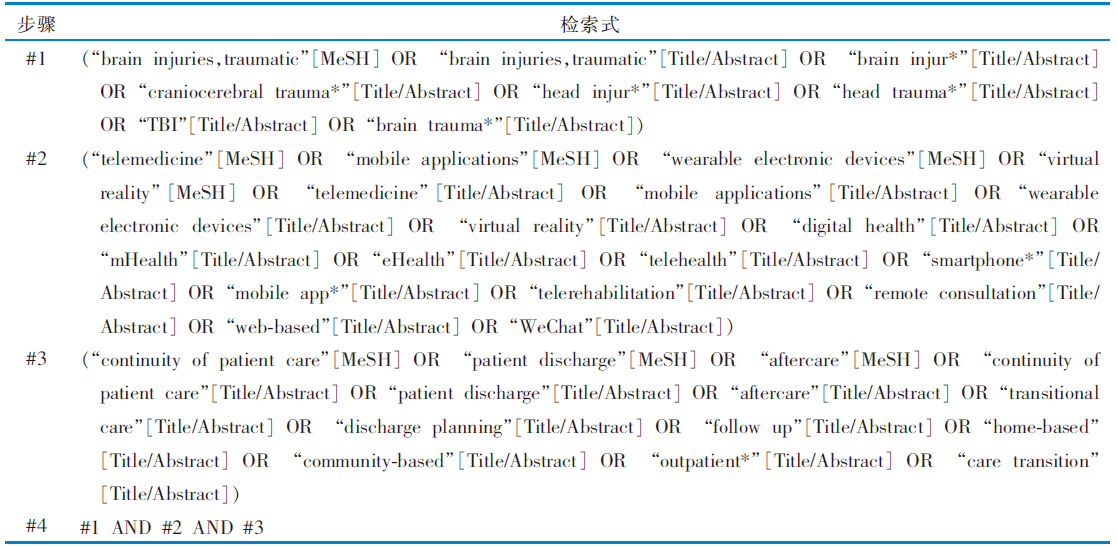 |
表1 PubMed检索策略
Table 1 Retrieval strategies of PubMed
| |
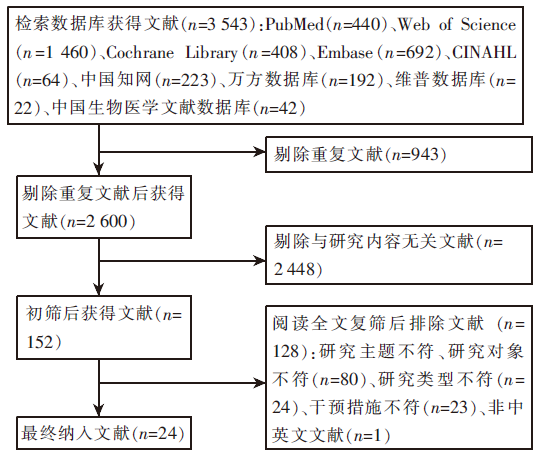
图1 文献纳入筛选流程
Figure 1 Literature inclusion and screening process
 |
表2 纳入文献的基本特征(n=24)
Table 2 (Continued) Basic characteristics of included literature(n=24)
| |
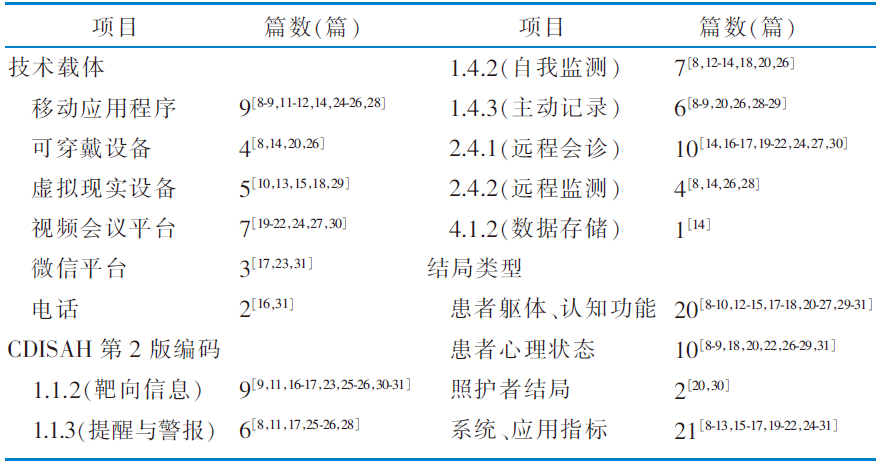 |
表3 纳入文献的数字干预特征与结局领域频次汇总表(n=24)
Table 3 Summary table of the characteristics of digital interventions and the frequency distribution across outcome domains in the included literature(n=24)
| |
| [1] |
Jiang JY, Gao GY, Feng JF, et al. Traumatic brain injury in China[J]. Lancet Neurol, 2019, 18(3):286-295.
DOI PMID |
| [2] |
王阳阳, 杨旻斐, 黄科儿, 等. 老年创伤性脑损伤合并衰弱患者早期运动康复照护促进与阻碍因素的质性研究[J]. 中华护理杂志, 2026, 61(7):939-946.
DOI |
| Wang YY, Yang MF, Huang KE, et al. Facilitating and hinder-ing factors for early exercise rehabilitation care of elderly patients with traumatic brain injury and frailty:a qualitative study[J]. Chin J Nurs, 2026, 61(7):939-946. | |
| [3] |
冯洁惠, 殷钰, 吴一女, 等. 专科护士主导的跨学科协作照护模式的构建与实践研究[J]. 中华护理杂志, 2025, 60(23):2821-2828.
DOI |
| Feng JH, Yin Y, Wu YN, et al. Development and implementa-tion of an interdisciplinary collaborative care model led by specialty nurses[J]. Chin J Nurs, 2025, 60(23):2821-2828. | |
| [4] |
毛文平, 骆金铠, 王力华, 等. 智能交互出院随访平台的构建与应用研究[J]. 中华护理杂志, 2024, 59(15):1812-1817.
DOI |
|
Mao WP, Luo JK, Wang LH, et al. Construction and application of an intelligent interactive discharge follow-up platform[J]. Chin J Nurs, 2024, 59(15):1812-1817.
DOI |
|
| [5] | World Health Organization. WHO classification of digital inter-ventions,services and applications in health:version 2[M]. Ge-neva: World Health Organization, 2023. |
| [6] |
Tricco AC, Lillie E, Zarin W, et al. PRISMA extension for scop-ing reviews(PRISMA-ScR):checklist and explanation[J]. Ann Intern Med, 2018, 169(7):467-473.
DOI URL |
| [7] | Peters MDJ, Godfrey C, McInerney P, et al. Chapter 11:scoping reviews(2020 version)[M/OL]//Aromataris E,Munn Z,editors. JBI manual for evidence synthesis. Adelaide: JBI,2020[2026-05-24]. https://synthesismanual.jbi.global. |
| [8] |
Tzeng HY, Chang CC, Chen SJ, et al. Impact of a digitally mo-nitored walking program on functional and psychological outcomes in individuals with mild traumatic brain injury:a randomized controlled trial[J]. Arch Phys Med Rehabil, 2026, 107(1):1-10.
DOI URL |
| [9] |
Gartell R, Morris J, Wallace T. Feasibility of using a mobile app supported executive function intervention in military service members and veterans with mTBI and co-occurring psy-chological conditions[J]. Int J Environ Res Public Health, 2023, 20(3):2457.
DOI URL |
| [10] |
Shen JB, Lundine JP, Koterba C, et al. VR-based cognitive re-habilitation for children with traumatic brain injuries:feasi-bility and safety[J]. Rehabil Psychol, 2022, 67(4):474-483.
DOI URL |
| [11] |
Juengst SB, McShan E, Conley M, et al. Feasibility and pilot testing of mobile health apps to supplement 2 healthy lifestyle interventions in chronic traumatic brain injury[J]. J Head Trauma Rehabil, 2022, 37(3):162-170.
DOI PMID |
| [12] |
Campbell KR, Peterka RJ, Fino PC, et al. The effects of aug-menting traditional rehabilitation with audio biofeedback in people with persistent imbalance following mild traumatic brain injury[J]. Front Neurol, 2022, 13:926691.
DOI URL |
| [13] |
Tefertiller C, Ketchum JM, Bartelt P, et al. Feasibility of vir-tual reality and treadmill training in traumatic brain injury:a randomized controlled pilot trial[J]. Brain Inj, 2022, 36(7):898-908.
DOI PMID |
| [14] | Raso MG, Arcuri F, Liperoti S, et al. Telemonitoring of patients with chronic traumatic brain injury:a pilot study[J]. Front Neu-rol, 2021, 12:598777. |
| [15] |
Tefertiller C, Hays K, Natale A, et al. Results from a randomi-zed controlled trial to address balance deficits after traumatic brain injury[J]. Arch Phys Med Rehabil, 2019, 100(8):1409-1416.
DOI URL |
| [16] |
Shahrokhi A, Azimian J, Amouzegar A, et al. The effect of telenursing on referral rates of patients with head trauma and their family’s satisfaction after discharge[J]. J Trauma Nurs, 2018, 25(4):248-253.
DOI PMID |
| [17] | 丁莉, 徐松侠, 郭锋. 微信公众平台在中重度颅脑损伤患者随访管理中的运用效果分析[J]. 中国实用护理杂志, 2016, 32(7):514-517. |
| Ding L, Xu SX, Guo F. Analysis on application effect of the WeChat public platform in follow-up management of patients with moderate or severe craniocerebral injury[J]. Chin J Pract Nurs, 2016, 32(7):514-517. | |
| [18] | Johansen T, Matre M, Tornås S, et al. Experiences with virtual reality-based cognitive training in persons with TBI:a quali-tative study[J]. Disabil Rehabil Assist Technol, 2025, 20(1):2490218. |
| [19] |
Kornblith E, Schweizer S, Abrams G, et al. Telehealth delivery of group-format cognitive rehabilitation to older veterans with TBI:a mixed-methods pilot study[J]. Appl Neuropsychol Adult, 2025, 32(3):615-627.
DOI URL |
| [20] |
O’Neil J, Egan M, Marshall S, et al. The impact of two telere-habilitation supervision schedules on physical activity,mobi-lity,and balance among people with moderate to severe trau-matic brain injury:a mixed-method single-subject design[J]. Physiother Can, 2023, 75(2):118-131.
DOI URL |
| [21] |
Demirtakan T, Işık S, Usta T, et al. Challenges and effective-ness of remote neurological follow-up of children with concus-sion following TBI using telemedicine[J]. Ir J Med Sci, 2025, 194(2):707-715.
DOI |
| [22] |
Conklin JP, McCauley KL, Breitenstein J, et al. Implementation of telehealth and hybrid service delivery of interdisciplinary rehabilitation for military populations with traumatic brain injury[J]. NeuroRehabilitation, 2023, 53(4):535-545.
DOI URL |
| [23] | 周林玲, 嵇慧, 俞岚, 等. 基于微信平台的延续性护理对重型颅脑损伤病人术后康复效果的影响[J]. 中国临床神经外科杂志, 2020, 25(7):481-483. |
| Zhou LL, Ji H, Yu L, et al. Effect of continuous nursing based on WeChat platform on postoperative rehabilitation of patients with severe traumatic brain injury[J]. Chin J Clin Neurosurg, 2020, 25(7):481-483. | |
| [24] | Bertolucci F, Fossati L, Agostini B, et al. Tele-rehabilitation for cognitive home-based treatment in young traumatic brain injury:a pilot study[J]. Eur J Phys Rehabil Med, 2024, 60(3):420-422. |
| [25] |
Ertas-Spantgar F, Korabova S, Gabel A, et al. Guiding patients with traumatic brain injury through the instrumental activities of daily living with the RehaGoal App:a feasibility study[J]. Disabil Rehabil Assist Technol, 2024, 19(2):254-265.
DOI URL |
| [26] |
Ding K, Juengst SB, Neaves S, et al. Usability of a two-way personalized mobile trainer system in a community-based exercise program for adults with chronic traumatic brain injury[J]. Brain Inj, 2022, 36(3):359-367.
DOI URL |
| [27] | Campbell KR, Wilhelm JL, Pettigrew NC, et al. Implementation and adoption of telerehabilitation for treating mild traumatic brain injury[J]. J Neurol Phys Ther, 2022, 46(4):E1-E10. |
| [28] |
Usmani S, Balcer L, Galetta S, et al. Feasibility of smartphone-delivered progressive muscle relaxation in persistent post-traumatic headache patients[J]. J Neurotrauma, 2021, 38(1):94-101.
DOI URL |
| [29] |
Moraes TM, Zaninotto AL, Neville IS, et al. Immersive virtual reality in patients with moderate and severe traumatic brain injury:a feasibility study[J]. Health Technol, 2021, 11(5):1035-1044.
DOI |
| [30] |
Rietdijk R, Power E, Attard M, et al. Improved conversation out-comes after social communication skills training for people with traumatic brain injury and their communication partners:a clinical trial investigating in-person and telehealth delivery[J]. J Speech Lang Hear Res, 2020, 63(2):615-632.
DOI URL |
| [31] | 吴海燕, 张和妹, 邢增娜, 等. 延续护理对重型颅脑损伤患者影响的研究[J]. 护理管理杂志, 2019, 19(12):898-901. |
| Wu HY, Zhang HM, Xing ZN, et al. Effect of continuous nurs-ing on patients with severe craniocerebral injury[J]. Chin J Nurs Manag, 2019, 19(12):898-901. |
| [1] | 李秋桦, 傅桂芬, 蒋建华, 尹丹, 左静, 刘艳群. 可穿戴设备在炎症性肠病患者动态监测与管理中应用的范围综述[J]. 中华护理杂志, 2026, 61(8): 1132-1140. |
| [2] | 王秀丽, 代春豪, 许梓婷, 李昊远, 冷敏敏, 张海博, 李晴, 杨丽娟. 运动干预在老年肌少性肥胖患者中应用的范围综述[J]. 中华护理杂志, 2026, 61(7): 995-1001. |
| [3] | 贺敬婷, 应燕萍, 陆秋芳, 赵慧函, 刘丽颖, 马含章, 张程. 多模态数据在护理领域中应用的范围综述[J]. 中华护理杂志, 2026, 61(7): 1002-1008. |
| [4] | 武玲, 吴波, 陈红, 古晨茜, 刘洋, 张春谨, 陈梦琪, 章青. 基于机器学习算法的成人术中低体温预测模型的范围综述[J]. 中华护理杂志, 2026, 61(6): 844-851. |
| [5] | 陈静, 王君君, 魏晓琼, 何欢, 孙秋怡, 唐莹, 韩莹, 何华云. 运动干预在幼年特发性关节炎患儿中应用的范围综述[J]. 中华护理杂志, 2026, 61(6): 858-864. |
| [6] | 温佳, 郭慧芳, 郭晶晶, 田云霞, 杨玥, 刘波. 维持性血液透析患者社会疏离感的范围综述[J]. 中华护理杂志, 2026, 61(5): 605-611. |
| [7] | 旷婉, 祝敏, 胡露红. 简短的正念干预在围手术期患者中应用的范围综述[J]. 中华护理杂志, 2026, 61(5): 707-714. |
| [8] | 陈丹露, 陈茹, 单亚维, 施春香, 沈中鸣. 远程医疗技术在全膝关节置换患者术后运动康复中应用的范围综述[J]. 中华护理杂志, 2026, 61(4): 467-474. |
| [9] | 周鑫滢, 徐亦虹, 周丽萍, 宫晓艳, 叶欢, 刘晓娜, 庄一渝. 脑卒中患者性别差异与健康相关生活质量关系的范围综述[J]. 中华护理杂志, 2026, 61(4): 571-577. |
| [10] | 张世纪, 田艳珍, 李金秀, 邓力邦, 张涛. 空巢老年糖尿病患者用药偏差影响因素分析[J]. 中华护理杂志, 2026, 61(3): 377-384. |
| [11] | 南雪, 孔佳琦, 李亘钰, 齐晴晴, 刘子琦, 吴娅妮, 尹敏. 护理领域理论评价标准研究的范围综述[J]. 中华护理杂志, 2026, 61(3): 412-418. |
| [12] | 范竞予, 尹婷婷, 杨冰清, 严菁菁, 宋玉磊, 殷海燕, 柏亚妹. 嗅觉训练在老年人认知功能干预中应用的范围综述[J]. 中华护理杂志, 2026, 61(22): 3142-3148. |
| [13] | 朱俊宇, 蒋玲. 捐赠人乳临床应用影响因素的范围综述及护理启示[J]. 中华护理杂志, 2026, 61(22): 3149-3156. |
| [14] | 刘志萍, 侯自梅, 原媛, 韩倩倩, 冯倩. 肠造口患者远程随访中数字排斥的范围综述[J]. 中华护理杂志, 2026, 61(22): 3157-3162. |
| [15] | 陈思佳, 徐梦娜, 张一帆, 陈梦然, 贾伞伞, 毋俊龙, 王静, 徐晓霞. 结直肠癌患者癌症复发恐惧干预研究的范围综述[J]. 中华护理杂志, 2026, 61(21): 3011-3017. |
| 阅读次数 | ||||||
|
全文 |
|
|||||
|
摘要 |
|
|||||
