

中华护理杂志 ›› 2026, Vol. 61 ›› Issue (22): 3093-3099.DOI: 10.3761/j.issn.0254-1769.2026.22.010
管惠兰1,*( ), 白萌1, 邵晓露1, 解艳红1, 李芳英1, 安琳琳1, 陈凌燕2, 沈珊珊1
收稿日期:2026-06-05
出版日期:2026-11-20
发布日期:2026-11-16
*通讯作者:
管惠兰,女,本科,主管护师,E-mail:zjyyghl@163.com作者简介:第一联系人: 管惠兰:研究设计、论文撰写与修改、数据统计、基金支持;白萌、李芳英、安琳琳:数据收集、整理与复核;邵晓露:主题选定、资料提取、研究指导;解艳红:文献检索、阅读整理;陈凌燕:论文审阅与修改;沈珊珊:数据统计与指导
基金资助:
GUAN Huilan1,*(), BAI Meng1, SHAO Xiaolu1, XIE Yanhong1, LI Fangying1, AN Linlin1, CHEN Lingyan2, SHEN Shanshan1
Received:2026-06-05
Online:2026-11-20
Published:2026-11-16
* Corresponding author:
GUAN Huilan,E-mail:zjyyghl@163.comFunding program:摘要:
目的 确定老年住院患者应用Morse跌倒评估量表与Barthel指数评估跌倒极高危风险阈值,并分析跌倒的核心影响因素,为临床精准识别跌倒极高危人群提供参考。 方法 采用回顾性队列研究设计,利用医院信息系统大数据收集2022年1月—2025年12月在杭州市某三级甲等医院老年住院患者的相关数据,包括一般资料、Morse跌倒评估量表评分、Barthel指数及住院期间跌倒发生情况。采用Mann-Whitney U检验进行组间比较,利用受试者操作特征曲线下面积及约登指数确定Morse跌倒评估量表最佳预警阈值,采用分层分析确定Barthel指数最佳风险区间,比较不同Morse跌倒评估量表阈值及联合方案的预测效能;通过LASSO回归筛选跌倒的影响因素。 结果 共纳入65 246例老年住院患者,住院期间210例(0.32%)发生跌倒。Morse跌倒评估量表预测跌倒的受试者操作特征曲线下面积为0.837(95%CI:0.813~0.860),理论最佳截断值为52.5分,临床推荐阈值为65分,敏感度为62.38%、特异度为85.28%;Barthel指数与跌倒风险呈倒U形分布,最佳风险区间为40~80分,敏感度为65.71%、特异度为73.35%;联合高危(Morse跌倒评估量表≥65分或Barthel指数40~80分)的敏感度为82.86%,约登指数为0.502,综合效能最优。Morse跌倒评估量表≥65分、服用降压药和降糖药、Barthel指数40~80分及患骨质疏松会增加跌倒风险,而痴呆与跌倒呈负相关(P<0.001)。 结论 老年住院患者极高危跌倒风险的Morse跌倒评估量表最佳预警阈值为65分,Barthel指数最佳风险区间为40~80分。建议护士重视降压与降糖类药物的管理、骨质疏松的相互作用机制,并审慎解读痴呆与跌倒的负相关关系,实现精准分层干预与资源优化配置。
管惠兰, 白萌, 邵晓露, 解艳红, 李芳英, 安琳琳, 陈凌燕, 沈珊珊. 老年住院患者跌倒风险评估量表的阈值与影响因素分析[J]. 中华护理杂志, 2026, 61(22): 3093-3099.
GUAN Huilan, BAI Meng, SHAO Xiaolu, XIE Yanhong, LI Fangying, AN Linlin, CHEN Lingyan, SHEN Shanshan. Threshold and influencing factors analysis of fall risk assessment scales in hospitalized older patients[J]. Chinese Journal of Nursing, 2026, 61(22): 3093-3099.
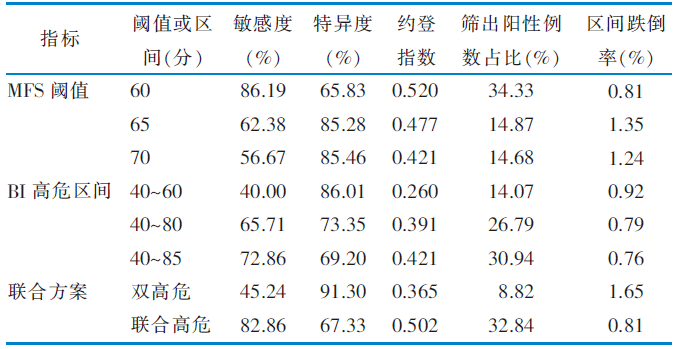 |
表1 不同Morse跌倒评估量表阈值、Barthel指数高危区间及联合方案的诊断效能比较(n=65 246)
Table 1 Comparison of predictive performance among different Morse Fall Scale cutoff values, Barthel Index high risk intervals, and combined screening strategies(n=65 246)
| |
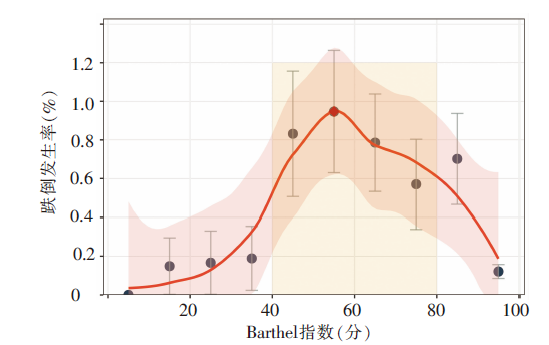
图1 Barthel指数倒U形风险特征
Figure 1 Inverted U shaped relationship between Barthel Index and fall risk
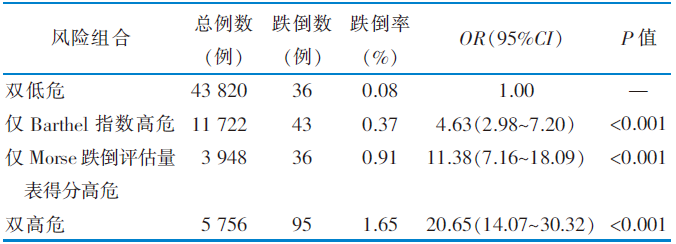 |
表2 风险组合与跌倒风险的关系(n=65 246)
Table 2 Association between risk combinations and fall risk(n=65 246)
| |
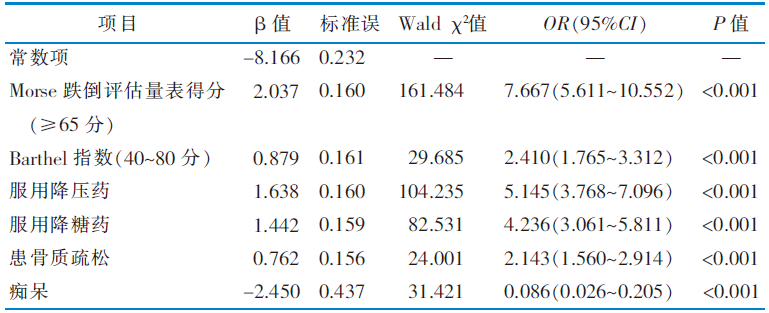 |
表3 老年住院患者跌倒影响因素的Logistic回归分析(n=65 246)
Table 3 Multivariable Logistic regression analysis of independent influencing factors for falls in hospitalized older patients(n=65 246)
| |
| [1] | World Health Organization. Falls[EB/OL]. (2021-04-26)[2023-04-03]. https://www.who.int/news-room/fact-sheets/detail/falls. |
| [2] |
Kwan MM, Close JCT, Wong AKW, et al. Falls incidence,risk factors,and consequences in Chinese older people:a systematic review[J]. J Am Geriatr Soc, 2011, 59(3):536-543.
DOI URL |
| [3] | 皮红英, 高远, 候惠如, 等. 老年人跌倒风险综合管理专家共识[J]. 中华保健医学杂志, 2022, 24(6):439-441. |
| Pi HY, Gao Y, Hou HR, et al. Expert consensus on comprehen-sive management of fall risk of the elderly[J]. Chin J Health Care Med, 2022, 24(6):439-441. | |
| [4] | 刘诗婕, 徐佩, 张燕, 等. 老年人跌倒风险评估工具的应用现状研究[J]. 中国老年保健医学, 2024, 22(6):112-115. |
| Liu SJ, Xu P, Zhang Y, et al. Research on the application status of fall risk assessment tools for the elderly[J]. Chin J Geriatr Care, 2024, 22(6):112-115. | |
| [5] | 李九红, 陈婷, 黄伶智, 等. 3种跌倒风险评估工具对养老机构中老年人跌倒风险的预测价值比较[J]. 护理研究, 2024, 38(13):2296-2301. |
| Li JH, Chen T, Huang LZ, et al. Comparison of predictive value of three fall risk assessment tools among middle-aged and elderly people in nursing facilities[J]. Chin Nurs Res, 2024, 38(13):2296-2301. | |
| [6] | 刘墩秀, 丁福, 朱跃平, 等. 汉化版Morse跌倒评估量表和Hen-drichⅡ跌倒因素模型量表在老年住院患者跌倒风险评估中的适用性比较[J]. 中国护理管理, 2020, 20(8):1168-1172. |
| Liu DX, Ding F, Zhu YP, et al. Comparison of the applicability in elderly inpatients between Chinese version of Morse Fall Scale and Hendrich Ⅱ Fall Risk Model[J]. Chin Nurs Manag, 2020, 20(8):1168-1172. | |
| [7] |
Lohse KR, Dummer DR, Hayes HA, et al. Combining the AM-PAC “6-clicks” and the Morse Fall Scale to predict individuals at risk for falls in an inpatient rehabilitation hospital[J]. Arch Phys Med Rehabil, 2021, 102(12):2309-2315.
DOI URL |
| [8] | Yan J, Zhang QF, Zhou J, et al. Inverted U-shaped relationship between Barthel Index Score and falls in Chinese non-bedridden patients:a cross-sectional study[J]. Top Stroke Reha-bil, 2024, 31(7):692-702. |
| [9] |
Kim MY, Kim Y. Comparison of factors influencing fall recur-rence in the young-old and old-old:a cross-sectional nation-wide study in South Korea[J]. BMC Geriatr, 2022, 22(1):520.
DOI |
| [10] | 韩清波, 钟媛, 张巧玲, 等. 老年住院患者复合跌倒风险评分表的构建及应用研究[J]. 护理学杂志, 2024, 39(1):56-59,71. |
| Han QB, Zhong Y, Zhang QL, et al. Development and applica-tion of a Combined Fall Risk Assessment Scale for older inpatients[J]. J Nurs Sci, 2024, 39(1):56-59,71. | |
| [11] |
Kim YJ, Choi KO, Cho SH, et al. Validity of the Morse Fall Scale and the Johns Hopkins Fall Risk Assessment Tool for fall risk assessment in an acute care setting[J]. J Clin Nurs, 2022, 31(23/24):3584-3594.
DOI URL |
| [12] |
Bally ELS, Ye LZ, van Grieken A, et al. Factors associated with falls among hospitalized and community-dwelling older adults:the APPCARE study[J]. Front Public Health, 2023, 11:1180914.
DOI URL |
| [13] | 周静, 廖庆萍, 何琼, 等. 国内老年患者跌倒评估量表文献研究现状分析[J]. 齐鲁护理杂志, 2016, 22(11):66-68. |
| Zhou J, Liao QP, He Q, et al. An analysis of the literature research status of the fall assessment scale for elderly patients in China[J]. J Qilu Nurs, 2016, 22(11):66-68. | |
| [14] | 章扬熙. 临床流行病学第六讲 诊断性试验研究[J]. 中华流行病学杂志, 1997, 18(2):118-119. |
| Zhang YX. Clinical epidemiology lecture 6:diagnostic experi-mental research[J]. Chin J Epidemiol, 1997, 18(2):118-119. | |
| [15] | 周君桂, 李亚洁, 范建中. Morse跌倒评估量表中文版在我国住院老年患者中的信度及效度研究[J]. 中国康复医学杂志, 2012, 27(3):244-247,284. |
| Zhou JG, Li YJ, Fan JZ. Research on the reliability and vali-dity of Chinese version Morse Fall Assessment Scale in elder-ly in patients[J]. Chin J Rehabil Med, 2012, 27(3):244-247, 284. | |
| [16] |
Leung SOC, Chan CCH, Shah S. Development of a Chinese version of the Modified Barthel Index:validity and reliability[J]. Clin Rehabil, 2007, 21(10):912-922.
DOI URL |
| [17] | 沈鸣雁, 王华芬, 封秀琴, 等. 住院跌倒患者的数据挖掘与跌倒防范对策分析[J]. 中华护理杂志, 2017, 52(9):1087-1091. |
| Shen MY, Wang HF, Feng XQ, et al. Data mining and preventive measures for 239 cases of falls in hospitalized adults[J]. Chin J Nurs, 2017, 52(9):1087-1091. | |
| [18] |
Ji S, Jung HW, Kim J, et al. Comparative study of the accu-racy of at-point Clinical Frailty Scale and Morse Fall Scale in identifying high-risk fall patients among hospitalized adults[J]. Ann Geriatr Med Res, 2023, 27(2):99-105.
DOI URL |
| [19] |
Choi JH, Choi ES, Park D. In-hospital fall prediction using ma-chine learning algorithms and the Morse Fall Scale in pa-tients with acute stroke:a nested case-control study[J]. BMC Med Inform Decis Mak, 2023, 23(1):246.
DOI |
| [20] |
Bóriková I, Tomagová M, Miertová M, et al. Predictive value of the Morse Fall Scale[J]. Cent Eur J Nurs Midw, 2017, 8(1):588-595.
DOI URL |
| [21] | 李晓瑞, 朱丽红, 赵阳, 等. 社区老年人跌倒风险筛查与评估的最佳证据总结[J]. 护理学杂志, 2022, 37(4):92-94,105. |
| Li XR, Zhu LH, Zhao Y, et al. Best evidence summary for screening and assessment of fall risk for community residing older adults[J]. J Nurs Sci, 2022, 37(4):92-94,105. | |
| [22] |
何梦欣, 陈德凤, 李蓓, 等. 智能化交互式认知运动干预在老年人跌倒预防中应用的范围综述[J]. 中华护理杂志, 2025, 60(7):884-890.
DOI |
| He MX, Chen DF, Li B, et al. Intelligent interactive cognitive-motor training for fall prevention in older adults:a scoping review[J]. Chin J Nurs, 2025, 60(7):884-890. | |
| [23] | 龙思宇, 姜雨婷, 丁福. 跨理论模型联合意外、死亡、伤害工具包在出院老年人跌倒防范中的应用研究[J]. 中国康复医学杂志, 2023, 38(9):1233-1238. |
| Long SY, Jiang YT, Ding F. Application of trans-theoretical and STEADI in prevention falls of elderly after discharged from hospital[J]. Chin J Rehabil Med, 2023, 38(9):1233-1238. | |
| [24] |
Colón-Emeric CS, McDermott CL, Lee DS, et al. Risk assess-ment and prevention of falls in older community-dwelling adults:a review[J]. JAMA, 2024, 331(16):1397-1406.
DOI PMID |
| [25] | 中华医学会老年医学分会, 中国医疗保健国际交流促进会高血压病分会. 老年高血压特点及临床诊治流程专家共识(2024)[J]. 中华老年医学杂志, 2024, 43(3):257-268. |
| Chinese Geriatrics Society,China International Exchange and Promotive Association for Medical and Health Care. Hyper-tension Society. Consensus on characteristics and clinical dia-gnosis and treatment process of hypertension in the elderly(2024)[J]. Chin J Geriatr, 2024, 43(3):257-268. | |
| [26] |
Freire LB, Brasil-Neto JP, da Silva ML, et al. Risk factors for falls in older adults with diabetes mellitus:systematic review and meta-analysis[J]. BMC Geriatr, 2024, 24(1):201.
DOI |
| [27] | 董婷婷, 韩斌如, 李秋萍. 住院患者跌倒预防循证管理方案的构建与实践[J]. 中国护理管理, 2025, 25(9):1343-1348. |
| Dong TT, Han BR, Li QP. Construction and practice of evidence-based management plan for fall prevention in hospitalized patients[J]. Chin Nurs Manag, 2025, 25(9):1343-1348. | |
| [28] | 李悦芃, 董娟, 张任飞, 等. 肌少-骨质疏松症的研究进展[J]. 中华老年医学杂志, 2024, 43(1):77-81. |
| Li YP, Dong J, Zhang RF, et al. Research progress on osteosar-copenia[J]. Chin J Geriatr, 2024, 43(1):77-81. | |
| [29] | Wei F, Hu Z, He R, et al. Effects of balance training on bala-nce and fall efficacy in patients with osteoporosis:a syste-matic review and meta-analysis with trial sequential analysis[J]. J Rehabil Med, 2023,55:jrm00390. |
| [30] |
Devries MC, Giangregorio L. Using the specificity and over-load principles to prevent sarcopenia,falls and fractures with exercise[J]. Bone, 2023, 166:116573.
DOI URL |
| [31] |
Khalili SM, Simpkins C, Yang F. A meta-analysis of fall risk in older adults with Alzheimer’s disease[J]. J Am Med Dir Assoc, 2024, 25(5):781-788.e3.
DOI URL |
| [32] |
Racey M, Markle-Reid M, Fitzpatrick-Lewis D, et al. Fall pre-vention in community-dwelling adults with mild to moderate cognitive impairment:a systematic review and meta-analysis[J]. BMC Geriatr, 2021, 21(1):689.
DOI PMID |
| [33] |
杨欣, 姚梅琪, 张玉萍, 等. 住院老年患者跌倒风险与风险感知的差异性研究[J]. 中华护理杂志, 2023, 58(19):2326-2332.
DOI |
|
Yang X, Yao MQ, Zhang YP, et al. Differences between fall risk and fall risk perception among hospitalized elderly patients[J]. Chin J Nurs, 2023, 58(19):2326-2332.
DOI |
| [1] | 中华护理学会静脉输液治疗专业委员会, 北京护理学会, (执笔:李佳, 李旭英, 覃惠英, 陈利芬, 吴珍明, 胡泽吟, 罗梦娜, 范育英, 吴嘉慧, 林宇萍, 王蕾, 孙文彦, 冯毕龙, 高伟, 李亚南, 侯罗娅, 李春燕. 中心静脉通路装置拔除护理专家共识[J]. 中华护理杂志, 2026, 61(9): 1157-1162. |
| [2] | 周霞, 马艳艳, 师正坤, 于海霞, 周艳, 胡红玲, 李莜, 陈思思, 张京慧. 隧道式经股静脉PICC置入术在困难静脉通路婴幼儿中的应用研究[J]. 中华护理杂志, 2026, 61(9): 1163-1170. |
| [3] | 黄萍, 李黎, 郭骊莉, 徐莹, 叶赟, 江淑芳. 与无针输液接头相关的导管相关性血流感染风险评估工具的构建与初步应用[J]. 中华护理杂志, 2026, 61(9): 1171-1179. |
| [4] | 李佳, 张玉玲, 邢乐, 张利峰, 牛秀峰, 许莉. 早产儿经上肢置入PICC尖端继发性异位风险预测模型的建立与验证[J]. 中华护理杂志, 2026, 61(9): 1180-1186. |
| [5] | 何娟, 赵蕾蕾, 叶冠军, 余艳芬, 傅晓君, 周琴. 1例双侧无名静脉及上腔静脉人工血管置换术后患者经上肢置入PICC的护理[J]. 中华护理杂志, 2026, 61(9): 1187-1191. |
| [6] | 梁江淑渊, 曾妃, 何鹏, 谢梦珊, 江悦, 蒋宗恒, 王建茗. 静脉-静脉体外膜肺氧合患者早期活动风险等级评估系统的构建及应用研究[J]. 中华护理杂志, 2026, 61(9): 1192-1199. |
| [7] | 陈晨, 顾肖, 郭凡, 王敏, 倪兴梅, 黄琴, 程念开. 3种衰弱评估工具对急诊老年创伤患者不良结局的预测价值[J]. 中华护理杂志, 2026, 61(9): 1200-1207. |
| [8] | 郑煜琳, 刘晋宁, 张静, 郭会敏, 谷艳梅, 张莉莉. 酒精性肝病患者肝移植术后再饮酒现状及其影响因素分析[J]. 中华护理杂志, 2026, 61(9): 1208-1214. |
| [9] | 叶俊霜, 沈丽佳, 孟霞靓, 张玉姣, 蔡根莲, 邵碧云, 周亚辉, 张柳倩, 应金萍. 维持性血液透析患者对口腔衰弱认知和体验的质性研究[J]. 中华护理杂志, 2026, 61(9): 1215-1220. |
| [10] | 王芸姣, 杨玉金, 郑春艳, 彭菲津, 王淑贞, 蒋喜露, 周为民, 王薇, 张娜. 糖尿病下肢动脉硬化闭塞症患者介入术后康复护理方案的构建及应用研究[J]. 中华护理杂志, 2026, 61(9): 1221-1229. |
| [11] | 杨明霞, 安冉, 臧金凤, 李春梅. 老年慢性病共病患者及照护者老老照护能力与自我忽视的相关性分析[J]. 中华护理杂志, 2026, 61(9): 1230-1236. |
| [12] | 梁和静, 许鹊, 史云霞, 祖金美, 黄文静, 杨春旭, 郭明华, 王磊. 颈动脉内膜剥脱术围手术期护理质量评价指标的构建[J]. 中华护理杂志, 2026, 61(9): 1237-1244. |
| [13] | 韩媛媛, 石玉竹, 尚文涵, 么莉. 870所三级甲等医院老年住院患者跌倒伤害发生现状与影响因素分析[J]. 中华护理杂志, 2026, 61(9): 1245-1252. |
| [14] | 夏云芳, 王洪, 崔岱, 付真真, 朱敏. 1例弥漫性毒性甲状腺肿合并超敏反应综合征青少年患者的护理[J]. 中华护理杂志, 2026, 61(9): 1253-1256. |
| [15] | 周益飞, 王海苹, 胡益环, 应莉, 罗松娜. 1例氢氟酸中毒并发呼吸心搏骤停患者的急救护理[J]. 中华护理杂志, 2026, 61(9): 1257-1260. |
| 阅读次数 | ||||||
|
全文 |
|
|||||
|
摘要 |
|
|||||
