

中华护理杂志 ›› 2026, Vol. 61 ›› Issue (17): 2374-2382.DOI: 10.3761/j.issn.0254-1769.2026.17.010
留俊霞1( ), 徐敏1, 郭思言1, 杨树慧1, 王华芬2,*()
收稿日期:2026-01-19
出版日期:2026-09-10
发布日期:2026-09-03
*通讯作者:
王华芬,E-mail:2185015@zju.edu.cn作者简介:留俊霞:女,本科(硕士在读),主管护师,E-mail:1709028@zju.edu.cn留俊霞:研究方案实施、数据整理与统计分析、论文撰写;徐敏:研究设计、研究指导、论文审阅及修改;郭思言:研究设计、数据收集、统计分析、论文修改;杨树慧:数据收集、论文修改;王华芬:研究设计、研究指导、论文审阅及修改
基金资助:
LIU Junxia1(), XU Min1, GUO Siyan1, YANG Shuhui1, WANG Huafen2,*()
Received:2026-01-19
Online:2026-09-10
Published:2026-09-03
* Corresponding author:
WANG Huafen,E-mail:2185015@zju.edu.cnFunding program:摘要:
目的 探讨人工肝经股静脉置管患者导管相关性血栓(catheter-related thrombosis,CRT)形成的高风险特征组合规律,构建并验证累积风险预测模型,为实施精准的预见性护理提供参考。 方法 连续纳入2024年1—12月杭州市某三级甲等医院收治的人工肝经股静脉置管患者作为调查对象,采集相关资料。运用Apriori算法挖掘CRT形成的核心高风险关联规则,通过分组矩阵聚类及网络拓扑图对核心高风险关联规则进行聚类与可视化分析,并基于分析结果构建累积风险预测模型,采用Logistic回归分析验证模型的预测效能。 结果 共纳入206例患者,CRT发生率为53.39%。运用Apriori算法,提取出1 712条核心高风险关联规则。对提升度排序前15位的核心高风险关联规则进行聚类分析,提炼出5类核心特征组合,其中有意识障碍且人工肝治疗次数≥3次的平均提升度最高。网络拓扑图分析结果显示,人工肝治疗次数≥3次、Caprini评分为3~4分、治疗前纤维蛋白原浓度<1.5 g/L是网络中连接度较高的3个枢纽节点。依据5类核心特征组合构建累积风险预测模型,Logistic回归分析结果显示,模型评分与CRT的发生风险呈正相关(OR=1.689,P<0.001)。 结论 该研究构建的模型能有效量化人工肝经股静脉置管患者CRT形成中多风险因素的叠加效应,对高风险患者的识别准确率较高。
留俊霞, 徐敏, 郭思言, 杨树慧, 王华芬. 人工肝经股静脉置管患者导管相关性血栓形成累积风险预测模型的构建及验证[J]. 中华护理杂志, 2026, 61(17): 2374-2382.
LIU Junxia, XU Min, GUO Siyan, YANG Shuhui, WANG Huafen. Development and validation of a risk prediction model for catheter-related thrombosis in patients undergoing artificial liver therapy via femoral vein catheterization[J]. Chinese Journal of Nursing, 2026, 61(17): 2374-2382.
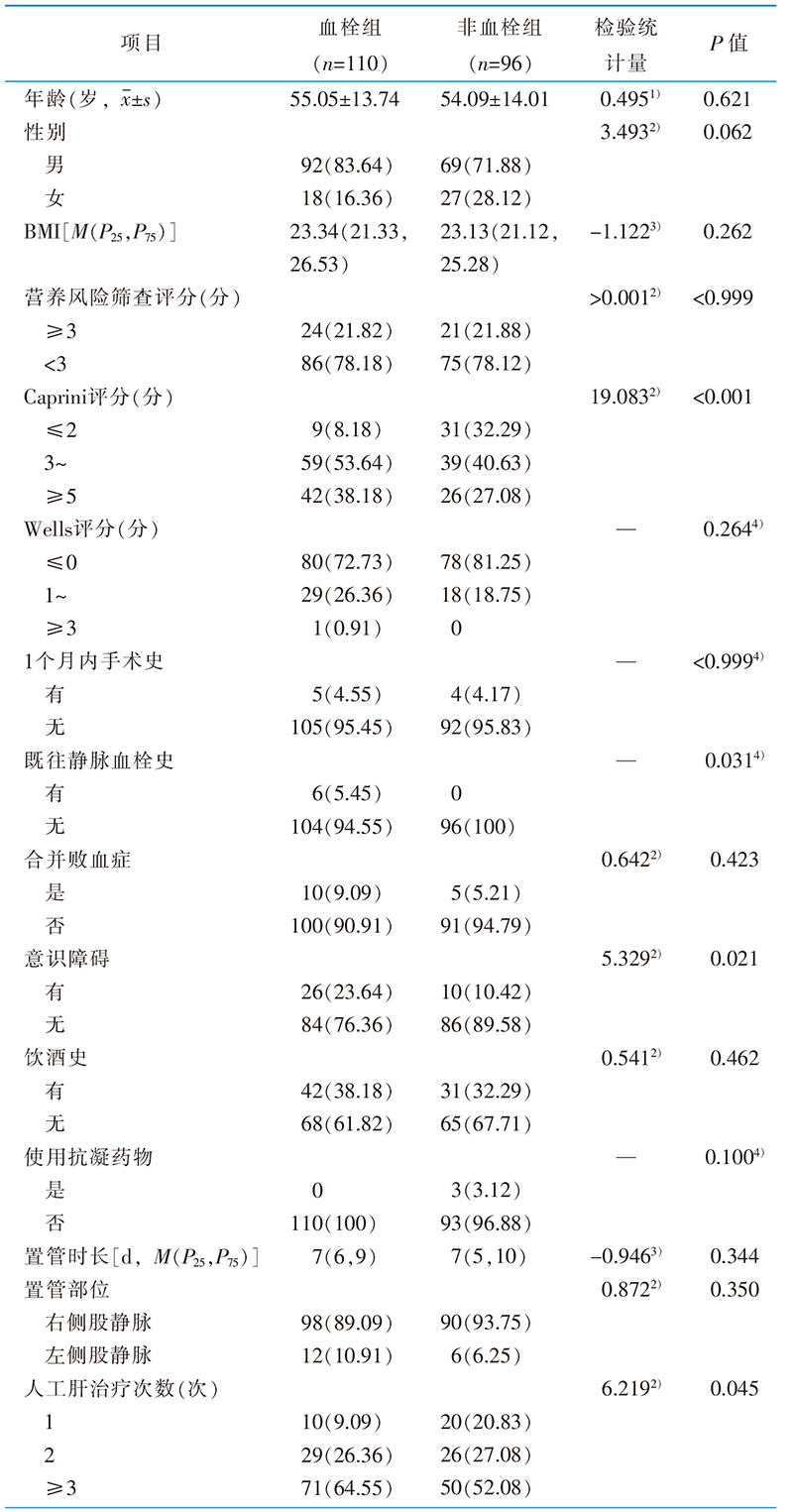 |
表1 人工肝经股静脉置管患者血栓组与非血栓组的一般资料比较
Table 1 Comparison of baseline characteristics between the thrombosis and non-thrombosis groups in patients undergoing artificial liver support system treatment
| |
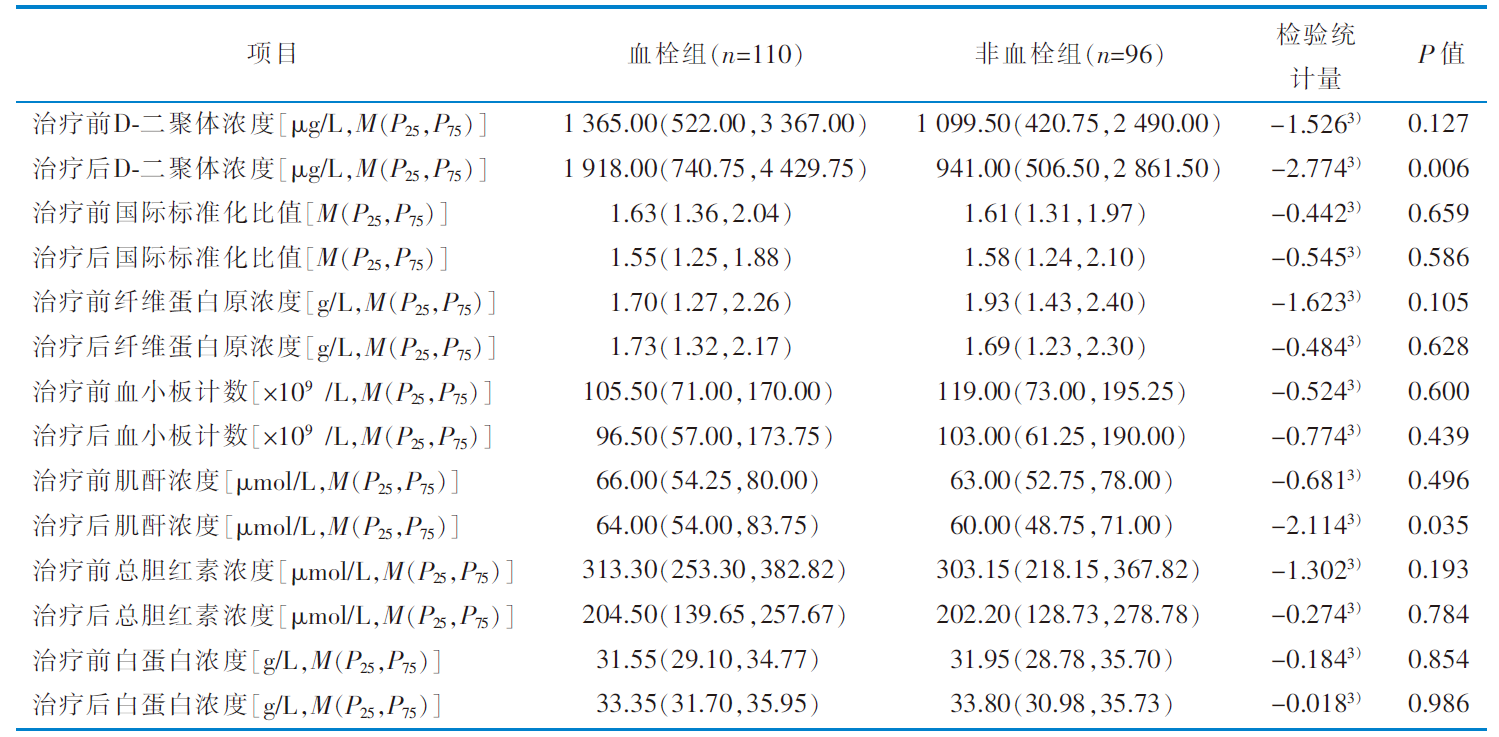 |
续表1 人工肝经股静脉置管患者血栓组与非血栓组的一般资料比较
Table 1(Continued) Comparison of baseline characteristics between the thrombosis and non-thrombosis groups in patients undergoing artificial liver support system treatment
| |
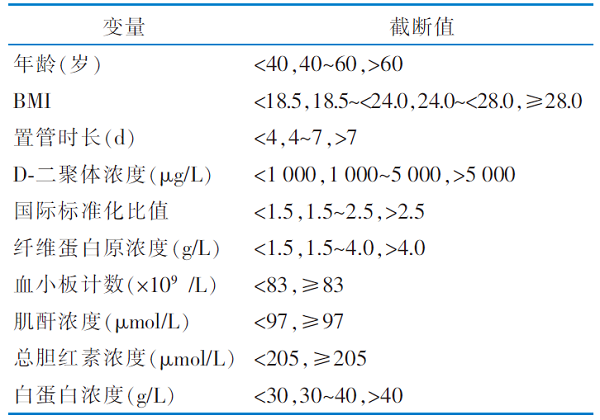 |
表2 连续型变量的截断值
Table 2 Cut-off of continuous variables
| |
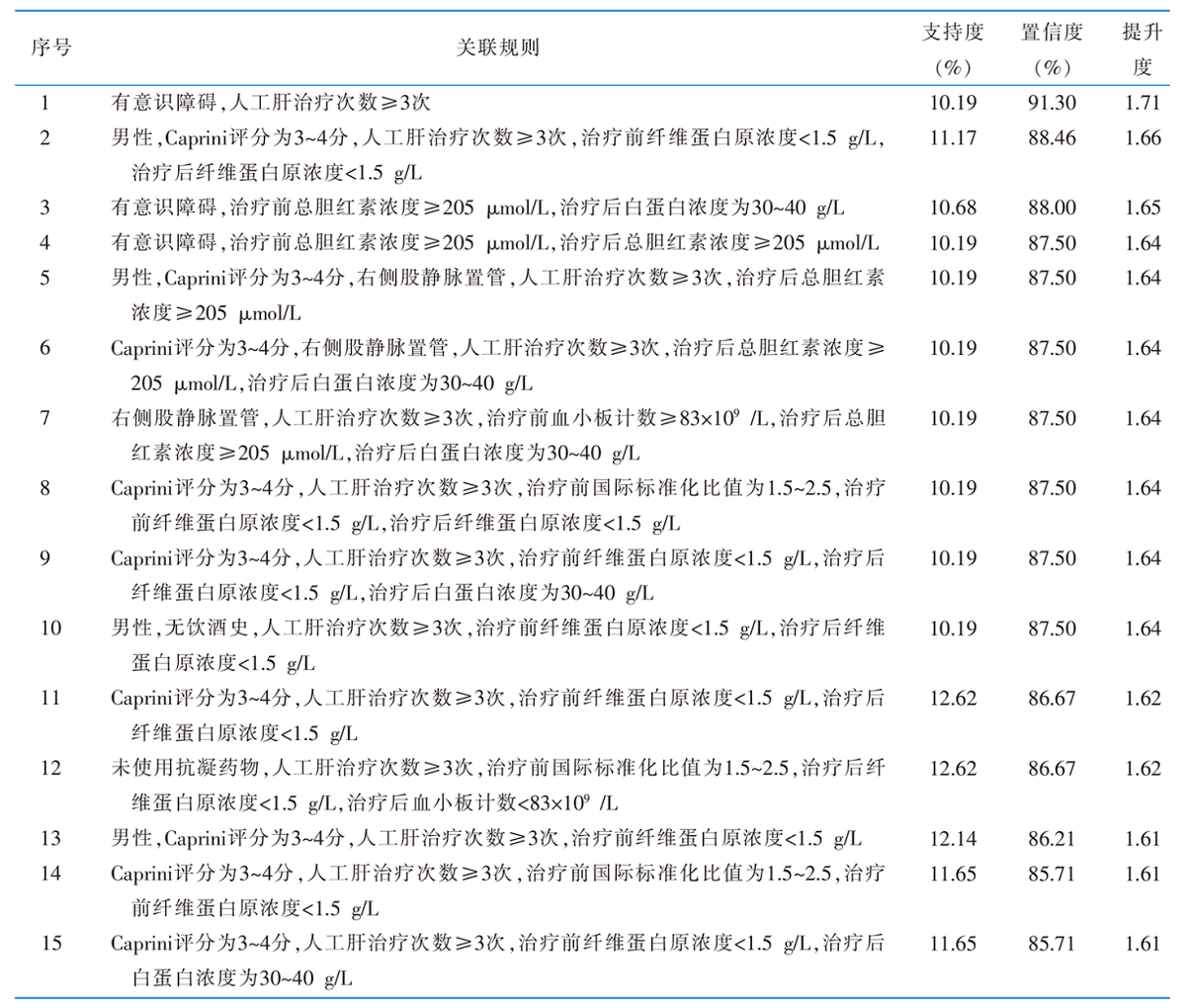 |
表3 人工肝经股静脉置管患者导管相关性血栓形成前15位核心高风险关联规则
Table 3 Top 15 association rules for the risk of catheter-related thrombosis in patients undergoing artificial liver support system treatment
| |
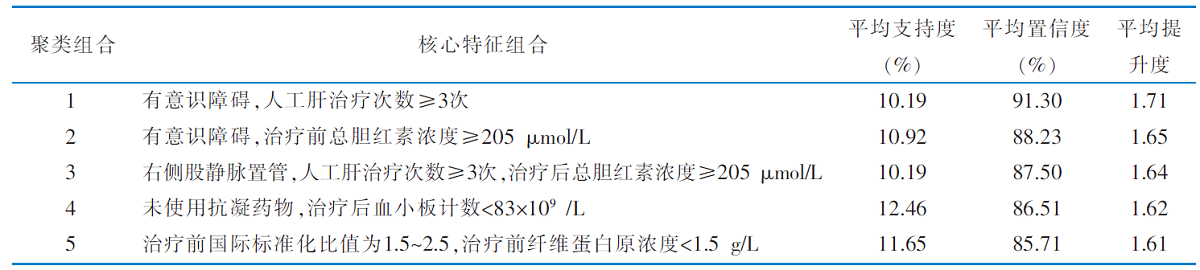 |
表4 人工肝经股静脉置管患者导管相关性血栓形成前15项核心高风险关联规则的聚类特征
Table 4 Clustering characteristics of the top 15 association rules for catheter-related thrombosis in patients undergoing artificial liver support system treatment
| |
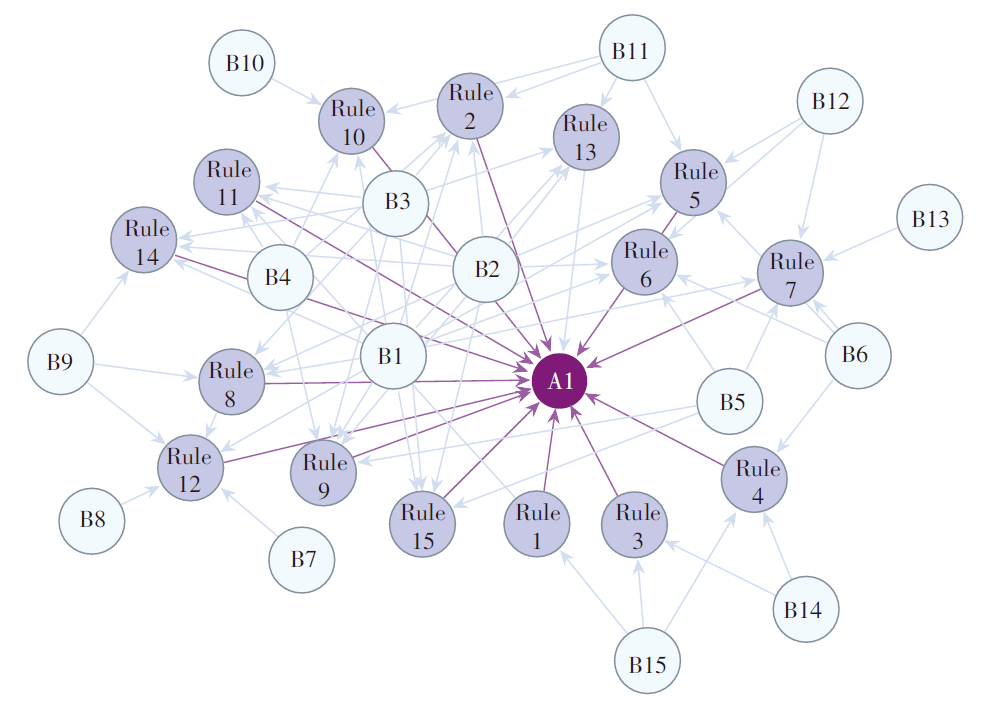
图1 人工肝经股静脉置管患者导管相关性血栓形成前15位核心高风险关联规则的网络拓扑图 注: 为结局事件; 为关联规则; 为临床风险特征。Rule 1~15对应表3中第1~15条核心高风险关联规则。A1为导管相关性血栓;B1为人工肝治疗次数≥3次;B2为Caprini评分为3~4分;B3为治疗前纤维蛋白原浓度<1.5 g/L;B4为治疗后纤维蛋白原浓度<1.5 g/L;B5为治疗后白蛋白浓度为30~40 g/L;B6为治疗后总胆红素浓度>205 μmol/L;B7为未使用抗凝药物;B8为治疗后血小板计数<83×109 /L;B9为治疗前国际标准化比值为1.5~2.5;B10为无饮酒史;B11为男性;B12为右侧股静脉置管;B13为治疗前血小板计数≥83×109 /L;B14为治疗前总胆红素浓度≥205 μmol/L;B15为有意识障碍。
Figure 1 Network topology of the top 15 core high-risk association rules for catheter-related thrombosis in patients undergoing artificial liver therapy via femoral vein catheterization
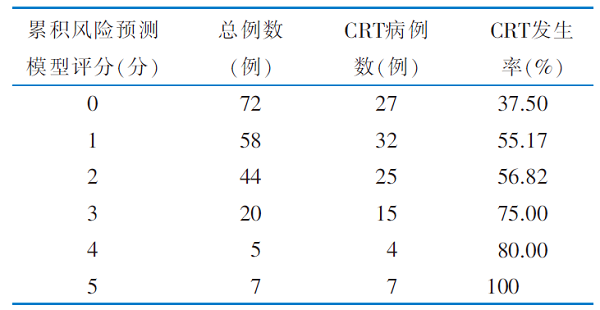 |
表5 不同累积风险评分值下人工肝经股静脉置管患者的导管相关性血栓发生率(n=206)
Table 5 Incidence of catheter-related thrombosis in patients undergoing artificial liver therapy via femoral vein catheterization at different cumulative risk scores(n=206)
| |
| [1] | 中华医学会肝病学分会重型肝病与人工肝学组, 中华医学会感染病学分会肝衰竭与人工肝学组. 肝衰竭诊治指南(2024年版)[J]. 临床肝胆病杂志, 2024, 40(12):2371-2387. |
| Severe Liver Disease and Artificial Liver Group, Branch of Hepatology, Chinese Medical Association,Liver Failure and Artificial Liver Group, Branch of Infectious Diseases,Chinese Medical Association. Guideline for diagnosis and treatment of liver failure(2024 version)[J]. J Clin Hepatol,2024, 40(12):2371-2387. | |
| [2] | 赵宝婕, 王妤, 刘婷. 人工肝治疗肝衰竭病人导管相关性血栓的危险因素及预防策略进展[J]. 循证护理, 2022, 8(20):2771-2774. |
| Zhao BJ, Wang Y, Liu T. Risk factors and prevention strategies progress of catheter-related thrombosis in patients with hepatic failure treated with artificial liver[J]. Chin Evid Based Nurs, 2022, 8(20):2771-2774. | |
| [3] |
郑焠燕, 封亚萍, 刘志梅, 等. 双手及单手握球锻炼在PICC置管患者中应用效果的比较研究[J]. 中华护理杂志, 2026, 61(1):57-62.
DOI |
| Zheng CY, Feng YP, Liu ZM, et al. Comparative study of the application of two-hand versus one-hand ball-holding exercise in patients with PICC catheters[J]. Chin J Nurs, 2026, 61(1):57-62. | |
| [4] | 章华芬, 陈辉, 张鑫, 等. 人工肝股静脉置管导管相关性血栓的影响因素分析[J]. 中华临床感染病杂志, 2024, 17(3):213-217. |
| Zhang HF, Chen H, Zhang X, et al. Risk factors of catheter-related thrombosis in femoral vein indwelling catheter for patients undergoing artificial liver therapy[J]. Chin J Clin Infect Dis, 2024, 17(3):213-217. | |
| [5] |
White D, Woller SC, Stevens SM, et al. Comparative thrombosis risk of vascular access devices among critically ill medical patients[J]. Thromb Res, 2018, 172:54-60.
DOI PMID |
| [6] | 陈怡莹, 杨佳, 李苹. 血液透析患者中心静脉置管后发生导管相关性血栓的现状调查及影响因素分析[J]. 分子诊断与治疗杂志, 2025, 17(11):2233-2236. |
| Chen YY, Yang J, Li P. Investigation on the current status and influencing factors of catheter-related thrombosis in hemodialysis patients after central venous catheterization[J]. J Mol Diagn Ther, 2025, 17(11):2233-2236. | |
| [7] |
Tripodi A, Mannucci PM. The coagulopathy of chronic liver disease[J]. N Engl J Med, 2011, 365(2):147-156.
DOI URL |
| [8] |
Saner FH, Bezinover D. Assessment and management of coagulopathy in critically-ill patients with liver failure[J]. Curr Opin Crit Care, 2019, 25(2):179-186.
DOI PMID |
| [9] | 中国健康促进基金会血栓与血管专项基金专家委员会. 静脉血栓栓塞症机械预防中国专家共识[J]. 中华医学杂志, 2020, 100(7):484-492. |
| Expert Committee on Thrombosis and Vascular Special Fund,China Health Promotion Foundation. Chinese expert consensus on mechanical prophylaxis of venous thromboembolism[J]. Natl Med J China, 2020, 100(7):484-492. | |
| [10] |
Caprini JA. Thrombosis risk assessment as a guide to quality patient care[J]. Dis Month, 2005, 51(2/3):70-78.
DOI URL |
| [11] |
Wells PS, Anderson DR, Bormanis J, et al. Value of assessment of pretest probability of deep-vein thrombosis in clinical management[J]. Lancet, 1997, 350(9094):1795-1798.
DOI PMID |
| [12] | 吴觅之, 余红梅, 潘红英, 等. 住院患者胃管非计划拔管的数据挖掘及防范对策分析[J]. 中华急危重症护理杂志, 2022, 3(4):360-364. |
| Wu MZ, Yu HM, Pan HY, et al. Data mining and preventive countermeasure analysis of unplanned extubation of gastric tube in hospitalized patients[J]. Chin J Emerg Crit Care Nurs, 2022, 3(4):360-364. | |
| [13] | 丁佳楠, 项珍珍, 许蓓妮, 等. 肿瘤患者中心静脉导管相关性血栓形成风险预测模型的研究进展[J]. 中华护理杂志, 2025, 60(增刊1):88-91. |
| Ding JN, Xiang ZZ, Xu BN, et al. Advances in risk prediction models for central venous catheter-related thrombosis in cancer patients[J]. Chin J Nurs, 2025, 60(S1):88-91. | |
| [14] | Riley RD, Ensor J, Snell KIE, et al. Calculating the sample size required for developing a clinical prediction model[J]. BMJ,2020:m441. |
| [15] |
吴文瑾, 徐亦虹, 柳小琳, 等. 中心静脉置管患者导管相关性血栓风险预测模型的系统评价[J]. 中华护理杂志, 2022, 57(23):2834-2842.
DOI |
|
Wu WJ, Xu YH, Liu XL, et al. Systematic review of risk prediction models for catheter-related thrombosis in patients undergoing central venous catheterization[J]. Chin J Nurs, 2022, 57(23):2834-2842.
DOI |
|
| [16] | 蒋姗宏, 李晓仟. 中心静脉导管相关性血栓预防策略的研究进展[J]. 中华护理杂志, 2025, 60(增刊1):45-48. |
| Jiang SH, Li XQ. A review of prevention and control strategies for central venous catheter-related thrombosis[J]. Chin J Nurs, 2025, 60(S1):45-48. | |
| [17] |
Kondrup J, Rasmussen HH, Hamberg O, et al. Nutritional Risk Screening(NRS 2002):a new method based on an analysis of controlled clinical trials[J]. Clin Nutr, 2003, 22(3):321-336.
DOI PMID |
| [18] | 中华医学会消化病学分会肝胆疾病学组. 中国隐匿性肝性脑病临床诊治专家共识意见[J]. 中华消化杂志, 2023, 43(11):721-736. |
| Hepatobiliary Disease Study Group, Chinese Society of Gastroenterology, Chinese Medical Association. Chinese consensus on clinical diagnosis and management of covert hepatic encephalopathy[J]. Chin J Dig, 2023, 43(11):721-736. | |
| [19] |
Wall C, Moore J, Thachil J. Catheter-related thrombosis:a practical approach[J]. J Intensive Care Soc, 2016, 17(2):160-167.
DOI URL |
| [20] | 蔡苗苗, 徐佳怡, 吕璇, 等. 超声评估癌症患者PICC相关性血栓的研究进展[J]. 中国实验诊断学, 2022, 26(4):626-629. |
| Cai MM, Xu JY, Lü X, et al. Research progress of ultrasound in evaluating PICC-related thrombosis in cancer patients[J]. Chin J Lab Diagn, 2022, 26(4):626-629. | |
| [21] | 李壮, 刘洋, 葛辛, 等. 基于数据挖掘的慢性疲劳综合征伴焦虑和抑郁状态的相关因素分析[J]. 中华全科医学, 2018, 16(2):204-206. |
| Li Z, Liu Y, Ge X, et al. Relative factor analysis on anxiety and depression state of patients with chronic fatigue syndrome based on data mining[J]. Chin J Gen Pract, 2018, 16(2):204-206. | |
| [22] | 伍鑫莉, 周会兰, 张荣菊. ICU脓毒症患者中心静脉导管相关性血栓相关因素及其列线图预测模型构建[J]. 中华医院感染学杂志, 2026, 36(9):1387-1392. |
| Wu XL, Zhou HL, Zhang RJ. Related factors for central venous catheter-related thrombosis in ICU patients with sepsis and construction of nomogram prediction model[J]. Chin J Nosocomiol, 2026, 36(9):1387-1392. | |
| [23] | 王宁, 郭振江, 张媛媛, 等. 危重症患者中心静脉导管相关性血栓危险因素分析及列线图预测模型的建立[J]. 中华危重病急救医学, 2021, 33(9):1047-1051. |
| Wang N, Guo ZJ, Zhang YY, et al. Risk factors analysis of central venous catheter-related thrombosis in critically ill patients and development of nomogram prediction model[J]. Chin Crit Care Med, 2021, 33(9):1047-1051. | |
| [24] |
李乾, 赵欣, 张晓维, 等. 国内成人肿瘤患者PICC相关性血栓发生率的Meta分析[J]. 中华护理杂志, 2022, 57(3):348-355.
DOI |
| Li Q, Zhao X, Zhang XW, et al. Incidence of peripherally inserted central catheter-related thrombosis in Chinese adult cancer patients:a meta-analysis[J]. Chin J Nurs, 2022, 57(3):348-355. | |
| [25] |
Capece GE, Luyendyk JP, Poole LG. Fibrinolysis-mediated pathways in acute liver injury[J]. Semin Thromb Hemost, 2024, 50(4):638-647.
DOI PMID |
| [26] |
Campello E, Zanetto A, Radu CM, et al. Profiling plasma alterations of extracellular vesicles in patients with acutely decompensated cirrhosis and bacterial infection[J]. Liver Int, 2024, 44(7):1610-1623.
DOI URL |
| [27] |
Nesci A, Ruggieri V, Manilla V, et al. Endothelial dysfunction and liver cirrhosis:unraveling of a complex relationship[J]. Int J Mol Sci, 2024, 25(23):12859.
DOI URL |
| [28] |
Citla Sridhar D, Abou-Ismail MY, Ahuja SP. Central venous catheter-related thrombosis in children and adults[J]. Thromb Res, 2020, 187:103-112.
DOI PMID |
| [29] |
Robinson DH, Peter K, McFadyen JD. Shear-induced dysregulation of haemostasis during extracorporeal membrane oxygenation:from cells to circuit[J]. Eur J Heart Fail, 2025, 27(12):3352-3365.
DOI URL |
| [30] |
Villa E, Bianchini M, Blasi A, et al. EASL Clinical practice guidelines on prevention and management of bleeding and thrombosis in patients with cirrhosis[J]. J Hepatol, 2022, 76(5):1151-1184.
DOI PMID |
| [31] |
Joynt GM, Kew J, Gomersall CD, et al. Deep venous thrombosis caused by femoral venous catheters in critically ill adult patients[J]. Chest, 2000, 117(1):178-183.
PMID |
| [32] |
O’Leary JG, Greenberg CS, Patton HM, et al. AGA clinical practice update:coagulation in cirrhosis[J]. Gastroenterology, 2019, 157(1):34-43.e1.
DOI URL |
| [1] | 中华护理学会静脉输液治疗专业委员会, 北京护理学会, (执笔:李佳, 李旭英, 覃惠英, 陈利芬, 吴珍明, 胡泽吟, 罗梦娜, 范育英, 吴嘉慧, 林宇萍, 王蕾, 孙文彦, 冯毕龙, 高伟, 李亚南, 侯罗娅, 李春燕. 中心静脉通路装置拔除护理专家共识[J]. 中华护理杂志, 2026, 61(9): 1157-1162. |
| [2] | 周霞, 马艳艳, 师正坤, 于海霞, 周艳, 胡红玲, 李莜, 陈思思, 张京慧. 隧道式经股静脉PICC置入术在困难静脉通路婴幼儿中的应用研究[J]. 中华护理杂志, 2026, 61(9): 1163-1170. |
| [3] | 黄萍, 李黎, 郭骊莉, 徐莹, 叶赟, 江淑芳. 与无针输液接头相关的导管相关性血流感染风险评估工具的构建与初步应用[J]. 中华护理杂志, 2026, 61(9): 1171-1179. |
| [4] | 李佳, 张玉玲, 邢乐, 张利峰, 牛秀峰, 许莉. 早产儿经上肢置入PICC尖端继发性异位风险预测模型的建立与验证[J]. 中华护理杂志, 2026, 61(9): 1180-1186. |
| [5] | 何娟, 赵蕾蕾, 叶冠军, 余艳芬, 傅晓君, 周琴. 1例双侧无名静脉及上腔静脉人工血管置换术后患者经上肢置入PICC的护理[J]. 中华护理杂志, 2026, 61(9): 1187-1191. |
| [6] | 梁江淑渊, 曾妃, 何鹏, 谢梦珊, 江悦, 蒋宗恒, 王建茗. 静脉-静脉体外膜肺氧合患者早期活动风险等级评估系统的构建及应用研究[J]. 中华护理杂志, 2026, 61(9): 1192-1199. |
| [7] | 陈晨, 顾肖, 郭凡, 王敏, 倪兴梅, 黄琴, 程念开. 3种衰弱评估工具对急诊老年创伤患者不良结局的预测价值[J]. 中华护理杂志, 2026, 61(9): 1200-1207. |
| [8] | 郑煜琳, 刘晋宁, 张静, 郭会敏, 谷艳梅, 张莉莉. 酒精性肝病患者肝移植术后再饮酒现状及其影响因素分析[J]. 中华护理杂志, 2026, 61(9): 1208-1214. |
| [9] | 叶俊霜, 沈丽佳, 孟霞靓, 张玉姣, 蔡根莲, 邵碧云, 周亚辉, 张柳倩, 应金萍. 维持性血液透析患者对口腔衰弱认知和体验的质性研究[J]. 中华护理杂志, 2026, 61(9): 1215-1220. |
| [10] | 王芸姣, 杨玉金, 郑春艳, 彭菲津, 王淑贞, 蒋喜露, 周为民, 王薇, 张娜. 糖尿病下肢动脉硬化闭塞症患者介入术后康复护理方案的构建及应用研究[J]. 中华护理杂志, 2026, 61(9): 1221-1229. |
| [11] | 杨明霞, 安冉, 臧金凤, 李春梅. 老年慢性病共病患者及照护者老老照护能力与自我忽视的相关性分析[J]. 中华护理杂志, 2026, 61(9): 1230-1236. |
| [12] | 梁和静, 许鹊, 史云霞, 祖金美, 黄文静, 杨春旭, 郭明华, 王磊. 颈动脉内膜剥脱术围手术期护理质量评价指标的构建[J]. 中华护理杂志, 2026, 61(9): 1237-1244. |
| [13] | 韩媛媛, 石玉竹, 尚文涵, 么莉. 870所三级甲等医院老年住院患者跌倒伤害发生现状与影响因素分析[J]. 中华护理杂志, 2026, 61(9): 1245-1252. |
| [14] | 夏云芳, 王洪, 崔岱, 付真真, 朱敏. 1例弥漫性毒性甲状腺肿合并超敏反应综合征青少年患者的护理[J]. 中华护理杂志, 2026, 61(9): 1253-1256. |
| [15] | 周益飞, 王海苹, 胡益环, 应莉, 罗松娜. 1例氢氟酸中毒并发呼吸心搏骤停患者的急救护理[J]. 中华护理杂志, 2026, 61(9): 1257-1260. |
| 阅读次数 | ||||||
|
全文 |
|
|||||
|
摘要 |
|
|||||
