

中华护理杂志 ›› 2026, Vol. 61 ›› Issue (17): 2367-2373.DOI: 10.3761/j.issn.0254-1769.2026.17.009
贾会英( ), 孟静*()
收稿日期:2026-03-29
出版日期:2026-09-10
发布日期:2026-09-03
*通讯作者:
孟静,E-mail:1786518394@qq.com作者简介:贾会英:女,硕士,主管护师,E-mail:1536825412@qq.com贾会英:资料分析、论文撰写、论文修改;孟静:研究指导、经费支持、质量控制
基金资助:
JIA Huiying(), MENG Jing*()
Received:2026-03-29
Online:2026-09-10
Published:2026-09-03
* Corresponding author:
MENG Jing,E-mail:1786518394@qq.comFunding program:摘要:
目的 探讨基于虚拟现实的肩关节康复训练在粘连性肩关节囊炎术后患者康复中的应用效果,旨在为临床护理实践提供借鉴。 方法 采用便利抽样法,选取2024年11月—2025年11月青岛市某三级甲等医院收治的74例原发性粘连性肩关节囊炎并行关节镜下松解术术后患者作为研究对象,采用掷硬币法为试验组和对照组,每组各37例。试验组在常规护理的基础上接受基于虚拟现实的肩关节康复训练,对照组接受常规护理,干预时间为4个周。比较两组干预2、4周后肩关节疼痛程度、运动恐惧水平、肩关节活动度差异。 结果 重复测量方差分析结果显示,两组疼痛得分、运动恐惧得分、肩关节外展、前屈、体侧外旋活动度的组间与时间存在交互效应,差异均有统计学意义(P<0.05)。干预2、4周后,试验组肩关节疼痛程度、运动恐惧水平低于对照组,肩关节活动度优于对照组,差异均具有统计学意义(P<0.05)。 结论 基于虚拟现实的肩关节康复训练能有效缓解粘连性肩关节囊炎术后患者疼痛及运动恐惧水平,改善其肩关节活动度。
贾会英, 孟静. 基于虚拟现实的肩关节康复训练在粘连性肩关节囊炎术后患者中的应用研究[J]. 中华护理杂志, 2026, 61(17): 2367-2373.
JIA Huiying, MENG Jing. Application of virtual reality-based shoulder rehabilitation training in postoperative patients with adhesive capsulitis[J]. Chinese Journal of Nursing, 2026, 61(17): 2367-2373.
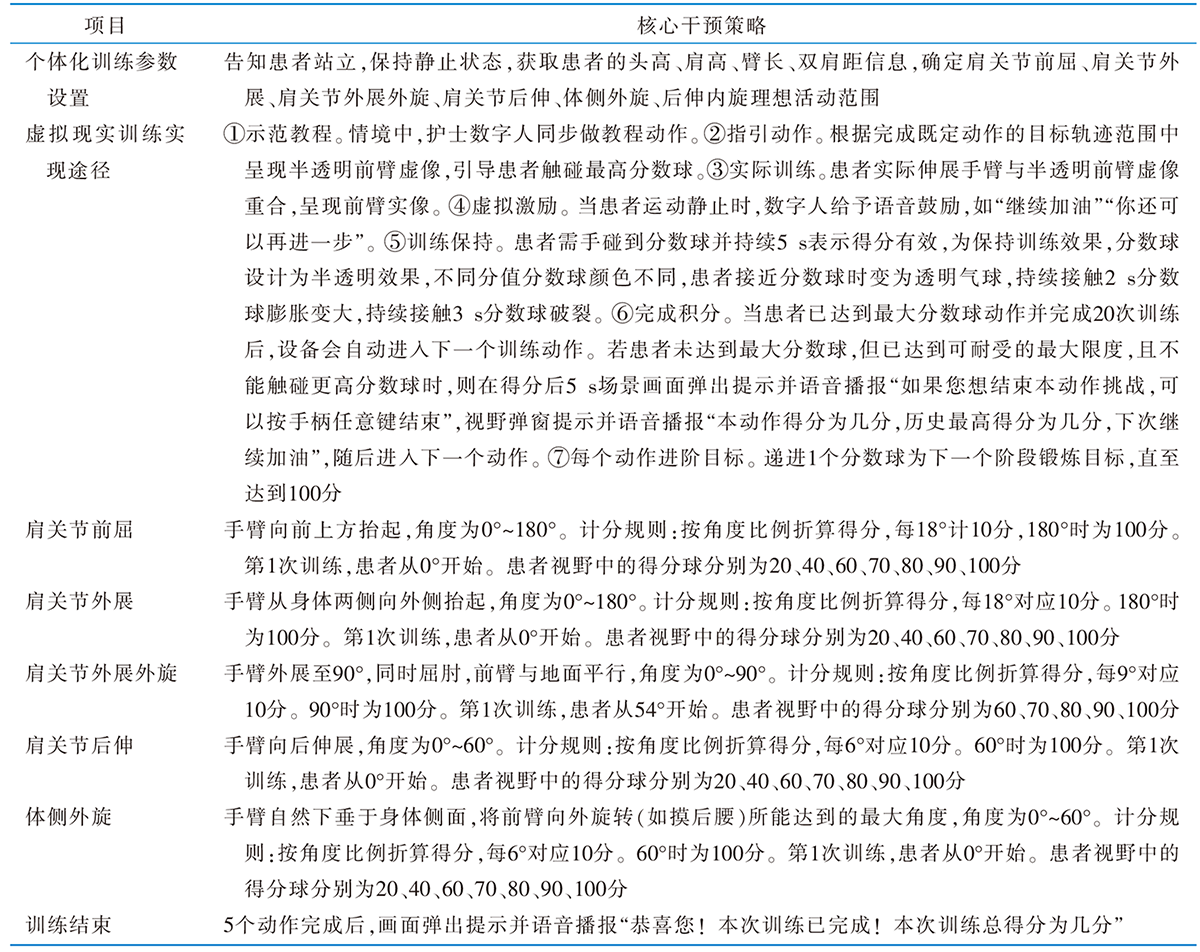 |
表1 基于虚拟现实的肩关节康复训练方案
Table 1 Virtual reality-based shoulder rehabilitation training program
| |
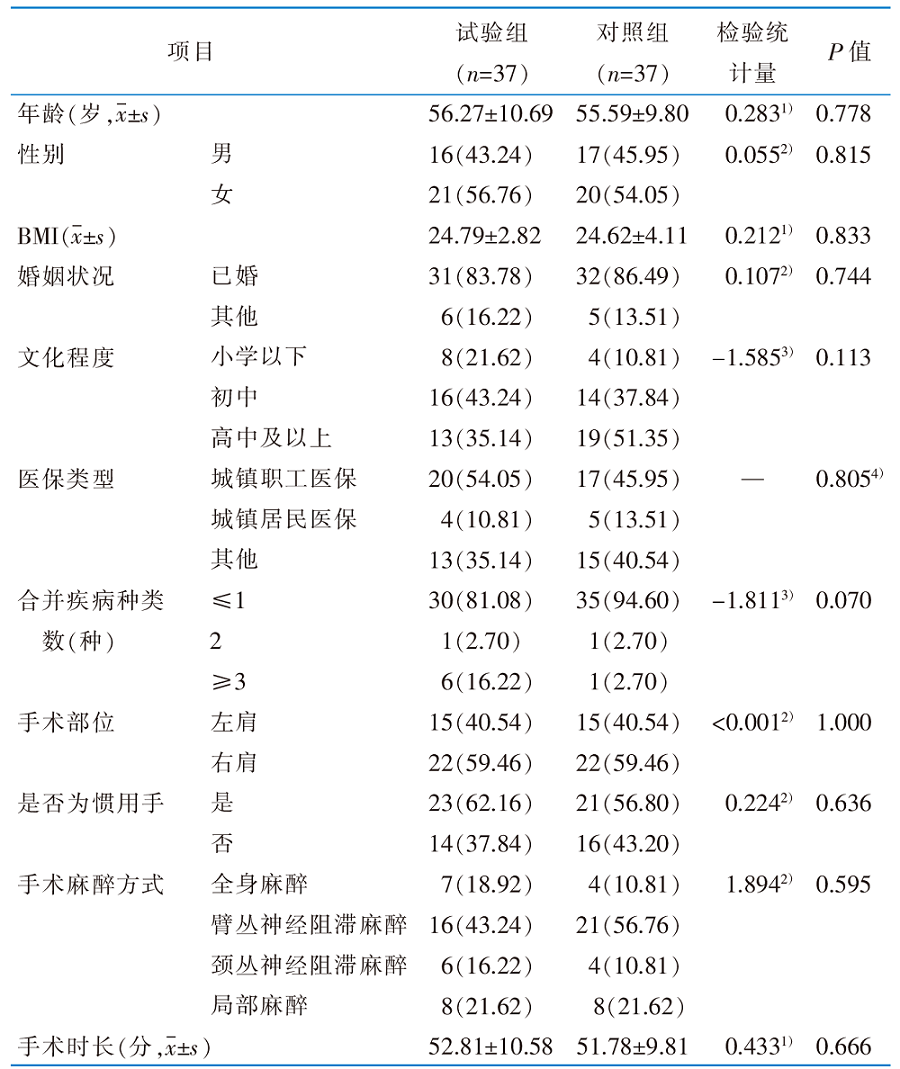 |
表2 两组一般资料比较
Table 2 Baseline characteristics of the 2 groups
| |
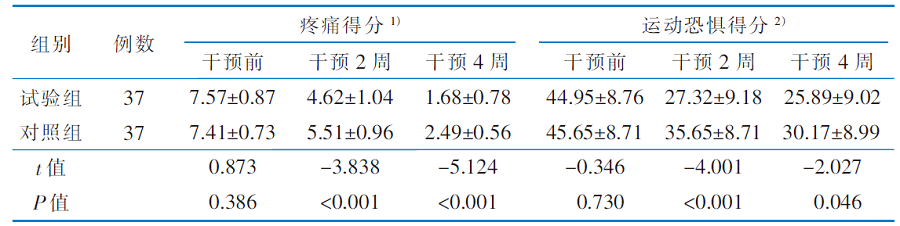 |
表3 两组干预前后疼痛得分及运动恐惧得分的比较(分,$\overline{x}\pm s$)
Table 3 Comparison of pain scores and kinesiophobia scores between the 2 groups before and after the intervention(score,$\overline{x}\pm s$)
| |
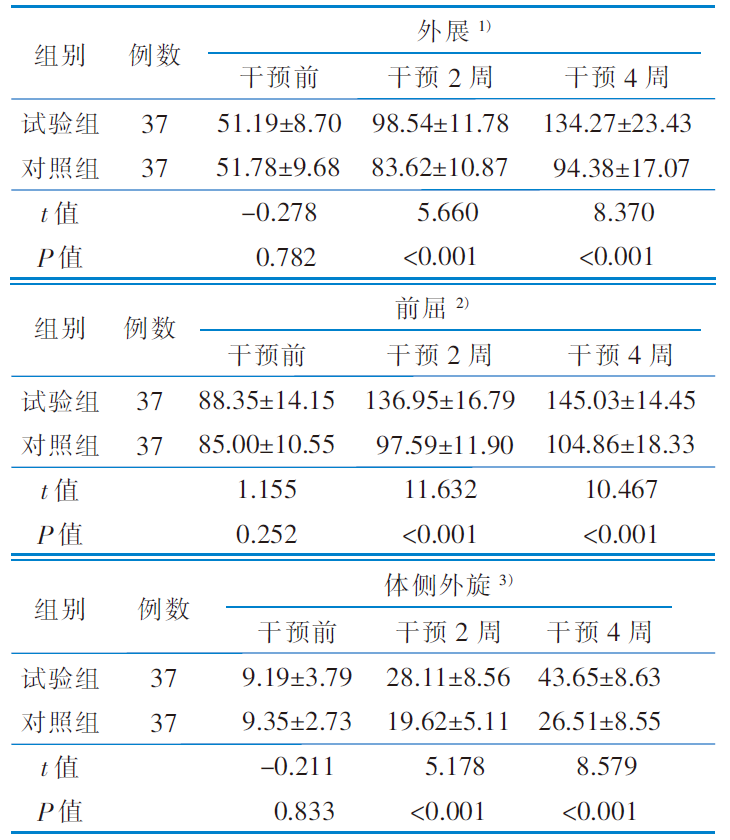 |
表4 两组干预前后肩关节活动度的比较(°,$\overline{x}\pm s$)
Table 4 Comparison of shoulder range of motion before and after intervention between the 2 groups(°,$\overline{x}\pm s$)
| |
| [1] | 董珉光, 王丽娜, 彭欣, 等. 超声引导下脉冲射频联合富血小板血浆注射治疗粘连性肩关节囊炎的长期疗效观察[J]. 中国疼痛医学杂志, 2024, 30(4):309-315. |
| Dong MG, Wang LN, Peng X, et al. Long-term effect of ultrasound-guided pulsed radio frequency combined with platelet-rich plasma injection on adhesive shoulder bursitis[J]. Chin J Pain Med, 2024, 30(4):309-315. | |
| [2] |
Leafblad N, Mizels J, Tashjian R, et al. Adhesive capsulitis[J]. Phys Med Rehabil Clin N Am, 2023, 34(2):453-468.
DOI PMID |
| [3] |
Chen MH, Chen WS. A narrative review of adhesive capsulitis with diabetes[J]. J Clin Med, 2024, 13(19):5696.
DOI URL |
| [4] |
Redler LH, Dennis ER. Treatment of adhesive capsulitis of the shoulder[J]. J Am Acad Orthop Surg, 2019, 27(12):e544-e554.
DOI |
| [5] |
Galasso O, Mercurio M, Luciano F, et al. Arthroscopic capsular release for frozen shoulder:when etiology matters[J]. Knee Surg Sports Traumatol Arthrosc, 2023, 31(11):5248-5254.
DOI URL |
| [6] | 黄家兴, 朱思政, 赵辰, 等. 关节镜下360°关节囊松解治疗冻结肩的疗效观察[J]. 中国修复重建外科杂志, 2021, 35(9):1141-1146. |
| Huang JX, Zhu SZ, Zhao C, et al. Effectiveness of arthroscopic 360° capsular release for frozen shoulder[J]. Chin J Reparative Reconstr Surg, 2021, 35(9):1141-1146. | |
| [7] |
Wei W, Tang HT, Luo Y, et al. Efficacy of virtual reality exercise in knee osteoarthritis rehabilitation:a systematic review and meta-analysis[J]. Front Physiol, 2024, 15:1424815.
DOI URL |
| [8] | 杨森林, 万权. 超声引导下多次肩袖间隙糖皮质激素注射治疗疼痛期粘连性肩关节囊炎的短期疗效[J]. 中国疼痛医学杂志, 2022, 28(5):379-383. |
| Yang SL, Wan Q. Short-term effect of ultrasound-guided multiple injections of glucocorticoid into rotator cuff space on adhesive shoulder bursitis in pain stage[J]. Chin J Pain Med, 2022, 28(5):379-383. | |
| [9] |
李丽, 曹英娟, 翟永华, 等. 机器人辅助手术多维协同护理管理方案的构建及应用研究[J]. 中华护理杂志, 2026, 61(12):1688-1694.
DOI |
| Li L, Cao YJ, Zhai YH, et al. Research on the construction and application of a multi-dimensional collaborative manage-ment plan for robotic surgery[J]. Chin J Nurs, 2026, 61(12):1688-1694. | |
| [10] |
Özlü A, Üstündağ S, Bulut Özkaya D, et al. Effect of exerga-me on pain,function,and quality of life in shoulder impinge-ment syndrome:a prospective randomized controlled study[J]. Games Health J, 2024, 13(2):109-119.
DOI URL |
| [11] | 孟静, 宋锋, 徐迈, 等. 一种基于虚拟现实技术的骨关节运动康复训练方法及装置:CN118718376A[P]. 2024-10-01. |
| Meng J, Song F, Xu M, et al. A bone and joint motion rehabilitation training method and device based on virtual reality technology:CN118718376A[P]. 2024-10-01. | |
| [12] |
金央, 冯莺, 徐秀玲, 等. 基于调周理论的火龙灸对痛经患者的中医护理效果研究[J]. 中华护理杂志, 2023, 58(17):2082-2087.
DOI |
|
Jin Y, Feng Y, Xu XL, et al. Study on the effect of Fire Dragon moxibustion on dysmenorrhea based on the theory of regulating menstrual cycle[J]. Chin J Nurs, 2023, 58(17):2082-2087.
DOI |
|
| [13] |
Kori SH, Miller RP, Todd DD. Kinesiophobia:a new view of chronic pain behavior[J]. Pain Manag, 1990, 3:35-43.
DOI URL |
| [14] | 胡文. 简体中文版TSK和FABQ量表的文化调适及其在退行性腰腿痛中的应用研究[D]. 上海: 第二军医大学, 2012. |
| Hu W. Cross-cultural adaptation of simplified Chinese version of TSK/FABQ,and its clinical application in the assessment of fear avoidance for patients with low back pain[D]. Shanghai: Second Military Medical University, 2012. | |
| [15] |
孙智祥, 傅静, 文苹频, 等. 学龄期哮喘患儿运动恐惧的研究进展及护理启示[J]. 中华护理杂志, 2025, 60(19):2419-2425.
DOI |
|
Sun ZX, Fu J, Wen PP, et al. Research progress on kinesiophobia in school-aged children with asthma and nursing enlightenment[J]. Chin J Nurs, 2025, 60(19):2419-2425.
DOI |
|
| [16] |
Kurashina W, Sasanuma H, Iijima Y, et al. Relationship between pain and range of motion in frozen shoulder[J]. JSES Int, 2023, 7(5):774-779.
DOI URL |
| [17] | 世界中医药学会联合会骨质疏松专业委员会, 上海中医药大学附属龙华医院, 中日友好医院, 等. 肩周炎中西医结合诊疗专家共识[J]. 世界中医药, 2023, 18(7):911-917. |
| Osteoporosis Professional Committee of the World Federation of Chinese Medicine Societies,Longhua Hospital Shanghai University of Traditional Chinese Medicine, China-Japan Friendship Hospital, et al. Expert consensus on the diagnosis and treatment of periarthritis of the shoulder with integrated traditional Chinese and Western Medicine[J]. World Chin Med, 2023, 18(7):911-917. | |
| [18] |
Billens A, van Oosterwijck S, Dhondt E, et al. The influence of expectations and attention on conditioned pain modulation:a systematic review and meta-analysis[J]. Clin Psychol Rev, 2024, 114:102517.
DOI URL |
| [19] | Hoffman HG, Garcia-Palacios A, Kapa V, et al. Immersive vir-tual reality for reducing experimental ischemic pain[J]. Int J Hum, 2003, 15(3):469-486. |
| [20] |
Lier EJ, Smits MLM, van Boekel RLM, et al. Virtual reality for postsurgical pain management:an explorative randomized con-trolled study[J]. Surgery, 2024, 176(3):818-825.
DOI URL |
| [21] |
Crowe SE, Yousefi M, Shahri B, et al. Interactions with virtual therapists during motor rehabilitation in immersive virtual environments:a systematic review[J]. Front Virtual Real, 2024, 5:1284696.
DOI URL |
| [22] | 陈婷, 朱月华, 李傲霜. 基于恐惧-回避模型的冠状动脉介入术后患者运动恐惧的混合方法研究[J]. 中国老年保健医学, 2025, 23(6):74-78. |
| Chen T, Zhu YH, Li AS. A mixed-methods study of kinesiophobia in patients after coronary intervention based on the fear-avoidance model[J]. Chin J Geriatr Care, 2025, 23(6):74-78. | |
| [23] |
Luque-Suarez A, Martinez-Calderon J, Navarro-Ledesma S, et al. Kinesiophobia is associated with pain intensity and disability in chronic shoulder pain:a cross-sectional study[J]. J Manipulative Physiol Ther, 2020, 43(8):791-798.
DOI URL |
| [24] | 杨铎, 程国杰, 唐文献. 运动疗法治疗冻结肩的临床进展[J]. 新疆中医药, 2023, 41(6):133-136. |
| Yang D, Cheng GJ, Tang WX. Clinical progress of exercise therapy in the treatment of frozen shoulder[J]. Xinjiang J Tradit Chin Med, 2023, 41(6):133-136. | |
| [25] |
陆斐, 王文霞, 支小燕, 等. 虚拟现实技术在肩关节功能障碍患者康复中应用的范围综述[J]. 中华护理杂志, 2025, 60(24):2971-2978.
DOI |
| Lu F, Wang WX, Zhi XY, et al. Application of virtual reality in rehabilitation training for shoulder function:a scoping review[J]. Chin J Nurs, 2025, 60(24):2971-2978. |
| [1] | 中华护理学会静脉输液治疗专业委员会, 北京护理学会, (执笔:李佳, 李旭英, 覃惠英, 陈利芬, 吴珍明, 胡泽吟, 罗梦娜, 范育英, 吴嘉慧, 林宇萍, 王蕾, 孙文彦, 冯毕龙, 高伟, 李亚南, 侯罗娅, 李春燕. 中心静脉通路装置拔除护理专家共识[J]. 中华护理杂志, 2026, 61(9): 1157-1162. |
| [2] | 周霞, 马艳艳, 师正坤, 于海霞, 周艳, 胡红玲, 李莜, 陈思思, 张京慧. 隧道式经股静脉PICC置入术在困难静脉通路婴幼儿中的应用研究[J]. 中华护理杂志, 2026, 61(9): 1163-1170. |
| [3] | 黄萍, 李黎, 郭骊莉, 徐莹, 叶赟, 江淑芳. 与无针输液接头相关的导管相关性血流感染风险评估工具的构建与初步应用[J]. 中华护理杂志, 2026, 61(9): 1171-1179. |
| [4] | 李佳, 张玉玲, 邢乐, 张利峰, 牛秀峰, 许莉. 早产儿经上肢置入PICC尖端继发性异位风险预测模型的建立与验证[J]. 中华护理杂志, 2026, 61(9): 1180-1186. |
| [5] | 何娟, 赵蕾蕾, 叶冠军, 余艳芬, 傅晓君, 周琴. 1例双侧无名静脉及上腔静脉人工血管置换术后患者经上肢置入PICC的护理[J]. 中华护理杂志, 2026, 61(9): 1187-1191. |
| [6] | 梁江淑渊, 曾妃, 何鹏, 谢梦珊, 江悦, 蒋宗恒, 王建茗. 静脉-静脉体外膜肺氧合患者早期活动风险等级评估系统的构建及应用研究[J]. 中华护理杂志, 2026, 61(9): 1192-1199. |
| [7] | 陈晨, 顾肖, 郭凡, 王敏, 倪兴梅, 黄琴, 程念开. 3种衰弱评估工具对急诊老年创伤患者不良结局的预测价值[J]. 中华护理杂志, 2026, 61(9): 1200-1207. |
| [8] | 郑煜琳, 刘晋宁, 张静, 郭会敏, 谷艳梅, 张莉莉. 酒精性肝病患者肝移植术后再饮酒现状及其影响因素分析[J]. 中华护理杂志, 2026, 61(9): 1208-1214. |
| [9] | 叶俊霜, 沈丽佳, 孟霞靓, 张玉姣, 蔡根莲, 邵碧云, 周亚辉, 张柳倩, 应金萍. 维持性血液透析患者对口腔衰弱认知和体验的质性研究[J]. 中华护理杂志, 2026, 61(9): 1215-1220. |
| [10] | 王芸姣, 杨玉金, 郑春艳, 彭菲津, 王淑贞, 蒋喜露, 周为民, 王薇, 张娜. 糖尿病下肢动脉硬化闭塞症患者介入术后康复护理方案的构建及应用研究[J]. 中华护理杂志, 2026, 61(9): 1221-1229. |
| [11] | 杨明霞, 安冉, 臧金凤, 李春梅. 老年慢性病共病患者及照护者老老照护能力与自我忽视的相关性分析[J]. 中华护理杂志, 2026, 61(9): 1230-1236. |
| [12] | 梁和静, 许鹊, 史云霞, 祖金美, 黄文静, 杨春旭, 郭明华, 王磊. 颈动脉内膜剥脱术围手术期护理质量评价指标的构建[J]. 中华护理杂志, 2026, 61(9): 1237-1244. |
| [13] | 韩媛媛, 石玉竹, 尚文涵, 么莉. 870所三级甲等医院老年住院患者跌倒伤害发生现状与影响因素分析[J]. 中华护理杂志, 2026, 61(9): 1245-1252. |
| [14] | 夏云芳, 王洪, 崔岱, 付真真, 朱敏. 1例弥漫性毒性甲状腺肿合并超敏反应综合征青少年患者的护理[J]. 中华护理杂志, 2026, 61(9): 1253-1256. |
| [15] | 周益飞, 王海苹, 胡益环, 应莉, 罗松娜. 1例氢氟酸中毒并发呼吸心搏骤停患者的急救护理[J]. 中华护理杂志, 2026, 61(9): 1257-1260. |
| 阅读次数 | ||||||
|
全文 |
|
|||||
|
摘要 |
|
|||||
