

中华护理杂志 ›› 2026, Vol. 61 ›› Issue (10): 1362-1370.DOI: 10.3761/j.issn.0254-1769.2026.10.009
王衍蝶( ), 曾妃(), 梁江淑渊, 顾培培, 谢梦珊, 郝芳芳
收稿日期:2025-07-08
出版日期:2026-05-20
发布日期:2026-05-09
*通讯作者:
曾妃,E-mail:zengfei@zju.edu.cn作者简介:王衍蝶:女,本科(硕士在读),E-mail:22318918@zju.edu.cn王衍蝶:设计与实施研究、整理与分析数据、撰写与修改论文;曾妃:设计与指导研究、提供基金支持、技术支持;梁江淑渊、顾培培:设计研究、技术指导;谢梦珊、郝芳芳:实施研究、收集数据
基金资助:
WANG Yandie(), ZENG Fei(), LIANG Jiangshuyuan, GU Peipei, XIE Mengshan, HAO Fangfang
Received:2025-07-08
Online:2026-05-20
Published:2026-05-09
* Corresponding author:
ZENG Fei,E-mail:zengfei@zju.edu.cnFunding program:摘要:
目的 基于健康行为过程取向理论构建肺移植患者骨代谢异常干预方案并进行初步验证,旨在提升患者骨骼健康状态,为临床护理实践提供参考。方法 以健康行为过程取向理论为指导,在文献回顾基础上,通过专家会议修订,构建肺移植患者骨代谢异常干预方案。采用便利抽样法,选取浙江省某三级甲等综合医院等待肺移植术的患者作为研究对象,其中,2024年7—11月的患者为试验组(n=41),2023年10月至2024年2月的患者为对照组(n=38)。试验组在常规护理的基础上实施骨代谢异常干预方案,对照组给予常规护理。干预周期涵盖移植等待期及术后6个月随访期。比较术前、术后3个月、术后6个月两组肺功能指标、6 min步行距离和骨密度的变化情况,以及两组不良事件发生率的差异。结果 试验组脱落5例,最终纳入36例,对照组脱落4例,最终纳入34例。术后3、6个月,试验组的肺功能指标、6 min步行距离均优于对照组(P<0.05);术后6个月试验组的左侧髋关节骨密度高于对照组(P<0.05)。干预过程中,两组均未出现不良事件。结论 实施基于健康行为过程取向理论的肺移植患者骨代谢异常干预方案对提升患者肺功能、运动能力效果显著,对改善骨骼健康方面也具有一定优势。
王衍蝶, 曾妃, 梁江淑渊, 顾培培, 谢梦珊, 郝芳芳. 肺移植患者骨代谢异常干预方案的构建及应用研究[J]. 中华护理杂志, 2026, 61(10): 1362-1370.
WANG Yandie, ZENG Fei, LIANG Jiangshuyuan, GU Peipei, XIE Mengshan, HAO Fangfang. Construction and application of an intervention program for bone metabolism abnormalities in lung transplant recipients[J]. Chinese Journal of Nursing, 2026, 61(10): 1362-1370.
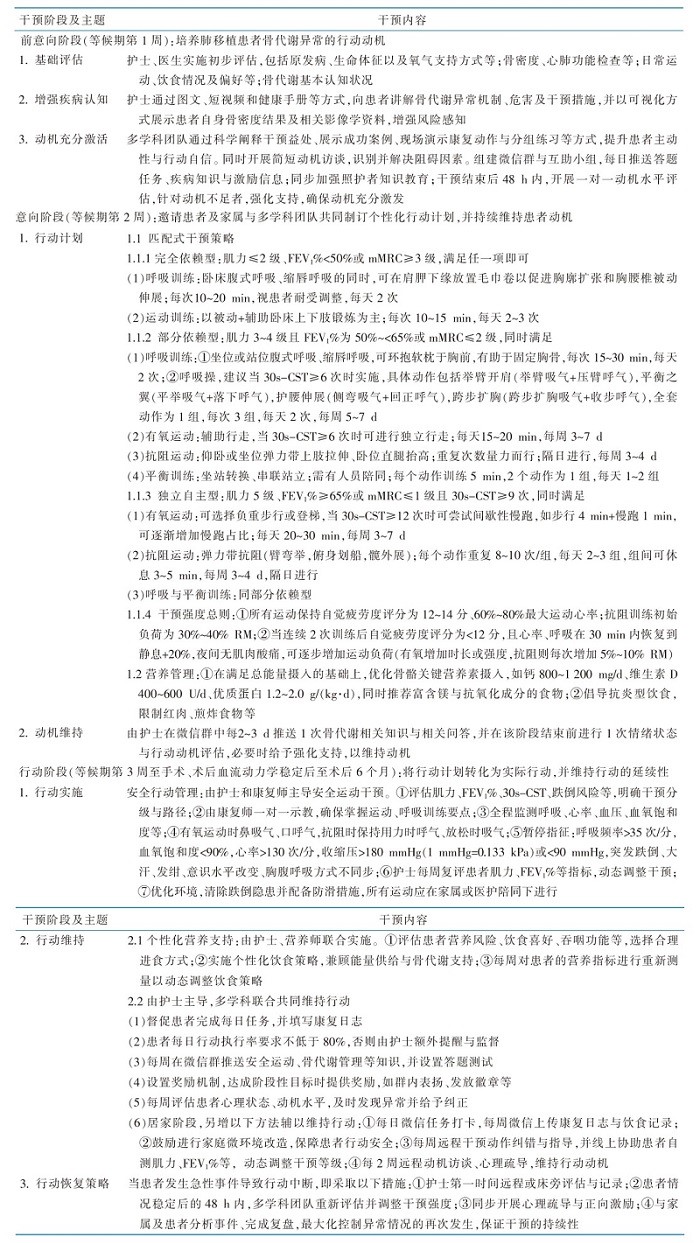 |
表1 肺移植患者骨代谢异常干预方案
Table 1 An intervention program for bone metabolism disorders in lung transplant recipients
| |
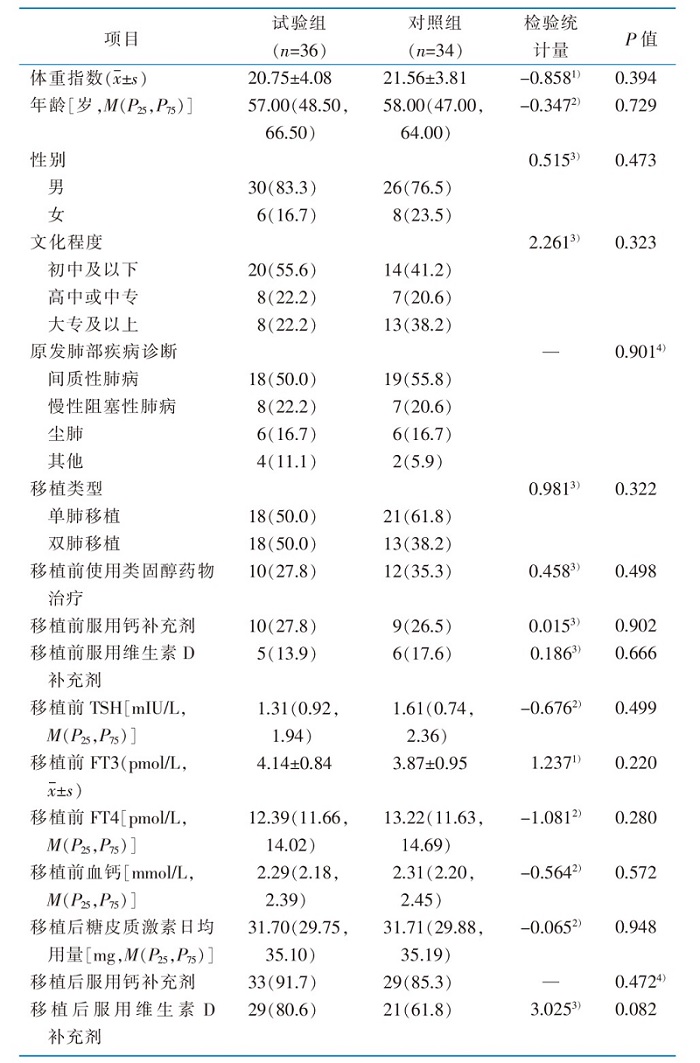 |
表2 两组一般资料的比较
Table 2 Comparison of general data between the 2 groups
| |
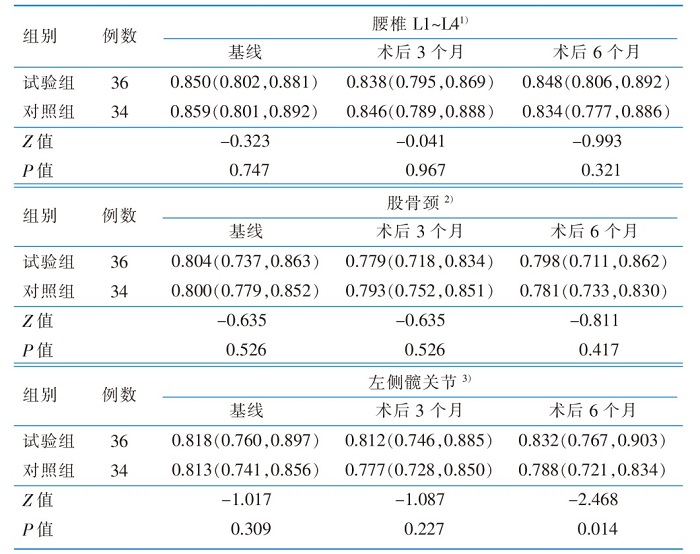 |
表3 两组患者骨密度的比较[g/cm2,M(P25,P75)]
Table 3 Comparison of bone mineral density between the 2 groups [g/cm2,M(P25,P75)]
| |
 |
表4 两组患者骨骼状态的比较[例(百分比,%)]
Table 4 Comparison of bone status between the 2 groups[cases(percentage,%)]
| |
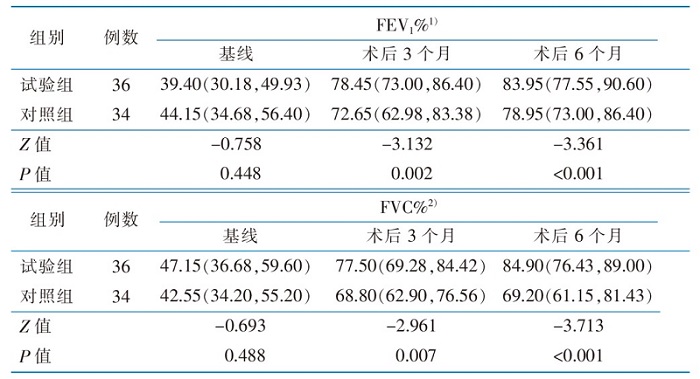 |
表5 两组肺功能指标的比较[%,M(P25,P75)]
Table 5 Comparison of pulmonary function between the 2 groups[%,M(P25,P75)]
| |
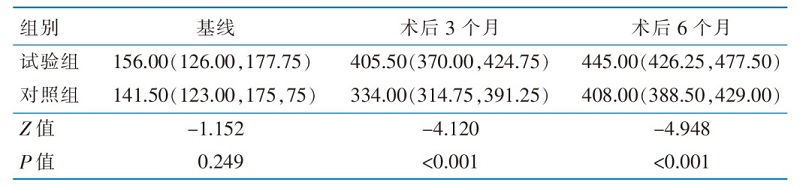 |
表6 两组6 min步行距离的比较[m,M(P25,P75)]
Table 6 Comparison of 6-minute walk distance between the 2 groups[m,M(P25,P75)]
| |
| [1] |
Adegunsoye A, Strek ME, Garrity E, et al. Comprehensive care of the lung transplant patient[J]. Chest, 2017, 152 (1):150-164.
DOI PMID |
| [2] |
MacRae TA, Lazo J, Viduya J, et al. Frailty and genetic risk predict fracture after lung transplantation[J]. Am J Transplant, 2023, 23(2):214-222.
DOI PMID |
| [3] | Mori R, Handa T, Ohsumi A, et al. Evaluation of bone mineral density in lung transplant recipients by chest computed tomography[J]. Re-spiration, 2024, 103(1):1-9. |
| [4] |
Grassi G, Chiodini I, Cairoli E, et al. Impact of bone-active drugs and underlying disease on bone health after lung transplantation:a longi-tudinal study[J]. J Cyst Fibros, 2021, 20(6):e100-e107.
DOI URL |
| [5] |
Grassi G, Cairoli E, Gentile LMS, et al. Bone disease in long-term lung transplant survivors[J]. Life, 2023, 13(4):928.
DOI URL |
| [6] |
Spira A, Gutierrez C, Chaparro C, et al. Osteoporosis and lung transplantation:a prospective study[J]. Chest, 2000, 117(2):476-481.
PMID |
| [7] |
Rzepka AM, Tile L, Chow CW, et al. Lung transplantation and bone health:a narrative review[J]. J Heart Lung Transplant, 2025, 44(6):849-857.
DOI URL |
| [8] | Ferreira SV, Gardy S, Churchward-Venne TA, et al. Effects of endurance exercise and dietary protein intake on osteokine,bone turnover,and inflammatory markers in endurance run-ners:a narrative review[J]. Bone Rep, 2025, 25:101850. |
| [9] |
Hume E, Ward L, Wilkinson M, et al. Exercise training for lung transplant candidates and recipients:a systematic review[J]. Eur Respir Rev, 2020, 29(158):200053.
DOI URL |
| [10] |
Meng Y, Zhu T, Chen W, et al. Understanding physical exer-cise among individuals with substance use disorders using an integrated theoretical perspective of the health action process approach and theory of planned behavior[J]. Front Psychol, 2024, 15:1377430.
DOI URL |
| [11] | 宋江浩, 许丽, 陈召, 等. 基于健康行动过程取向理论的分阶段康复运动对老年肩袖损伤患者疼痛程度及功能恢复的影响[J]. 中国老年学杂志, 2025, 45(3):733-737. |
| Song JH, Xu L, Chen Z, et al. Effect of staged rehabilitation exercise based on the health action process approach theory on pain and functional recovery in elderly patients with rotator cuff injury[J]. Chin J Gerontol, 2025, 45(3):733-737. | |
| [12] | 耿文垚. HAPA理论和助推策略结合的妊娠糖尿病患者饮食管理的方案构建及应用[D]. 青岛: 青岛大学, 2023. |
| Geng WY. Construction and application of diet management scheme for gestational diabetesmellitus patients combined with HAPA theory and boosting strategy[D]. Qingdao: Qingdao University, 2023. | |
| [13] | Clark H, Bassett S. An application of the health action pro-cess approach to physiotherapy rehabilitation adherence[J]. Phy-siother Theory Pract, 2014, 30(8):527-533. |
| [14] |
戚少丹, 朱婷, 沈伟杰, 等. 危重症患儿非药物睡眠管理措施的最佳证据总结[J]. 中华护理杂志, 2023, 58(24):3037-3044.
DOI |
|
Qi SD, Zhu T, Shen WJ, et al. Evidence summary of non-pharmacological sleep management measures in critically ill children[J]. Chin J Nurs, 2023, 58(24):3037-3044.
DOI |
|
| [15] |
Muschitz C, Zwick RH, Haschka J, et al. Osteoporosis in pneu-mological diseases:Joint guideline of the Austrian Society for Bone and Mineral Research(ÖGKM) and the Austrian Society for Pneumology(ÖGP)[J]. Wien Klin Wochenschr, 2021, 133(Suppl 4):155-173.
DOI |
| [16] |
Bar M, Ott SM, Michael Lewiecki E, et al. Bone health mana-gement after hematopoietic cell transplantation:an expert panel opinion from the American society for transplantation and cellular therapy[J]. Biol Blood Marrow Transplant, 2020, 26(10):1784-1802.
DOI URL |
| [17] |
Shah P, Lowery E, Chaparro C, et al. Cystic fibrosis foundation consensus statements for the care of cystic fibrosis lung tran-splant recipients[J]. J Heart Lung Transplant, 2021, 40(7):539-556.
DOI URL |
| [18] |
Laurent MR, Goemaere S, Verroken C, et al. Prevention and treatment of glucocorticoid-induced osteoporosis in adults:consensus recommendations from the Belgian bone club[J]. Front Endocrinol, 2022, 13:908727.
DOI URL |
| [19] |
Ulvestad M, Godang K, Durheim MT, et al. Effect of high-in-tensity training on bone health and body composition in lung transplant recipients:a secondary analysis of a randomized controlled trial[J]. Clin Transplant, 2021, 35(8):e14375.
DOI URL |
| [20] |
Luan X, Tian XY, Zhang HX, et al. Exercise as a prescription for patients with various diseases[J]. J Sport Health Sci, 2019, 8(5):422-441.
DOI PMID |
| [21] |
Fuller LM, Button B, Tarrant B, et al. Longer versus shorter duration of supervised rehabilitation after lung transplanta-tion:arandomized trial[J]. Arch Phys Med Rehabil, 2017, 98(2):220-226.
DOI URL |
| [22] |
Gregson CL, Armstrong DJ, Bowden J, et al. UK clinical gui-deline for the prevention and treatment of osteoporosis[J]. Arch Osteoporos, 2022, 17(1):58.
DOI PMID |
| [23] | 赵薇, 徐晓敏, 万霞, 等. 提升造血干细胞移植成年病人骨健康的最佳证据总结[J]. 循证护理, 2022, 8(17):2307-2311. |
| Zhao W, Xu XM, Wan X, et al. Evidence summary of promo-tion of bone health for adult patients underwent hematopoie-tic stem cell transplantation[J]. Chin Evid Based Nurs, 2022, 8(17):2307-2311. | |
| [24] | Gutierrez-Arias R, Martinez-Zapata MJ, Gaete-Mahn MC, et al. Exercise training for adult lung transplant recipients[J]. Coch-rane Database Syst Rev, 2021, 7(7):CD012307. |
| [25] | 《中国老年骨质疏松症诊疗指南(2023)》工作组, 中国老年学和老年医学学会骨质疏松分会, 中国医疗保健国际交流促进会骨质疏松病学分会, 等. 中国老年骨质疏松症诊疗指南(2023)[J]. 中华骨与关节外科杂志, 2023, 16(10):865-885. |
| Working Group of Chinese Guidelines for the Diagnosis and Treatment of Senile Osteoporosis(2023), Osteoporosis Branch,Chinese Gerontological Society,Osteoporosis Branch, China In-ternational Exchange and Promotive Association for Medical and Health Care, et al. Chinese guidelines for the diagnosis and treatment of senile osteoporosis(2023)[J]. Chin J Bone Joint Surg,2023, 16(10):865-885. | |
| [26] |
曾妃, 兰美娟, 梁江淑渊, 等. 25例肺移植患者术前预康复的护理[J]. 中华护理杂志, 2022, 57(17):2080-2084.
DOI |
| Zeng F, Lan MJ, Liang JSY, et al. Nursing care for preope-rative rehabilitation in 25 patients with lung transplantation[J]. Chin J Nurs, 2022, 57(17):2080-2084. | |
| [27] |
Griffith JF, Engelke K, Genant HK. Looking beyond bone mi-neral density:imaging assessment of bone quality[J]. Ann NY Acad Sci, 2010, 1192:45-56.
DOI PMID |
| [28] |
ATS Committee on Proficiency Standards for Clinical Pulmo-nary Function Laboratories. ATS statement:guidelines for the six-minute walk test[J]. Am J Respir Crit Care Med, 2002, 166(1):111-117.
DOI URL |
| [29] |
Daly RM, Dalla Via J, Duckham RL, et al. Exercise for the pre-vention of osteoporosis in postmenopausal women:an evi-dence-based guide to the optimal prescription[J]. Braz J Phys Ther, 2019, 23(2):170-180.
DOI URL |
| [30] | 赵赛赛. 膳食炎症指数与骨质密度和骨质疏松症的关联研究:基于美国NHANES数据库[D]. 长春: 吉林大学, 2023. |
| Zhao SS. Study on the association of dietary inflammation index with bone density and osteoporosis:based on NHANES database in America[D]. Changchun: Jilin University, 2023. | |
| [31] |
Kistler-Fischbacher M, Weeks BK, Beck BR. The effect of exer-cise intensity on bone in postmenopausal women(part 2):a meta-analysis[J]. Bone, 2021, 143:115697.
DOI URL |
| [32] |
宗小燕, 朱灵智, 王雪菲, 等. 居家运动方案在老年骨质疏松合并衰弱患者中的应用研究[J]. 中华护理杂志, 2024, 59(10):1171-1179.
DOI |
|
Zong XY, Zhu LZ, Wang XF, et al. Application of a home-based exercise program in elderly patients with osteoporosis and frailty[J]. Chin J Nurs, 2024, 59(10):1171-1179.
DOI |
|
| [33] | 冯梦月. 吸气肌训练对肺移植患者肺功能、膈肌功能和运动能力的影响[D]. 南京: 南京体育学院, 2023. |
| Feng MY. Effects of inspiratory muscle training on lung function, diaphragm function and exercise ability of lung transplant patients[D]. Nanjing: Nanjing Sport Institute, 2023. | |
| [34] |
Hämäläinen OO, Savikangas TM, Tirkkonen AK, et al. Effects of 12-month physical and cognitive training on sarcopenia determinants in older adults:a subgroup analysis of a ran-domised clinical trial[J]. Aging Clin Exp Res, 2025, 37(1):36.
DOI PMID |
| [35] |
浙江省护理学会呼吸护理专业委员会. 肺移植患者术后肺康复护理专家共识[J]. 中华护理杂志, 2024, 59(1):10-15.
DOI |
| Respiratory Nursing Committee of Zhejiang Nursing Associa-tion. Expert consensus on postoperative pulmonary rehabilita-tion nursing for lung transplant patients[J]. Chin J Nurs, 2024, 59(1):10-15. |
| [1] | 中华护理学会静脉输液治疗专业委员会, 北京护理学会, (执笔:李佳, 李旭英, 覃惠英, 陈利芬, 吴珍明, 胡泽吟, 罗梦娜, 范育英, 吴嘉慧, 林宇萍, 王蕾, 孙文彦, 冯毕龙, 高伟, 李亚南, 侯罗娅, 李春燕. 中心静脉通路装置拔除护理专家共识[J]. 中华护理杂志, 2026, 61(9): 1157-1162. |
| [2] | 周霞, 马艳艳, 师正坤, 于海霞, 周艳, 胡红玲, 李莜, 陈思思, 张京慧. 隧道式经股静脉PICC置入术在困难静脉通路婴幼儿中的应用研究[J]. 中华护理杂志, 2026, 61(9): 1163-1170. |
| [3] | 黄萍, 李黎, 郭骊莉, 徐莹, 叶赟, 江淑芳. 与无针输液接头相关的导管相关性血流感染风险评估工具的构建与初步应用[J]. 中华护理杂志, 2026, 61(9): 1171-1179. |
| [4] | 李佳, 张玉玲, 邢乐, 张利峰, 牛秀峰, 许莉. 早产儿经上肢置入PICC尖端继发性异位风险预测模型的建立与验证[J]. 中华护理杂志, 2026, 61(9): 1180-1186. |
| [5] | 何娟, 赵蕾蕾, 叶冠军, 余艳芬, 傅晓君, 周琴. 1例双侧无名静脉及上腔静脉人工血管置换术后患者经上肢置入PICC的护理[J]. 中华护理杂志, 2026, 61(9): 1187-1191. |
| [6] | 梁江淑渊, 曾妃, 何鹏, 谢梦珊, 江悦, 蒋宗恒, 王建茗. 静脉-静脉体外膜肺氧合患者早期活动风险等级评估系统的构建及应用研究[J]. 中华护理杂志, 2026, 61(9): 1192-1199. |
| [7] | 陈晨, 顾肖, 郭凡, 王敏, 倪兴梅, 黄琴, 程念开. 3种衰弱评估工具对急诊老年创伤患者不良结局的预测价值[J]. 中华护理杂志, 2026, 61(9): 1200-1207. |
| [8] | 郑煜琳, 刘晋宁, 张静, 郭会敏, 谷艳梅, 张莉莉. 酒精性肝病患者肝移植术后再饮酒现状及其影响因素分析[J]. 中华护理杂志, 2026, 61(9): 1208-1214. |
| [9] | 叶俊霜, 沈丽佳, 孟霞靓, 张玉姣, 蔡根莲, 邵碧云, 周亚辉, 张柳倩, 应金萍. 维持性血液透析患者对口腔衰弱认知和体验的质性研究[J]. 中华护理杂志, 2026, 61(9): 1215-1220. |
| [10] | 王芸姣, 杨玉金, 郑春艳, 彭菲津, 王淑贞, 蒋喜露, 周为民, 王薇, 张娜. 糖尿病下肢动脉硬化闭塞症患者介入术后康复护理方案的构建及应用研究[J]. 中华护理杂志, 2026, 61(9): 1221-1229. |
| [11] | 杨明霞, 安冉, 臧金凤, 李春梅. 老年慢性病共病患者及照护者老老照护能力与自我忽视的相关性分析[J]. 中华护理杂志, 2026, 61(9): 1230-1236. |
| [12] | 梁和静, 许鹊, 史云霞, 祖金美, 黄文静, 杨春旭, 郭明华, 王磊. 颈动脉内膜剥脱术围手术期护理质量评价指标的构建[J]. 中华护理杂志, 2026, 61(9): 1237-1244. |
| [13] | 韩媛媛, 石玉竹, 尚文涵, 么莉. 870所三级甲等医院老年住院患者跌倒伤害发生现状与影响因素分析[J]. 中华护理杂志, 2026, 61(9): 1245-1252. |
| [14] | 夏云芳, 王洪, 崔岱, 付真真, 朱敏. 1例弥漫性毒性甲状腺肿合并超敏反应综合征青少年患者的护理[J]. 中华护理杂志, 2026, 61(9): 1253-1256. |
| [15] | 周益飞, 王海苹, 胡益环, 应莉, 罗松娜. 1例氢氟酸中毒并发呼吸心搏骤停患者的急救护理[J]. 中华护理杂志, 2026, 61(9): 1257-1260. |
| 阅读次数 | ||||||
|
全文 |
|
|||||
|
摘要 |
|
|||||
