

中华护理杂志 ›› 2025, Vol. 60 ›› Issue (21): 2613-2619.DOI: 10.3761/j.issn.0254-1769.2025.21.008
吴瑞芝( ), 杜云红, 黄菊, 周佩夏, 陈小杰, 宋艳如, 王莉()
收稿日期:2025-05-13
出版日期:2025-11-10
发布日期:2025-11-05
通讯作者:
王莉,E-mail:wangli70@126.com作者简介:吴瑞芝:女,本科(硕士在读),护士,E-mail:19862206786@163.com
基金资助:
WU Ruizhi(), DU Yunhong, HUANG Ju, ZHOU Peixia, CHEN Xiaojie, SONG Yanru, WANG Li()
Received:2025-05-13
Online:2025-11-10
Published:2025-11-05
摘要:
目的 探究慢性阻塞性肺疾病患者运动恐惧的发生机制,为制订临床护理干预措施提供参考。 方法 运用目的抽样法和理论抽样法,选取2025年1—4月在青岛市某三级甲等医院呼吸内科住院和门诊就诊的15例存在运动恐惧的慢性阻塞性肺疾病患者进行半结构化访谈,并采用程序化扎根理论方法对资料进行分析。 结果 访谈总时长为427 min,转录文字共计7.8万余字。构建的慢性阻塞性肺疾病患者运动恐惧发生机制涵盖运动恐惧触发事件、非理性认知评估、恐惧情绪唤醒、不良应对模式、外显行为反应5个核心范畴。 结论 构建的慢性阻塞性肺疾病患者运动恐惧发生机制有助于指导医护人员识别多种运动恐惧触发事件,通过提升锻炼感知益处水平、缓解恐惧情绪以及减少回避行为,降低患者的运动恐惧程度。
吴瑞芝, 杜云红, 黄菊, 周佩夏, 陈小杰, 宋艳如, 王莉. 慢性阻塞性肺疾病患者运动恐惧的发生机制研究及护理对策[J]. 中华护理杂志, 2025, 60(21): 2613-2619.
WU Ruizhi, DU Yunhong, HUANG Ju, ZHOU Peixia, CHEN Xiaojie, SONG Yanru, WANG Li. Study on the mechanism of kinesiophobia in patients with chronic obstructive pulmonary disease and nursing countermeasures[J]. Chinese Journal of Nursing, 2025, 60(21): 2613-2619.
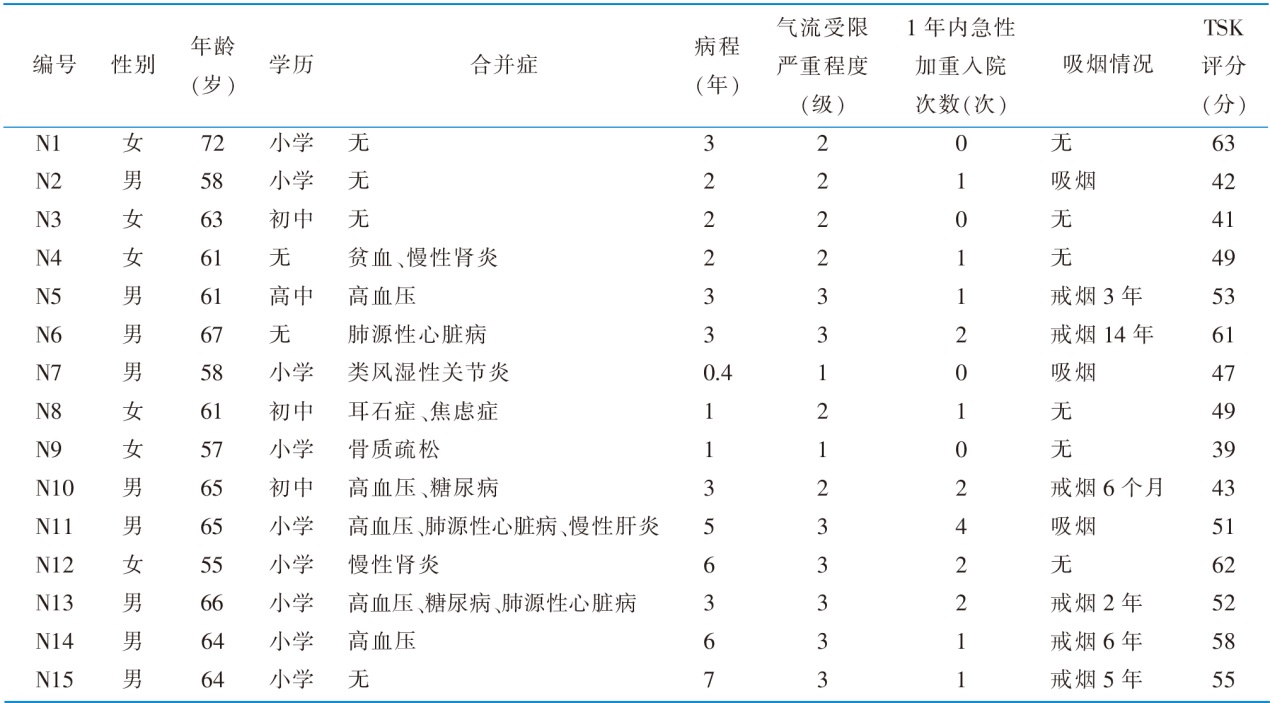 |
表1 研究对象的一般资料(n=15)
Table 1 General information of the study subjects(n=15)
| |
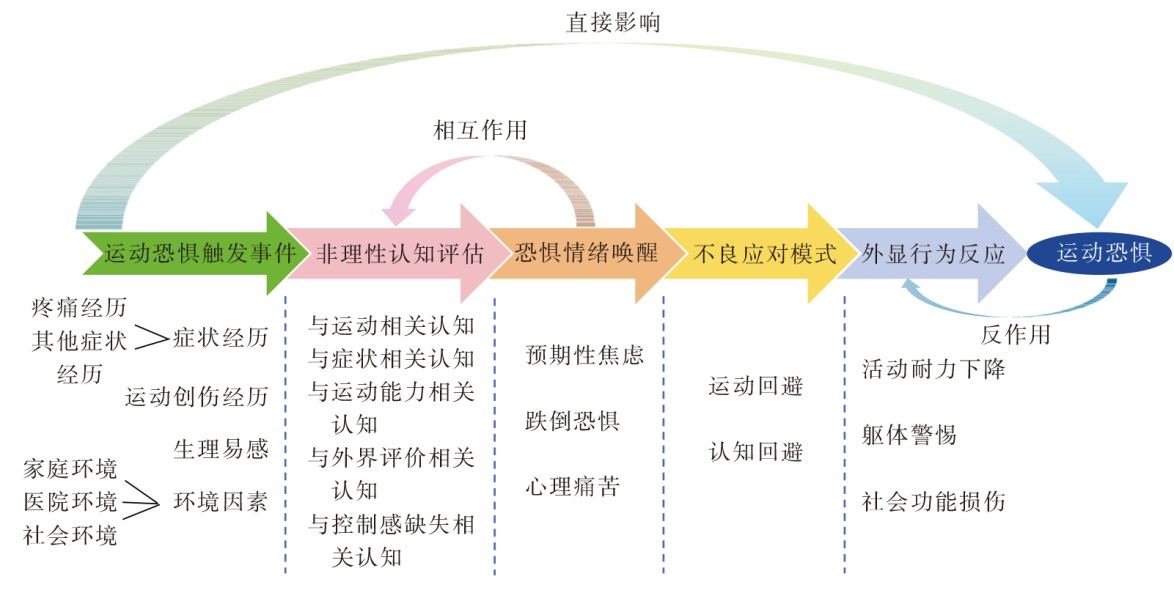
图1 慢阻肺患者运动恐惧发生机制模型
Figure 1 Mechanism model of kinesiophobia in COPD patients
| [1] | Li HY, Gao TY, Fang W, et al. Global,regional and national burden of chronic obstructive pulmonary disease over a 30-year period:estimates from the 1990 to 2019 global burden of disease study[J]. Respirology, 2023, 28(1):29-36. |
| [2] | Global Initiative for Chronic Obstructive Lung Disease. Global strategy for prevention,diagnosis and management of COPD:2025[EB/OL]. [2024-12-16]. https://goldcopd.org/2025-goldreport/. . |
| [3] | Cox M, O’Connor C, Biggs K, et al. The feasibility of early pulmonary rehabilitation and activity after COPD exacerbations:external pilot randomised controlled trial,qualitative case study and exploratory economic evaluation[J]. Health Technol Assess, 2018, 22(11):1-204. |
| [4] |
胡树菁, 孙菁, 王奕, 等. 肺移植受者居家肺康复锻炼促进与障碍因素的质性研究[J]. 中华护理杂志, 2024, 59(17):2070-2077.
DOI |
| Hu SJ, Sun J, Wang Y, et al. Facilitators and barriers of home pulmonary rehabilitation for lung transplant recipients:a qualitative study[J]. Chin J Nurs, 2024, 59(17):2070-2077. | |
| [5] |
王海珍, 周莉莉, 程鹏飞, 等. 经皮冠状动脉介入治疗术后患者恐动症预测模型的构建及验证[J]. 中华护理杂志, 2024, 59(17):2108-2115.
DOI |
|
Wang HZ, Zhou LL, Cheng PF, et al. Construction and validation of a predictive model for kinetophobia in patients after percutaneous coronary intervention[J]. Chin J Nurs, 2024, 59(17):2108-2115.
DOI |
|
| [6] |
Vardar-Yagli N, Calik-Kutukcu E, Saglam M, et al. The relationship between fear of movement,pain and fatigue severity,dyspnea level and comorbidities in patients with chronic obstructive pulmonary disease[J]. Disabil Rehabil, 2019, 41(18):2159-2163.
DOI PMID |
| [7] |
梁发存, 刘梦如, 尹艳茹, 等. 慢性阻塞性肺疾病患者运动恐惧的调查研究[J]. 中华护理杂志, 2023, 58(6):721-726.
DOI |
|
Liang FC, Liu MR, Yin YR, et al. Investigation on the development trajectories of exercise fear in patients with chronic obstructive pulmonary disease[J]. Chin J Nurs, 2023, 58(6):721-726.
DOI |
|
| [8] | Janssens T, Van de Moortel Z, Geidl W, et al. Impact of disease-specific fears on pulmonary rehabilitation trajectories in patients with COPD[J]. J Clin Med, 2019, 8(9):1460. |
| [9] | Vitacca M, Ambrosino N, Belli S, et al. The severity of acute exacerbations of COPD and the effectiveness of pulmonary rehabilitation[J]. Respir Med, 2021,184:106465. |
| [10] | Luque-Suarez A, Martinez-Calderon J, Falla D. Role of kinesiophobia on pain,disability and quality of life in people suffering from chronic musculoskeletal pain:a systematic review[J]. Br J Sports Med, 2019, 53(9):554-559. |
| [11] | Jia YY, Cui NQ, Jia TT, et al. Measurement properties of assessment tools of kinesophobia in patients with cardiovascular disease:a systematic review[J]. Int J Nurs Sci, 2024, 11(1):57-65. |
| [12] | Jordán-López J, Arguisuelas MD, Doménech J, et al. Visual feedback manipulation in virtual reality alters movement-evoked pain perception in chronic low back pain[J]. Sci Rep, 2025, 15(1):20372. |
| [13] | 刘超, 夏湘玉. 城市社区干部队伍“女性化”的生成机理研究:基于扎根理论的探索性分析[J]. 领导科学, 2025(4):145-153. |
| Liu C, Xia XY. Research on the generation mechanism of “feminization” of urban community cadres:exploratory analysis based on rooting theory[J]. Leadersh Sci, 2025(4):145-153. | |
| [14] | 中华医学会呼吸病学分会慢性阻塞性肺疾病学组, 中国医师协会呼吸医师分会慢性阻塞性肺疾病工作委员会. 慢性阻塞性肺疾病诊治指南(2021年修订版)[J]. 中华结核和呼吸杂志, 2021, 44(3):170-205. |
| Chronic Obstructive Pulmonary Disease Group of the Respi-ratory Medicine Branch of the Chinese Medical Association,Chronic Obstructive Pulmonary Disease Working Committee of the Respiratory Medicine Branch of the Chinese Medical Doctor Association. Guidelines for the diagnosis and management of chronic obstructive pulmonary disease(revised version 2021)[J]. Chin J Tuberc Respir Dis, 2021, 44(3):170-205. | |
| [15] | 胡文. 简体中文版TSK和FABQ量表的文化调适及其在退行性腰腿痛中的应用研究[D]. 上海: 第二军医大学, 2012. |
| Hu W. Cultural adjustment of simplified Chinese TSK and FABQ scale and its application in degenerative lumbago and leg pain[D]. Shanghai: Second Military Medical University, 2012. | |
| [16] |
刘皓昕, 黄丽丽, 崔晓花, 等. 孕妇静脉血栓栓塞风险感知模型的构建[J]. 中华护理杂志, 2024, 59(18):2229-2237.
DOI |
|
Liu HX, Huang LL, Cui XH, et al. Research on a model of risk perception of venous thromboembolism in pregnant women[J]. Chin J Nurs, 2024, 59(18):2229-2237.
DOI |
|
| [17] | 王子涵, 岳雯静, 张向毅, 等. 心脏康复患者运动恐惧形成与消退质性研究的Meta整合[J]. 中国护理管理, 2024, 24(5):725-730. |
| Wang ZH, Yue WJ, Zhang XY, et al. Formation and extinction of kinesiophobia in patients attending cardiac rehabilitation:a Meta-synthesis[J]. Chin Nurs Manag, 2024, 24(5):725-730. | |
| [18] | 何敏峰, 严素敏, 关露娟, 等. 恐动症在老年骨质疏松患者家庭功能与锻炼依从性间的中介效应[J]. 中国老年学杂志, 2024, 44(13):3310-3314. |
| He MF, Yan SM, Guan LJ, et al. Mediating effect of phobia between family function and exercise compliance in elderly patients with osteoporosis[J]. Chin J Gerontol, 2024, 44(13):3310-3314. | |
| [19] | 陈伟仙, 金晓红, 陈曦, 等. 老年全髋关节置换术后患者住院期间康复训练体验的质性研究[J]. 军事护理, 2024, 41(10):66-69. |
| Chen WX, Jin XH, Chen X, et al. Experience of hospitalization rehabilitation training among elderly patients after total hip arthroplasty:a qualitative study[J]. Mil Nurs, 2024, 41(10):66-69. | |
| [20] |
罗浩月, 李秋芳, 赵燕利, 等. 基于网络的心理干预对慢性腰背痛患者效果的Meta分析[J]. 中华护理杂志, 2023, 58(19):2409-2415.
DOI |
|
Luo HY, Li QF, Zhao YL, et al. A meta-analysis of the effect of web-based psychological intervention in patients with chronic low back pain[J]. Chin J Nurs, 2023, 58(19):2409-2415.
DOI |
|
| [21] |
Livermore N, Sharpe L, McKenzie D. Catastrophic interpretations and anxiety sensitivity as predictors of panic-spectrum psychopathology in chronic obstructive pulmonary disease[J]. J Psychosom Res, 2012, 72(5):388-92.
DOI PMID |
| [22] |
王子安, 刘欣, 张茜, 等. 经皮冠状动脉介入治疗术后患者恐动症水平变化轨迹研究[J]. 中华护理杂志, 2022, 57(9):1035-1041.
DOI |
| Wang ZA, Liu X, Zhang Q, et al. Longitudinal study of kinesiophobia trajectory in patients with acute myocardial infarction after percutaneous coronary intervention[J]. Chin J Nurs, 2022, 57(9):1035-1041. | |
| [23] | 李雯欣, 涂惠, 郭婷, 等. 经皮冠状动脉介入治疗术后恐动症患者早期运动康复方案的构建[J]. 中国护理管理, 2024, 24(12):1792-1797. |
| Li WX, Tu H, Guo T, et al. Construction of early exercise rehabilitation program for patients with kinesophobia after PCI[J]. Chin Nurs Manag, 2024, 24(12):1792-1797. | |
| [24] | Qin JW, Xiong JJ, Chen C, et al. Influencing factors of kinesiophobia in older patients with chronic heart failure:a structural equation model[J]. Clin Cardiol, 2023, 46(7):729-736. |
| [25] | 徐书琦, 万瑾凌, 王学义, 等. 虚拟现实暴露疗法治疗创伤后应激障碍的meta分析[J]. 中国心理卫生杂志, 2021, 35(9):745-750. |
| Xu SQ, Wan JL, Wang XY, et al. A meta-analysis of effectiveness of virtual reality exposure therapy in patients with post-traumatic stress disorder[J]. Chin Ment Health J, 2021, 35(9):745-750. | |
| [26] |
蔡冬青, 丁慧敏, 杨群, 等. 糖尿病周围神经病变患者运动恐惧轨迹的潜在类别及影响因素研究[J]. 中华护理杂志, 2025, 60(4):439-445.
DOI |
|
Cai DQ, Ding HM, Yang Q, et al. Analysis of latent classes and root cause of kinesiophobia in patients with diabetic peripheral neuropathy[J]. Chin J Nurs, 2025, 60(4):439-445.
DOI |
|
| [27] | Bottary R, Seo J, Daffre C, et al. Fear extinction memory is negatively associated with REM sleep in insomnia disorder[J]. Sleep, 2020, 43(7):zsaa007. |
| [1] | 曾妃, 兰美娟, 顾培培, 梁江淑渊, 王衍蝶, 蔡凌云. 儿童双肺移植术后肺康复护理方案的构建及初步验证[J]. 中华护理杂志, 2025, 60(9): 1029-1035. |
| [2] | 阎寅至, 闻芳, 王敏, 周雪梅, 马金玲, 吴惠芳, 姚文英. 造血干细胞移植患儿运动康复分级护理方案的构建与应用研究[J]. 中华护理杂志, 2025, 60(9): 1036-1042. |
| [3] | 刘曦璇, 刘玉琳, 刘莎, 杨帆, 谢晓虹, 王紫娟, 刘丽芳, 魏红雨. 学龄期支气管哮喘患儿呼吸康复操的研制及效果评价[J]. 中华护理杂志, 2025, 60(9): 1043-1049. |
| [4] | 黄盼盼, 李丽玲, 胡晓静. 先天性心脏病婴儿早期运动康复的研究进展[J]. 中华护理杂志, 2025, 60(9): 1050-1055. |
| [5] | 陈丽鸥, 张文婷, 刘俊其, 王允琮, 王振霖, 齐赛, 杨娜. 肺叶体表投影定位结合肺段引流排痰技术对吸入性肺炎患者气道廓清的效果研究[J]. 中华护理杂志, 2025, 60(9): 1056-1061. |
| [6] | 杨娜娜, 程传丽, 曾慧, 符丹丹, 王燕, 陈悦, 冉宏敏, 范红静, 龙霞. 分级运动康复对慢性阻塞性肺疾病急性加重期患者的效果评价[J]. 中华护理杂志, 2025, 60(9): 1062-1067. |
| [7] | 曹云, 孙国珍, 陈凤, 季学丽, 闫梦婉, 敬雷, 钱堃. 改良式踝泵运动在脑卒中患者中的应用研究[J]. 中华护理杂志, 2025, 60(9): 1068-1074. |
| [8] | 谢敏, 漆文凯, 殷玲, 张旋, 赵如琴. 腹膜透析患者恐动症潜在剖面分析及影响因素研究[J]. 中华护理杂志, 2025, 60(9): 1080-1086. |
| [9] | 陈冰倩, 赵彬, 孙佳蓉, 郝四芳, 侯晓丽. 慢性牙周炎种植义齿患者口腔健康管理困境的质性研究[J]. 中华护理杂志, 2025, 60(9): 1087-1092. |
| [10] | 秦春兰, 吴振云, 钱红英, 赵茜, 孙锦庭. 慢性阻塞性肺疾病患者疾病自我控制体验的质性研究[J]. 中华护理杂志, 2025, 60(9): 1093-1098. |
| [11] | 李子崴, 冯丽娟, 陈旭升, 黄毅, 杨洁. PICC置管患者运动恐惧评估量表的编制及应用[J]. 中华护理杂志, 2025, 60(9): 1099-1106. |
| [12] | 程志强, 张宝珍, 汤利萍, 李静, 夏娇云, 魏雪岩, 龚智娴, 张美珍, 黎露思. 尿失禁患者疾病认知与态度量表的汉化及初步应用[J]. 中华护理杂志, 2025, 60(9): 1107-1112. |
| [13] | 杨静, 王华芬, 卢芳燕, 鲍瑞洁, 朱莉. 肝移植患儿术后营养状况变化的影响因素分析及护理启示[J]. 中华护理杂志, 2025, 60(9): 1113-1119. |
| [14] | 石美琴, 吴建芳, 张铎, 吴春萍, 陈玲, 陶磊. 1例全喉切除辅助发音管Ⅰ期植入患者术后喉功能康复的护理[J]. 中华护理杂志, 2025, 60(9): 1120-1123. |
| [15] | 谷茜, 黄玺, 施伟雄, 吴静, 谭若铭, 王枫. 1例T细胞免疫治疗后并发细胞因子释放综合征患者的护理[J]. 中华护理杂志, 2025, 60(9): 1124-1127. |
| 阅读次数 | ||||||
|
全文 |
|
|||||
|
摘要 |
|
|||||
