

中华护理杂志 ›› 2025, Vol. 60 ›› Issue (10): 1164-1170.DOI: 10.3761/j.issn.0254-1769.2025.10.002
李蕊( ), 宋红(), 张春艳, 耿黎明, 蔡文娟, 李一帆
收稿日期:2024-11-05
出版日期:2025-05-20
发布日期:2025-05-13
*通讯作者:
宋红,E-mail:songhong197712@163.com作者简介:李蕊:女,硕士,主管护师,E-mail:vividlee2011@126.com
基金资助:
LI Rui(), SONG Hong(), ZHANG Chunyan, GENG Liming, CAI Wenjuan, LI Yifan
Received:2024-11-05
Online:2025-05-20
Published:2025-05-13
摘要:
目的 探讨老年骨质疏松性椎体压缩性骨折术后邻近椎体再骨折患者(简称“老年邻近椎体再骨折患者”)运动恐惧在家庭功能及锻炼依从性间的纵向中介作用。方法 采用便利抽样法,选取2022年1月—2024年2月徐州市某三级甲等医院骨科收治的233例老年邻近椎体再骨折患者作为调查对象,采用家庭关怀度指数、功能锻炼依从性量表及运动恐惧评分量表对其进行纵向调查。采用无条件潜变量增长模型、结构方程及Bootstrap法进行统计分析。结果 回收有效问卷232份。纵向中介模型显示,老年邻近椎体再骨折患者的家庭功能的截距负向预测其运动恐惧的截距(β=-0.456,P<0.001),家庭功能的斜率负向预测运动恐惧的斜率(β=-0.962,P<0.001)。老年邻近椎体再骨折患者的运动恐惧的截距能负向预测其锻炼依从性的截距(β=-0.623,P<0.001),并负向预测锻炼依从性的斜率(β=-0.354,P=0.013)。结论 老年邻近椎体再骨折患者的运动恐惧初始水平和变化速率在家庭功能对锻炼依从性影响中起完全纵向中介作用。建议医护人员针对患者的家庭功能、运动恐惧进行评估和管理,利用其相互关系,以改善患者的锻炼依从性水平。
李蕊, 宋红, 张春艳, 耿黎明, 蔡文娟, 李一帆. 老年邻近椎体再骨折患者家庭功能与锻炼依从性的相关性研究[J]. 中华护理杂志, 2025, 60(10): 1164-1170.
LI Rui, SONG Hong, ZHANG Chunyan, GENG Liming, CAI Wenjuan, LI Yifan. The effect of family functioning on exercise adherence in elderly patients with postoperative vertebral compression fractures and adjacent vertebral re-fractures[J]. Chinese Journal of Nursing, 2025, 60(10): 1164-1170.
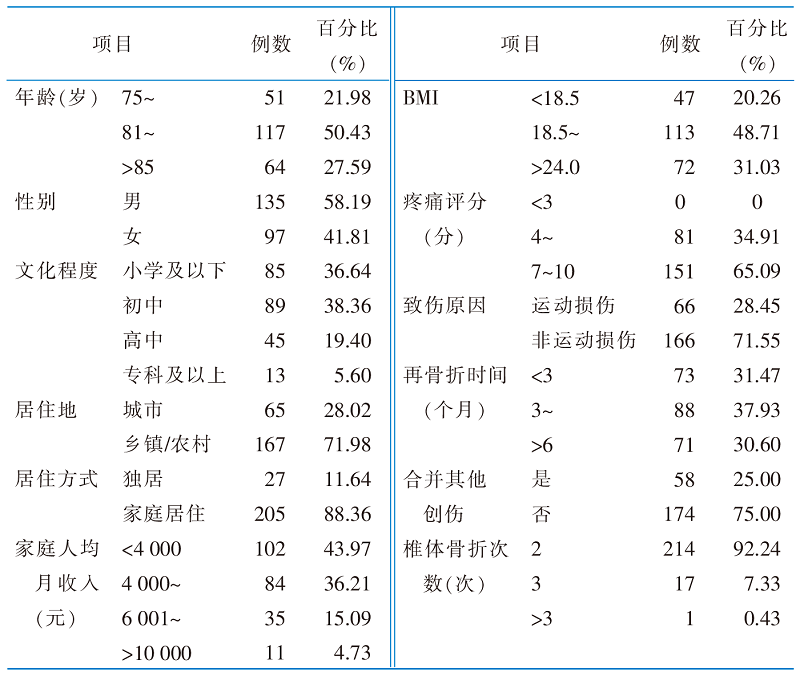 |
表1 调查对象的一般资料(n=232)
Table 1 General information on respondents(n=232)
| |
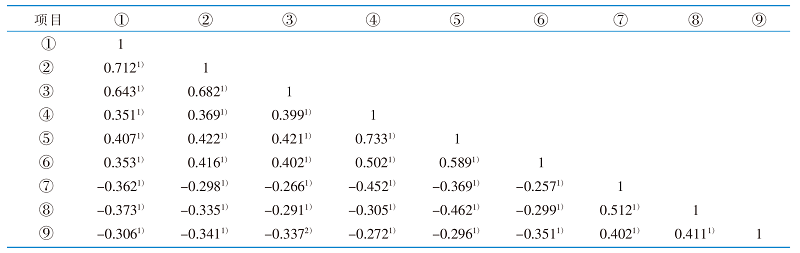 |
表2 老年邻近椎体再骨折患者3个时间点家庭功能、锻炼依从性与运动恐惧的相关性分析(r 值,n=232)
Table 2 Correlation analysis of home functioning,exercise adherence and kinesophobia in elderly patients with vertebral re-fracture adjacent after OVCF at 3 time points(r value,n=232)
| |
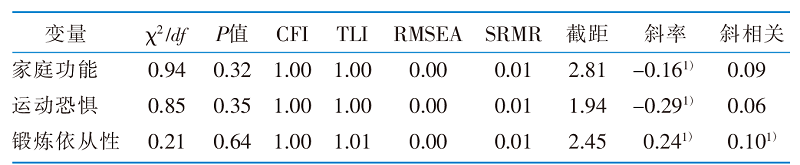 |
表3 老年邻近椎体再骨折患者家庭功能、锻炼依从性及运动恐惧线性无条件潜变量增长模型的拟合指数和系数(n=232)
Table 3 Fitting indices and coefficients of a linear unconditional potential growth model of home functioning,exercise adherence,and kinesophobia in elderly patients with vertebral re-fracture adjacent after OVCF(n=232)
| |
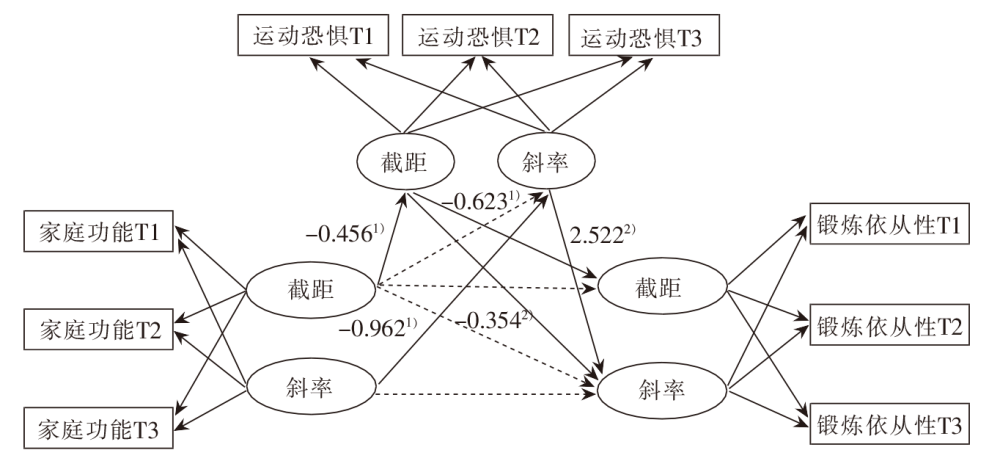
图1 运动恐惧在老年邻近椎体再骨折患者家庭功能及锻炼依从性间的纵向中介模型 注:T1为术前,T2为术后下床前,T3为术后1个月。 1)P<0.001,2)P<0.05。
Figure 1 A longitudinal mediation model of kinesophobia between family functioning and exercise adherence in elderly patients with vertebral re-fracture adjacent after OVCF
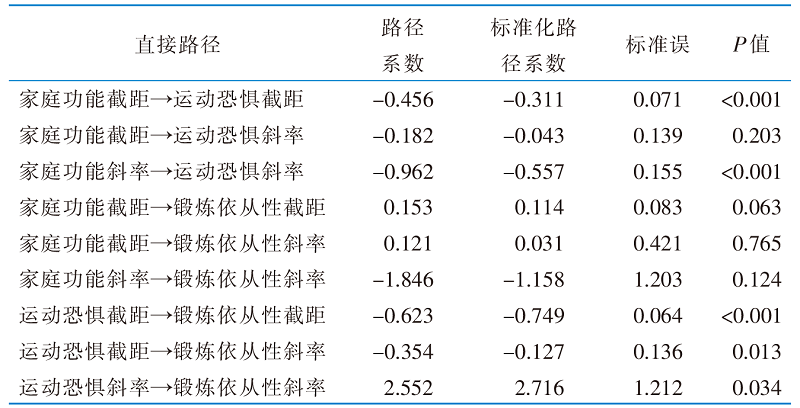 |
表4 运动恐惧在老年邻近椎体再骨折患者家庭功能及锻炼依从性间的纵向中介模型中的直接路径(n=232)
Table 4 Direct pathways of kinesophobia in a longitudinal mediation model between family functioning and exercise adherence in elderly patients with vertebral re-fracture adjacent after OVCF(n=232)
| |
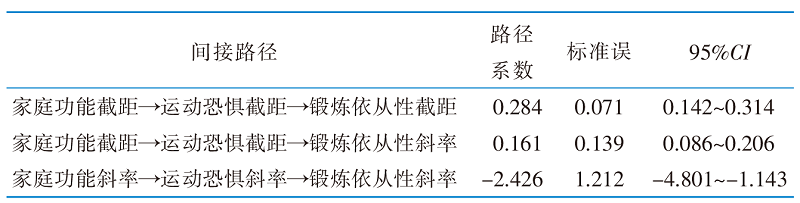 |
表5 运动恐惧在老年邻近椎体再骨折患者家庭功能及锻炼依从性间的纵向中介模型中的间接路径(n=232)
Table 5 Indirect pathways of kinesophobia in a longitudinal mediation model between family functioning and exercise adherence in elderly patients with vertebral re-fracture adjacent after OVCF(n=232)
| |
| [1] |
Ling X, Cummings SR, Mingwei Q, et al. Vertebral fractures in Beijing,China:the Beijing osteoporosis project[J]. J Bone Miner Res, 2000, 15(10):2019-2025.
DOI PMID |
| [2] | Liang DW, Pei J, Pei RY, et al. Clinical efficacy of percutaneous vertebroplasty versus percutaneous kyphoplasty treating osteoporotic vertebral compression fractures with kyphosis[J]. Eur J Trauma Emerg Surg, 2024, 50(3):1043-1049. |
| [3] |
Liu DH, Xu J, Wang Q, et al. Timing of percutaneous balloon kyphoplasty for osteoporotic vertebral compression fractures[J]. Pain Physician, 2023, 26(3):231-243.
PMID |
| [4] | Ko BS, Cho KJ, Park JW. Early adjacent vertebral fractures after balloon kyphoplasty for osteoporotic vertebral compression fractures[J]. Asian Spine J, 2019, 13(2):210-215. |
| [5] |
Hwang SH, Cho PG, Kim KT, et al. What are the risk factors for a second osteoporotic vertebral compression fracture?[J]. Spine J, 2023, 23(11):1586-1592.
DOI PMID |
| [6] |
Zhang AQ, Lin YC, Kong MX, et al. A nomogram for predicting the risk of new vertebral compression fracture after percutaneous kyphoplasty[J]. Eur J Med Res, 2023, 28(1):280.
DOI PMID |
| [7] |
徐榕璟, 贺旭妍, 贾守梅. 骨科老年患者术后运动恐惧的范围综述[J]. 中华护理杂志, 2024, 59(5):626-633.
DOI |
|
Xu RJ, He XY, Jia SM. A scoping review of kinesiophobia research in elderly orthopedic postoperative patients[J]. Chin J Nurs, 2024, 59(5):626-633.
DOI |
|
| [8] |
罗屹惟, 程悦, 罗如珍, 等. 骨质疏松椎体压缩性骨折患者术后居家康复体验的质性研究[J]. 中华护理杂志, 2022, 57(10):1165-1171.
DOI |
| Luo YW, Cheng Y, Luo RZ, et al. Experiences of home-based rehabilitation continuity care after osteoporotic vertebral compression fracture:a qualitative study[J]. Chin J Nurs, 2022, 57(10):1165-1171. | |
| [9] | Bäck M, Caldenius V, Svensson L, et al. Perceptions of kinesiophobia in relation to physical activity and exercise after myocardial infarction:a qualitative study[J]. Phys Ther, 2020, 100(12):2110-2119. |
| [10] | Yu L, Guo YL, Che T. The effect of Pilates exercise nursing combined with communication standard-reaching theory nursing and pelvic floor muscle training on bladder function and family function of patients after cervical cancer surgery[J]. Comput Math Methods Med, 2022, 2022:6444462. |
| [11] |
Camacho PM, Petak SM, Binkley N, et al. American association of clinical endocrinologists/American college of endocrinology clinical practice guidelines for the diagnosis and treatment of postmenopausal osteoporosis-2020 update[J]. Endocr Pract, 2020, 26(Suppl 1):1-46.
DOI PMID |
| [12] | 陈楠, 刘红云. 基于增长模型的非随机缺失数据处理:选择模型和极大似然方法[J]. 心理科学, 2015, 38(2):446-451. |
| Chen N, Liu HY. Comparison of methods addressing MNAR missing data when fitting a latent growth model:selection model and ML[J]. J Psychol Sci, 2015, 38(2):446-451. | |
| [13] | Smilkstein G. The family APGAR:a proposal for a family function test and its use by physicians[J]. J Fam Pract, 1978, 6(6):1231-1239. |
| [14] | 吕繁, 曾光, 刘松暖, 等. 家庭关怀度指数问卷测量脑血管病病人家庭功能的信度和效度研究[J]. 中国公共卫生, 1999, 15(11):987-988. |
| Lü F, Zeng G, Liu SN, et al. Reliability and validity of the Family Care Index Questionnaire for measuring family functioning in patients with cerebrovascular disease[J]. Chin J Public Health, 1999, 15(11):987-988. | |
| [15] | 谭媛媛, 和晖, 杨秀贤, 等. 骨科患者功能锻炼依从性量表的编制及信度效度检验[J]. 中国护理管理, 2019, 19(11):1626-1631. |
| Tan YY, He H, Yang XX, et al. Development and reliability and validity test of the Compliance Scale of Functional Exercise for Orthopedic Patients[J]. Chin Nurs Manag, 2019, 19(11):1626-1631. | |
| [16] | 胡文. 简体中文版TSK和FABQ量表的文化调适及其在退行性腰腿痛中的应用研究[D]. 上海: 第二军医大学, 2012. |
| Hu W. Cultural adjustment of simplified Chinese TSK and FABQ Scale and its application in degenerative lumbago and leg pain[D]. Shanghai: Second Military Medical University, 2012. | |
| [17] | 汤丹丹, 温忠麟. 共同方法偏差检验:问题与建议[J]. 心理科学, 2020, 43(1):215-223. |
| Tang DD, Wen ZL. Statistical approaches for testing common method bias:problems and suggestions[J]. J Psychol Sci, 2020, 43(1):215-223. | |
| [18] | 钟梅艳, 莫忠贵, 唐海军, 等. 骨质疏松性椎体压缩性骨折二级预防依从性现状及其影响因素的统计分析[J]. 解放军预防医学杂志, 2020, 38(5):69-72. |
| Zhong MY, Mo ZG, Tang HJ, et al. Statistical analysis of compliance status and influencing factors of secondary prevention of osteoporotic vertebral compression fracture[J]. J Prev Med Chin PLA, 2020, 38(5):69-72. | |
| [19] | Gawulayo S, Erasmus CJ, Rhoda AJ. Family functioning and stroke:family members’ perspectives[J]. Afr J Disabil, 2021, 10:801. |
| [20] | Chang LX, Zhang SJ, Yan ZP, et al. Symptom burden,family resilience,and functional exercise adherence among postoperative breast cancer patients[J]. Asia Pac J Oncol Nurs, 2022, 9(11):100129. |
| [21] |
Zakiei A, Vafapoor H, Alikhani M, et al. The relationship between family function and personality traits with general self-efficacy(parallel samples studies)[J]. BMC Psychol, 2020, 8(1):88.
DOI PMID |
| [22] |
Rosenblatt A, Greenberg J, Solomon S, et al. Evidence for terror management theory:I. the effects of mortality salience on reactions to those who violate or uphold cultural values[J]. J Pers Soc Psychol, 1989, 57(4):681-690.
PMID |
| [23] | Wang Q, Du N. Relationship between kinesiophobia and quality of life among patients with breast cancer-related lymphedema:chain-mediating effect of self-care and functional exercise compliance[J]. Asia Pac J Oncol Nurs, 2024, 11(1):100346. |
| [24] |
梁琪, 胡三莲, 韦小梅, 等. 前交叉韧带重建术后患者运动恐惧的研究进展及护理启示[J]. 中华护理杂志, 2024, 59(24):3049-3054.
DOI |
|
Liang Q, Hu SL, Wei XM, et al. Research progress on kinesiophobia in patients after anterior cruciate ligament reconstruction and nursing enlightenment[J]. Chin J Nurs, 2024, 59(24):3049-3054.
DOI |
| [1] | 中华护理学会静脉输液治疗专业委员会, 北京护理学会, (执笔:李佳, 李旭英, 覃惠英, 陈利芬, 吴珍明, 胡泽吟, 罗梦娜, 范育英, 吴嘉慧, 林宇萍, 王蕾, 孙文彦, 冯毕龙, 高伟, 李亚南, 侯罗娅, 李春燕. 中心静脉通路装置拔除护理专家共识[J]. 中华护理杂志, 2026, 61(9): 1157-1162. |
| [2] | 周霞, 马艳艳, 师正坤, 于海霞, 周艳, 胡红玲, 李莜, 陈思思, 张京慧. 隧道式经股静脉PICC置入术在困难静脉通路婴幼儿中的应用研究[J]. 中华护理杂志, 2026, 61(9): 1163-1170. |
| [3] | 黄萍, 李黎, 郭骊莉, 徐莹, 叶赟, 江淑芳. 与无针输液接头相关的导管相关性血流感染风险评估工具的构建与初步应用[J]. 中华护理杂志, 2026, 61(9): 1171-1179. |
| [4] | 李佳, 张玉玲, 邢乐, 张利峰, 牛秀峰, 许莉. 早产儿经上肢置入PICC尖端继发性异位风险预测模型的建立与验证[J]. 中华护理杂志, 2026, 61(9): 1180-1186. |
| [5] | 何娟, 赵蕾蕾, 叶冠军, 余艳芬, 傅晓君, 周琴. 1例双侧无名静脉及上腔静脉人工血管置换术后患者经上肢置入PICC的护理[J]. 中华护理杂志, 2026, 61(9): 1187-1191. |
| [6] | 梁江淑渊, 曾妃, 何鹏, 谢梦珊, 江悦, 蒋宗恒, 王建茗. 静脉-静脉体外膜肺氧合患者早期活动风险等级评估系统的构建及应用研究[J]. 中华护理杂志, 2026, 61(9): 1192-1199. |
| [7] | 陈晨, 顾肖, 郭凡, 王敏, 倪兴梅, 黄琴, 程念开. 3种衰弱评估工具对急诊老年创伤患者不良结局的预测价值[J]. 中华护理杂志, 2026, 61(9): 1200-1207. |
| [8] | 郑煜琳, 刘晋宁, 张静, 郭会敏, 谷艳梅, 张莉莉. 酒精性肝病患者肝移植术后再饮酒现状及其影响因素分析[J]. 中华护理杂志, 2026, 61(9): 1208-1214. |
| [9] | 叶俊霜, 沈丽佳, 孟霞靓, 张玉姣, 蔡根莲, 邵碧云, 周亚辉, 张柳倩, 应金萍. 维持性血液透析患者对口腔衰弱认知和体验的质性研究[J]. 中华护理杂志, 2026, 61(9): 1215-1220. |
| [10] | 王芸姣, 杨玉金, 郑春艳, 彭菲津, 王淑贞, 蒋喜露, 周为民, 王薇, 张娜. 糖尿病下肢动脉硬化闭塞症患者介入术后康复护理方案的构建及应用研究[J]. 中华护理杂志, 2026, 61(9): 1221-1229. |
| [11] | 杨明霞, 安冉, 臧金凤, 李春梅. 老年慢性病共病患者及照护者老老照护能力与自我忽视的相关性分析[J]. 中华护理杂志, 2026, 61(9): 1230-1236. |
| [12] | 梁和静, 许鹊, 史云霞, 祖金美, 黄文静, 杨春旭, 郭明华, 王磊. 颈动脉内膜剥脱术围手术期护理质量评价指标的构建[J]. 中华护理杂志, 2026, 61(9): 1237-1244. |
| [13] | 韩媛媛, 石玉竹, 尚文涵, 么莉. 870所三级甲等医院老年住院患者跌倒伤害发生现状与影响因素分析[J]. 中华护理杂志, 2026, 61(9): 1245-1252. |
| [14] | 夏云芳, 王洪, 崔岱, 付真真, 朱敏. 1例弥漫性毒性甲状腺肿合并超敏反应综合征青少年患者的护理[J]. 中华护理杂志, 2026, 61(9): 1253-1256. |
| [15] | 周益飞, 王海苹, 胡益环, 应莉, 罗松娜. 1例氢氟酸中毒并发呼吸心搏骤停患者的急救护理[J]. 中华护理杂志, 2026, 61(9): 1257-1260. |
| 阅读次数 | ||||||
|
全文 |
|
|||||
|
摘要 |
|
|||||
