

中华护理杂志 ›› 2025, Vol. 60 ›› Issue (4): 396-403.DOI: 10.3761/j.issn.0254-1769.2025.04.002
李瑞华( ), 甄莉, 朱木兰, 叶新梅, 秦芳, 张星星, 林梅燕, 李国新()
收稿日期:2024-05-13
出版日期:2025-02-20
发布日期:2025-02-26
*通讯作者:
李国新,E-mail:gzliguoxin@163.com作者简介:李瑞华:女,本科(硕士在读),护士,E-mail:ruihuali2000@163.com
基金资助:
LI Ruihua(), ZHEN Li, ZHU Mulan, YE Xinmei, QIN Fang, ZHANG Xingxing, LIN Meiyan, LI Guoxin()
Received:2024-05-13
Online:2025-02-20
Published:2025-02-26
摘要:
目的 了解预防性回肠造口患者的营养状况并分析其影响因素,为医护人员制订营养干预策略提供依据。 方法 采用便利抽样法,于2023年11月—2024年7月选取在广州市4所三级甲等医院复诊或住院等待还纳的239例预防性回肠造口患者为调查对象,采用一般资料调查问卷和患者主观整体营养状况评估工具进行调查,采用单因素分析和多因素有序Logistic回归分析预防性回肠造口患者营养状况的影响因素。 结果 共回收有效问卷227份,有效问卷回收率为94.98%,其中营养良好或可疑营养不良组64例(28.19%),中度营养不良组104例(45.81%),重度营养不良组59例(25.99%)。多因素有序Logistic回归分析结果显示,术前累计化疗周期、术后时间、年龄、当前饮食类型、有无摄入口服营养补充剂(oral nutritional supplements,ONS)、有无肠造口并发症和造口自我护理能力是预防性回肠造口患者营养状况的影响因素(P<0.05)。 结论 预防性回肠造口患者的中、重度营养不良发生率较高,ONS的摄入并未有效改善其营养状况。术前累计化疗周期多、术后时间较短、年龄≥65岁、流质饮食或半流质饮食、存在肠造口并发症和造口自我护理能力不足的患者营养状况较差。建议医护人员根据相关影响因素制订干预策略,以改善预防性回肠造口患者的营养状况。
李瑞华, 甄莉, 朱木兰, 叶新梅, 秦芳, 张星星, 林梅燕, 李国新. 预防性回肠造口患者营养状况及影响因素分析[J]. 中华护理杂志, 2025, 60(4): 396-403.
LI Ruihua, ZHEN Li, ZHU Mulan, YE Xinmei, QIN Fang, ZHANG Xingxing, LIN Meiyan, LI Guoxin. Nutritional status and influencing factors in patients undergoing preventive ileostomy[J]. Chinese Journal of Nursing, 2025, 60(4): 396-403.
 |
表1 调查对象的一般资料及营养状况单因素分析结果(n=227)
Table 1 General information of the respondents and results of univariate analysis on the influencing factors of nutritional status(n=227)
| |
 |
表2 自变量赋值情况
Table 2 Assignment of independent variables
| |
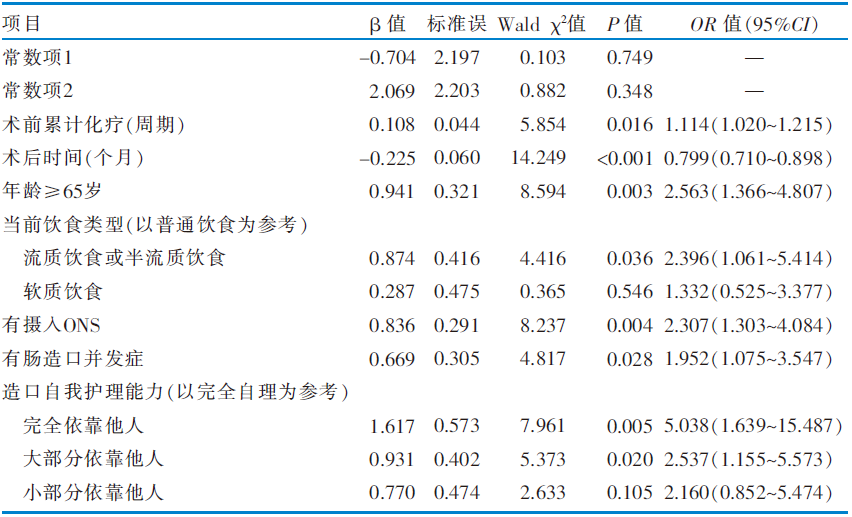 |
表3 预防性回肠造口患者营养状况影响因素的有序Logistic回归分析结果(n=227)
Table 1 Ordinal Logistic regression analysis of the influencing factors of nutritional status in patients undergoing preventive ileostomy(n=227)
| |
| [1] | 中国医师协会肛肠医师分会造口专业委员会, 中国医师协会肛肠医师分会, 中华医学会外科学分会结直肠外科学组, 等. 中低位直肠癌手术预防性肠造口中国专家共识(2022版)[J]. 中华胃肠外科杂志, 2022, 25(6):741-748. |
| Ostomy Professional Committee, Chinese Society of Coloproc-tology, Chinese Medical Doctor Association; Chinese Society of Colorectal Surgery, Chinese Society of Surgery, Chinese Medical Association; Colorectal Tumor Professional Committee, Chinese Medical Doctor Association; et al. Chinese expert consensus on protective ostomy for mid-low rectal cancer(version 2022)[J]. Chin J Gastrointest Surg, 2022, 25(6):741-748. | |
| [2] |
England C, Mitchell A, Atkinson C. Diet after ileostomy study:an observational study describing dietary intake and stoma-related symptoms in people with an ileostomy[J]. J Hum Nutr Diet, 2023, 36(4):1600-1612.
DOI PMID |
| [3] |
Santamaría MM, Villafranca JJA, Abilés J, et al. Impact of a nutrition consultation on the rate of high output stoma-related readmission:an ambispective cohort study[J]. Sci Rep, 2021, 11(1):16620.
DOI PMID |
| [4] |
Martellucci J, Balestri R, Brusciano L, et al. Ileostomy versus colostomy:impact on functional outcomes after total mesorectal excision for rectal cancer[J]. Colorectal Dis, 2023, 25(8):1686-1693.
DOI PMID |
| [5] |
Shiraishi T, Ogawa H, Katayama C, et al. The presurgical controlling nutritional status(CONUT) score is independently associated with severe peristomal skin disorders:a single-center retrospective cohort study[J]. Sci Rep, 2021, 11(1):18857.
DOI PMID |
| [6] | Abe S, Nozawa H, Sasaki K, et al. Nutritional status indicators predict tolerability to adjuvant chemotherapy in patients with stage Ⅱ/Ⅲ rectal cancer undergoing neoadjuvant chemoradiotherapy[J/OL]. Digestion, 2024,105:345-358. |
| [7] | 杜茜茜, 邹其云, 霍明科, 等. 结直肠癌回肠造口患者营养状况与社会心理适应的关系研究[J]. 护理管理杂志, 2019, 19(12):845-848. |
| Du XX, Zou QY, Huo MK, et al. Correlation between nutritional status and psychosocial adaptation in colorectal cancer patients with ileostomy[J]. J Nurs Adm, 2019, 19(12):845-848. | |
| [8] | 林鸿缘, 陈璟, 刘颖洁, 等. 直肠癌预防性回肠造口患者的营养教育[J]. 护理学杂志, 2022, 37(10):10-14. |
| Lin HY, Chen J, Liu YJ, et al. Nutrition education for patients with rectal cancer undergoing prophylactic ileostomy[J]. J Nurs Sci, 2022, 37(10):10-14. | |
| [9] | 李乐之, 路潜. 外科护理学[M]. 7版. 北京: 人民卫生出版社,2021:422. |
| Li LZ, Lu Q. Surgical nursing[M]. 7th ed. Beijing: People’s Medical Publishing House,2021:422. | |
| [10] | 倪平, 陈京立, 刘娜. 护理研究中量性研究的样本量估计[J]. 中华护理杂志, 2010, 45(4):378-380. |
| Ni P, Chen JL, Liu N. The sample size estimation in quantitative nursing research[J]. Chin J Nurs, 2010, 45(4):378-380. | |
| [11] | 中国造口管理协作组, 中华护理学会伤口造口失禁护理专业委员会, 中国医师协会外科医师分会结直肠医师专业委员会, 等. 肠造口并发症的分型与分级标准(2023版)[J]. 中华胃肠外科杂志, 2023, 26(10):915-921. |
| The Chinese Ostomy Collaboration Group; Wound, Ostomy,and Continence Nursing Committee of Chinese Nursing Association; Colon and Rectal Surgeon Committee of Surgeon Branch of Chinese Medical Doctor Association, et al. Criteria of enterostomy complications:classification and grading(2023 edition)[J]. Chin J Gastrointest Surg, 2023, 26(10):915-921. | |
| [12] |
Ottery FD. Rethinking nutritional support of the cancer patient:the new field of nutritional oncology[J]. Semin Oncol, 1994, 21(6):770-778.
PMID |
| [13] |
Bauer J, Capra S, Ferguson M. Use of the scored Patient-Generated Subjective Global Assessment(PG-SGA) as a nutrition assessment tool in patients with cancer[J]. Eur J Clin Nutr, 2002, 56(8):779-785.
DOI PMID |
| [14] | 国家卫生和计划生育委员会. 肿瘤患者主观整体营养评估(WS/T 555-2017)[S/OL]. 北京: 中国标准出版社, 2017:1-7[2023-08-23]. http://www.nhc.gov.cn/wjw/yingyang/201708/fb23588e8ea64da7ae93c8d81b1fa663.shtml. |
| National Health and Family Planning Commission of the People’s Republic of China. Subjective nutrition assessment for cancer patients(WS/T 555-2017)[S/OL]. Beijing: China Standard Press, 2017:1-7[2023-08-23]. http://www.nhc.gov.cn/wjw/yingyang/201708/fb23588e8ea64da7ae93c8d81b1fa663.shtml. | |
| [15] | 中华护理学会伤口、造口、失禁护理专业委员会. 成人肠造口护理标准[J]. 中华护理杂志, 2020, 55(增刊):15-19. |
| Wound, Ostomy,and Continence Nursing Committee of Chinese Nursing Association. Nursing care for adult stoma patients[J]. Chin J Nurs, 2020, 55(Suppl):15-19. | |
| [16] | Daly LE, Ní Bhuachalla éB, Power DG, et al. Loss of skeletal muscle during systemic chemotherapy is prognostic of poor survival in patients with foregut cancer[J]. J Cachexia Sar-copenia Muscle, 2018, 9(2):315-325. |
| [17] | Willett CG. Neoadjuvant therapy for rectal adenocarcinoma[EB/OL]. (2024-03-08)[2024-08-07]. https://www.uptodate.cn/contents/neoadjuvant-therapy-for-rectal-adenocarcinoma. |
| [18] | Rowe KM, Schiller LR. Ileostomy diarrhea:pathophysiology and management[J]. Proc(Bayl Univ Med Cent), 2020, 33(2):218-226. |
| [19] |
Whiteley I, Randall S, Fetheny J, et al. Comparison of adjustment to a temporary or permanent ostomy using the OAI-23[J]. Colorectal Dis, 2024, 26(6):1231-1238.
DOI PMID |
| [20] | 汤玉梅, 张桂菊, 马静. 老年肠造口患者症状群与生活质量的相关性[J]. 中国老年学杂志, 2022, 42(2):477-480. |
| Tang YM, Zhang GJ, Ma J. Correlation between symptom groups and quality of life in elderly patients with enterostomy[J]. Chin J Gerontol, 2022, 42(2):477-480. | |
| [21] | Ritchie C. Geriatric nutrition:nutritional issues in older adults[EB/OL]. (2023-03-23)[2024-07-11]. https://www.uptodate.cn/contents/zh-Hans/geriatric-nutrition-nutritional-issues-in-older-adults?search=Geriatric%20nutrition%3A%20nutritional%20issues%20in%20older%20adults&source=search_result&selectedTitle=1%7E150&usage_type=default&display_rank=1. |
| [22] |
Weimann A, Braga M, Carli F, et al. ESPEN practical guide-line:clinical nutrition in surgery[J]. Clin Nutr, 2021, 40(7):4745-4761.
DOI PMID |
| [23] |
刘莺歌, 吴燕, 曹秋君, 等. 肠造口周围潮湿相关性皮肤损伤风险预测模型的构建及应用[J]. 中华护理杂志, 2021, 56(11):1612-1617.
DOI URL |
|
Liu YG, Wu Y, Cao QJ, et al. The development and validation of a risk prediction model for peristomal moisture-associated skin damage[J]. Chin J Nurs, 2021, 56(11):1612-1617.
DOI URL |
|
| [24] | Wu XS, Miles A, Braakhuis AJ. Texture-modified diets,nutritional status and mealtime satisfaction:a systematic review[J]. Healthcare, 2021, 9(6):624. |
| [25] |
熊照玉, 柯卉, 李素云, 等. 围手术期患者口服营养补充的最佳证据总结[J]. 中华护理杂志, 2021, 56(2):283-288.
DOI URL |
|
Xiong ZY, Ke H, Li SY, et al. Evidence summary of oral nutritional supplements in perioperative patients[J]. Chin J Nurs, 2021, 56(2):283-288.
DOI URL |
|
| [26] | 中华医学会肠外肠内营养学分会. 中国成人患者肠外肠内营养临床应用指南(2023版)[J]. 中华医学杂志, 2023, 103(13):946-974. |
| Chinese Society of Parenteral and Enteral Nutrition. Guideline for clinical application of parenteral and enteral nutrition in adults patients in China(2023 edition)[J]. Natl Med J China, 2023, 103(13):946-974. | |
| [27] | 中华医学会外科学分会胃肠外科学组, 中华医学会外科学分会结直肠外科学组,中国医师协会外科医师分会上消化道外科医师委员会. 胃肠外科病人围手术期全程营养管理中国专家共识(2021版)[J]. 中国实用外科杂志, 2021, 41(10):1111-1125. |
| Chinese Society of Gastrointestinal Surgery,Chinese Society of Surgery, Chinese Medical Association; Chinese Society of Colorectal Surgery,Chinese Society of Surgery,Chinese Medical Association; Association of Upper Gastrointestinal Surgeons,Chinese College of Surgeons,Chinese Medical Doctor Association. Chinese expert consensus on perioperative whole-course nutrition management for gastrointestinal surgery(2021 edition)[J]. Chin J Pract Surg, 2021, 41(10):1111-1125. | |
| [28] | 王方, 戴晓冬, 蒋秀敏, 等. 直肠癌永久性肠造口患者的营养状况现状[J]. 中华现代护理杂志, 2022, 28(31):4426-4429. |
| Wang F, Dai XD, Jiang XM, et al. Nutritional status of rectal cancer patients with permanent enterostomy[J]. Chin J Mod Nurs, 2022, 28(31):4426-4429. |
| [1] | 中华护理学会静脉输液治疗专业委员会, 北京护理学会, (执笔:李佳, 李旭英, 覃惠英, 陈利芬, 吴珍明, 胡泽吟, 罗梦娜, 范育英, 吴嘉慧, 林宇萍, 王蕾, 孙文彦, 冯毕龙, 高伟, 李亚南, 侯罗娅, 李春燕. 中心静脉通路装置拔除护理专家共识[J]. 中华护理杂志, 2026, 61(9): 1157-1162. |
| [2] | 周霞, 马艳艳, 师正坤, 于海霞, 周艳, 胡红玲, 李莜, 陈思思, 张京慧. 隧道式经股静脉PICC置入术在困难静脉通路婴幼儿中的应用研究[J]. 中华护理杂志, 2026, 61(9): 1163-1170. |
| [3] | 黄萍, 李黎, 郭骊莉, 徐莹, 叶赟, 江淑芳. 与无针输液接头相关的导管相关性血流感染风险评估工具的构建与初步应用[J]. 中华护理杂志, 2026, 61(9): 1171-1179. |
| [4] | 李佳, 张玉玲, 邢乐, 张利峰, 牛秀峰, 许莉. 早产儿经上肢置入PICC尖端继发性异位风险预测模型的建立与验证[J]. 中华护理杂志, 2026, 61(9): 1180-1186. |
| [5] | 何娟, 赵蕾蕾, 叶冠军, 余艳芬, 傅晓君, 周琴. 1例双侧无名静脉及上腔静脉人工血管置换术后患者经上肢置入PICC的护理[J]. 中华护理杂志, 2026, 61(9): 1187-1191. |
| [6] | 梁江淑渊, 曾妃, 何鹏, 谢梦珊, 江悦, 蒋宗恒, 王建茗. 静脉-静脉体外膜肺氧合患者早期活动风险等级评估系统的构建及应用研究[J]. 中华护理杂志, 2026, 61(9): 1192-1199. |
| [7] | 陈晨, 顾肖, 郭凡, 王敏, 倪兴梅, 黄琴, 程念开. 3种衰弱评估工具对急诊老年创伤患者不良结局的预测价值[J]. 中华护理杂志, 2026, 61(9): 1200-1207. |
| [8] | 郑煜琳, 刘晋宁, 张静, 郭会敏, 谷艳梅, 张莉莉. 酒精性肝病患者肝移植术后再饮酒现状及其影响因素分析[J]. 中华护理杂志, 2026, 61(9): 1208-1214. |
| [9] | 叶俊霜, 沈丽佳, 孟霞靓, 张玉姣, 蔡根莲, 邵碧云, 周亚辉, 张柳倩, 应金萍. 维持性血液透析患者对口腔衰弱认知和体验的质性研究[J]. 中华护理杂志, 2026, 61(9): 1215-1220. |
| [10] | 王芸姣, 杨玉金, 郑春艳, 彭菲津, 王淑贞, 蒋喜露, 周为民, 王薇, 张娜. 糖尿病下肢动脉硬化闭塞症患者介入术后康复护理方案的构建及应用研究[J]. 中华护理杂志, 2026, 61(9): 1221-1229. |
| [11] | 杨明霞, 安冉, 臧金凤, 李春梅. 老年慢性病共病患者及照护者老老照护能力与自我忽视的相关性分析[J]. 中华护理杂志, 2026, 61(9): 1230-1236. |
| [12] | 梁和静, 许鹊, 史云霞, 祖金美, 黄文静, 杨春旭, 郭明华, 王磊. 颈动脉内膜剥脱术围手术期护理质量评价指标的构建[J]. 中华护理杂志, 2026, 61(9): 1237-1244. |
| [13] | 韩媛媛, 石玉竹, 尚文涵, 么莉. 870所三级甲等医院老年住院患者跌倒伤害发生现状与影响因素分析[J]. 中华护理杂志, 2026, 61(9): 1245-1252. |
| [14] | 夏云芳, 王洪, 崔岱, 付真真, 朱敏. 1例弥漫性毒性甲状腺肿合并超敏反应综合征青少年患者的护理[J]. 中华护理杂志, 2026, 61(9): 1253-1256. |
| [15] | 周益飞, 王海苹, 胡益环, 应莉, 罗松娜. 1例氢氟酸中毒并发呼吸心搏骤停患者的急救护理[J]. 中华护理杂志, 2026, 61(9): 1257-1260. |
| 阅读次数 | ||||||
|
全文 |
|
|||||
|
摘要 |
|
|||||
