

中华护理杂志 ›› 2023, Vol. 58 ›› Issue (19): 2309-2318.DOI: 10.3761/j.issn.0254-1769.2023.19.001
• 论著 • 下一篇
孟晓静( ), 李翔, 冯英璞(), 范晶丽, 霍晓冉, 张春霞, 周立民, 高敏
收稿日期:2023-01-03
出版日期:2023-10-10
发布日期:2023-10-12
通讯作者:
冯英璞,E-mail:yingpufeng@126.com作者简介:孟晓静:女,硕士,副主任护师,护士长,E-mail:mengxiaojing512@126.com
MENG Xiaojing(), LI Xiang, FENG Yingpu(), FAN Jingli, HUO Xiaoran, ZHANG Chunxia, ZHOU Limin, GAO Min
Received:2023-01-03
Online:2023-10-10
Published:2023-10-12
摘要:
目的 将颅脑损伤患者目标温度管理最佳证据应用于临床实践并评价其效果。方法 遵循乔安娜布里格斯研究所循证护理中心应用模式,基于最佳证据制订16条审查指标,以基于证据的持续质量改进模式为理论框架,于2021年6月—2022年4月,按照基线审查、实践变革和证据应用后变革效果的再审查将循证实践应用于神经外科ICU颅脑损伤患者,比较循证实践前后护理人员审查指标的执行率、目标温度管理相关知识水平、循证实践能力、患者并发症发生率及组织文化水平等。结果 循证实践后,各项审查指标第1、2轮审查执行率较基线均有提升,其中审查指标2~3、7~11、13执行率提升显著,差异有统计学意义(P<0.05);基线审查、第1轮审查、第2轮审查3组患者的3级寒颤发生率显著降低(χ2=7.680,P=0.021);基线审查、第1轮审查、第2轮审查护士关于颅脑损伤患者目标温度管理的知识现状调查问卷、循证实践影响因素问卷得分均提高(F=3.827,P=0.025;F=4.997,P=0.009),循证实践后护士循证护理实践障碍量表得分较基线降低(F=4.174,P=0.018),组织文化水平较基线提升(F=7.421,P=0.024)。结论 通过循证实践对神经外科ICU颅脑损伤患者进行目标温度管理,可有效规范医护人员的诊疗、护理行为,降低患者并发症发生率,但后期仍需持续质量监管及审查。
孟晓静, 李翔, 冯英璞, 范晶丽, 霍晓冉, 张春霞, 周立民, 高敏. 颅脑损伤患者目标温度管理的循证实践[J]. 中华护理杂志, 2023, 58(19): 2309-2318.
MENG Xiaojing, LI Xiang, FENG Yingpu, FAN Jingli, HUO Xiaoran, ZHANG Chunxia, ZHOU Limin, GAO Min. Evidence-based practice of target temperature management in patients with traumatic brain injury[J]. Chinese Journal of Nursing, 2023, 58(19): 2309-2318.
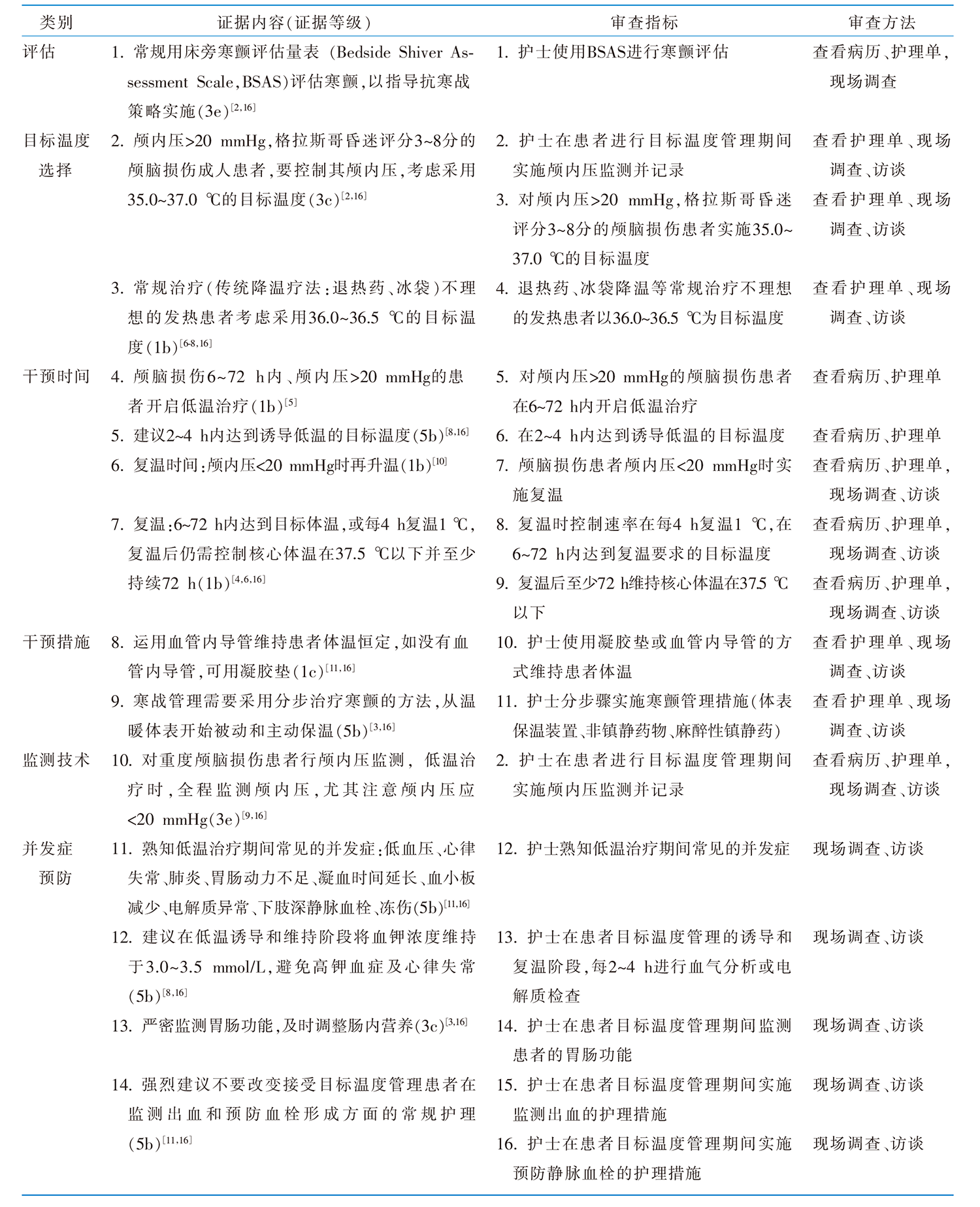 |
表1 颅脑损伤患者目标温度管理的证据、审查指标及审查方法
Table 1 Evidence, review indicators and data collection methods for target temperature management in patients with traumatic brain injury
| |
 |
表2 证据应用前后患者一般资料比较 (n=98)
Table 2 Comparison of patients’ general data before and after evidence application (n=98)
| |
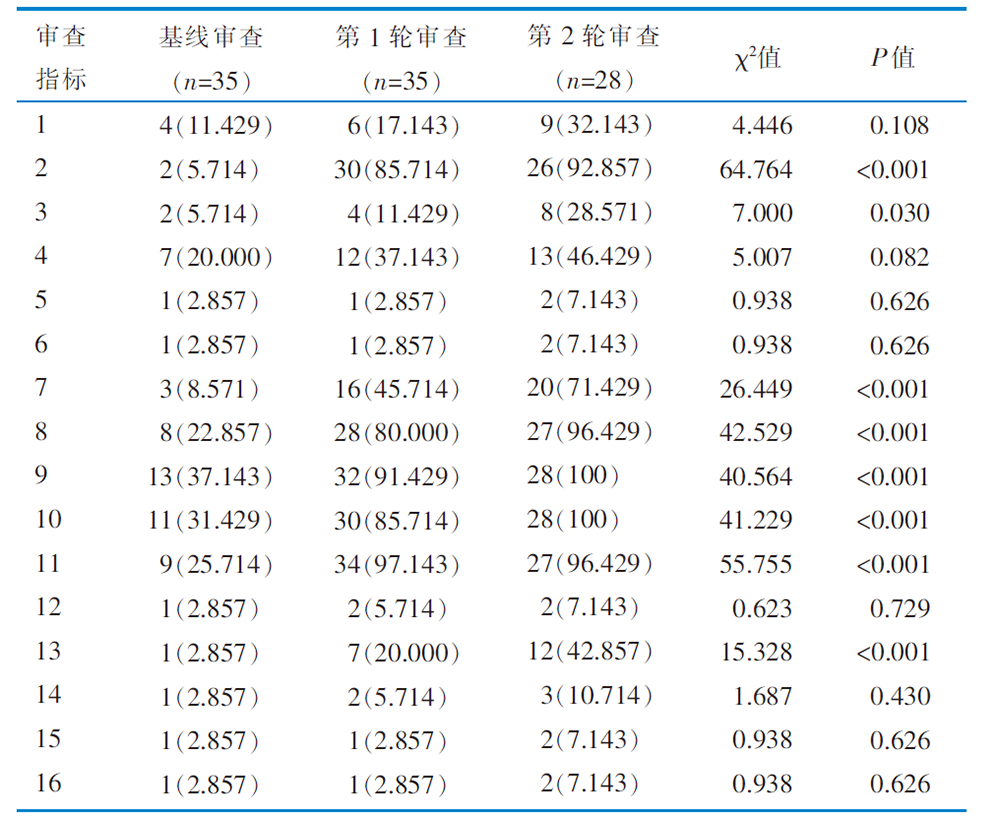 |
表3 证据应用前后审查标准执行情况比较 [例(百分率,%)]
Table 3 Comparison of the implementation of review standards before and after application of evidence [case(percent,%)]
| |
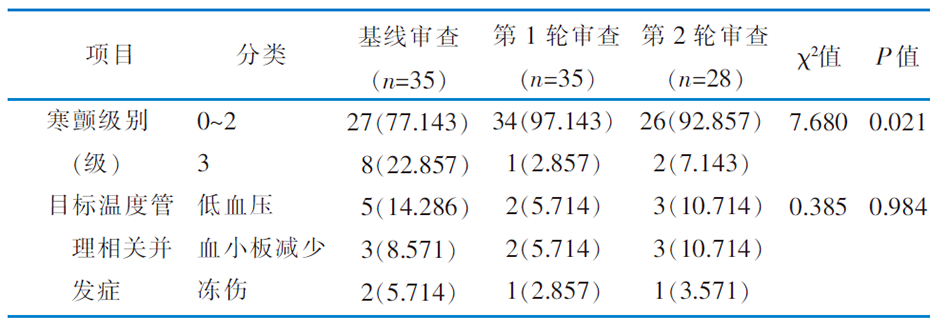 |
表4 证据应用前后患者3级寒颤、目标温度管理相关并发症发生率比较 [例(百分率,%)]
Table 4 Comparison of complications related to Grade 3 chills and target temperature management before and after evidence application [case(percent,%)]
| |
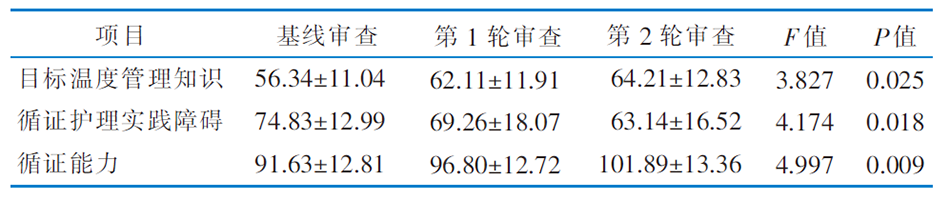 |
表5 证据应用前后护士颅脑损伤患者目标温度管理知识水平及循证实践能力 比较(分,$ \overline{x}\pm s$,n=27)
Table 5 Comparison of target temperature management knowledge level and evidence-based practice ability of nurses with traumatic brain injury before and after the application of evidence (scores,$ \overline{x}\pm s$,n=27)
| |
| [22] |
Harden SM, Smith ML, Ory MG, et al. RE-AIM in clinical,community,and corporate settings:perspectives,strategies,and recommendations to enhance public health impact[J]. Front Public Health, 2018, 6:71.
DOI URL |
| [23] |
Mathisen GE, Einarsen S. A Review of instruments assessing creative and innovative environments within organizations[J]. Creat Res J, 2004, 16(1):119-140.
DOI URL |
| [24] | 刘晓华, 张晋昕, 张振路, 等. 中文版循证护理实践障碍量表信度与效度的评价[J]. 中华护理杂志, 2008, 43(11):1041-1044. |
| Liu XH, Zhang JX, Zhang ZL, et al. Reliability and validity of Chinese version of Handicap Inventory Short Form about Evaluation of Evidence-Based Nursing Practice[J]. Chin J Nurs, 2008, 43(11):1041-1044. | |
| [25] | 杨如美. 英文版循证实践知识、态度、行为问卷及循证实践影响因素问卷的初步修订与应用[D]. 长沙: 中南大学, 2010. |
| Yang RM. Preliminary revision and application of the English version of the Evidence-Based Practical Knowledge,Attitude,and Behavior Questionnaire and the evidence-based practical influencing factors questionnaire[D]. Changsha: Central South University, 2010 | |
| [26] | 王薇, 李朝煜, 张敏, 等. 关注实践过程的循证护理模式研究进展[J]. 中国护理管理, 2018, 18(3):428-432. |
| Wang W, Li ZY, Zhang M, et al. Evidence-based nursing models:focusing on the process of evidence-based practice[J]. Chin Nurs Manag, 2018, 18(3):428-432. | |
| [27] |
Sharp MK, Tyner B, Awang Baki DAB, et al. Evidence synthesis summary formats for clinical guideline development group members:a mixed-methods systematic review protocol[J]. HRB Open Res, 2021, 4:76.
DOI URL |
| [28] |
Yoo JY, Kim JH, Kim JS, et al. Clinical nurses’ beliefs,knowledge,organizational readiness and level of implementation of evidence-based practice:the first step to creating an evidence-based practice culture[J]. PLoS One, 2019, 14(12):e0226742.
DOI URL |
| [29] | 付艳芬, 王春青, 胡雁. 证据临床转化中障碍因素和促进因素的内容分析[J]. 护理学报, 2022, 29(5):64-68. |
| Fu YF, Wang CQ, Hu Y. Content analysis of obstacles and promoters in clinical transformation of evidence[J]. J Nurs China, 2022, 29(5):64-68. | |
| [30] |
Moreda M, Beacham PS, Reese A, et al. Increasing the effectiveness of targeted temperature management[J]. Crit Care Nurse, 2021, 41(5):59-63.
DOI PMID |
| [31] |
Jain A, Gray M, Slisz S, et al. Shivering treatments for targeted temperature management:a review[J]. J Neurosci Nurs, 2018, 50(2):63-67.
DOI URL |
| [32] | 章梅云, 冯志仙, 邵乐文, 等. 循证护理团队培训方案的制订及应用效果评价[J]. 中华护理杂志, 2015, 50(4):446-449. |
| Zhang MY, Feng ZX, Shao LW, et al. The development and outcomes of training program for members of evidence-based nursing team[J]. Chin J Nurs, 2015, 50(4):446-449. | |
| [33] |
胡双, 陈嘉, 陈文俊, 等. 湖南省二三级医院护士长循证实践领导力的现状调查[J]. 中华护理杂志, 2021, 56(11):1679-1684.
DOI |
| Hu S, Chen J, Chen WJ, et al. Implementation leadership of head nurses in Chinese tertiary and secondary hospitals:a cross-sectional study in Hunan[J]. Chin J Nurs, 2021, 56(11):1679-1684. | |
| [34] |
Wieringa S, Engebretsen E, Heggen K, et al. Rethinking bias and truth in evidence-based health care[J]. J Eval Clin Pract, 2018, 24(5):930-938.
DOI PMID |
| [1] |
Alcamo AM, Fink EL. Targeted temperature management for everyone[J]. Pediatr Crit Care Med, 2019, 20(2):206-207.
DOI URL |
| [2] |
Andrews PJD, Verma V, Healy M, et al. Targeted temperature management in patients with intracerebral haemorrhage,subarachnoid haemorrhage,or acute ischaemic stroke:consensus recommendations[J]. Br J Anaesth, 2018, 121(4):768-775.
DOI PMID |
| [3] |
Madden LK, Hill M, May TL, et al. The implementation of targeted temperature management:an evidence-based guideline from the neurocritical care society[J]. Neurocritical Care, 2017, 27(3):468-487.
DOI |
| [4] |
Cariou A, Payen JF, Asehnoune K, et al. Targeted temperature management in the ICU:guidelines from a French expert panel[J]. Anaesth Crit Care Pain Med, 2018, 37(5):481-491.
DOI URL |
| [5] |
Picetti E, Iaccarino C, Servadei F. Letter:guidelines for the management of severe traumatic brain injury fourth edition[J]. Neurosurgery, 2017, 81(1):E2.
DOI URL |
| [6] |
Huang HP, Zhao WJ, Pu J. Effect of mild hypothermia on prognosis of patients with severe traumatic brain injury:a meta-analysis with trial sequential analysis[J]. Aust Crit Care, 2020, 33(4):375-381.
DOI PMID |
| [7] | Pegoli M, Zurlo Z, Bilotta F. Temperature management in acute brain injury:a systematic review of clinical evidence[J]. Clin Neurol Neurosurg, 2020, 197:106-165. |
| [8] |
Crompton EM, Lubomirova I, Cotlarciuc I, et al. Meta-analysis of therapeutic hypothermia for traumatic brain injury in adult and pediatric patients[J]. Crit Care Med, 2017, 45(4):575-583.
DOI PMID |
| [9] | Lewis SR, Evans DJ, Butler AR, et al. Hypothermia for traumatic brain injury[J]. Cochrane Database Syst Rev, 2017, 9(9):CD001048. |
| [10] | 中国医师协会急诊医师分会, 中国医药教育协会急诊医学专业委员会, 成人急危重症脑损伤患者目标温度管理临床实践专家共识组, 等. 成人急危重症脑损伤患者目标温度管理临床实践专家共识[J]. 中华急诊医学杂志, 2019, 28(3):282-291. |
| Branch of Emergency Physicians of Chinese Medical Doctor Association,Professional Committee of Emergency Medicine of Chinese Medical Education Association, Expert Consensus Group on Clinical Practice of Target Temperature Management for Adult Patients with Acute and Severe Brain Injury. Clinical practice expert consensus on target temperature management in adult patients with acute and severe brain injury[J]. Chin J Emerg Med, 2019, 28(3):282-291. | |
| [11] | 宿英英, 黄旭升, 潘速跃, 等. 神经重症低温治疗中国专家共识[J]. 中华神经科杂志, 2015, 48(6):453-458. |
| Su YY, Huang XS, Pan SY, et al. Chinese expert consensus on severe neurohypothermia treatment[J]. Chin J Neurol, 2015, 48(6):453-458. | |
| [12] | 中国研究型医院学会神经再生与修复专业委员会心脏重症脑保护学组, 中国研究型医院学会神经再生与修复专业委员会神经重症护理与康复学组. 亚低温脑保护中国专家共识[J]. 中华危重病急救医学, 2020, 32(4):385-391. |
| Cardiac Critical Brain Protection Group, Neurological Regen-eration and Repair Professional Committee of Chinese Society of Research Hospitals, Neurological Critical Care and Reha-bilitation Group of Neurological Regeneration and Repair Professional Committee of Chinese Society of Research Hos-pitals. Chinese expert consensus on mild hypothermia brain protection[J]. Chin J Crit Care Emerg Med, 20, 32(4):385-391. | |
| [13] | 贺亚龙, 刘文博. 颅脑创伤后加重继发性脑损伤的危险因素防治专家共识[J]. 临床神经外科杂志, 2020, 17(3):241-249,253. |
| He YL, Liu WB. Experts consensus on the management of factors of secondary brain insults following traumatic brain injury[J]. J Clin Neurosurg, 2020, 17(3):241-249,253. | |
| [14] | 王琦, 袁莉莉, 丁贤慧, 等. 低温干预对成人严重颅脑损伤患者疗效的Meta分析[J]. 中国循证医学杂志, 2020, 20(10):1180-1186. |
| Wang Q, Yuan LL, Ding XH, et al. Efficacy of hypothermia intervention on adult severe craniocerebral injury:a metaanalysis[J]. Chin J Evid Based Med, 2020, 20(10):1180-1186. | |
| [15] | 宋向奇, 陈通, 付爱军, 等. 长期亚低温对比短期亚低温治疗重型颅脑损伤的系统评价[J]. 医学研究生学报, 2014, 27(11):1184-1187. |
| Song XQ, Chen T, Fu AJ, et al. Comparison of long-term and short-term mild hypothermia on severe traumatic brain injury:a systematic review[J]. J Med Postgrad, 2014, 27(11):1184-1187. | |
| [16] | 荀静, 祁静, 周梦良, 等. 颅脑创伤患者目标温度管理护理实践最佳证据总结[J]. 解放军护理杂志, 2021, 38(4):70-73,88. |
| Xun J, Qi J, Zhou ML, et al. Best evidence summary of nurs-ing practice of targeted temperature management in traumatic brain injury patients[J]. Nurs J Chin PLA, 2021, 38(4):70-73,88. | |
| [17] |
Ranegger R, Haug S, Vetsch J, et al. Providing evidence-based knowledge on nursing interventions at the point of care:findings from a mapping project[J]. BMC Med Inform Decis Mak, 2022, 22(1):308.
DOI |
| [18] | 胡雁, 郝玉芳. 循证护理学[M]. 2版. 北京: 人民卫生出版社, 2018:219-221. |
| Hu Y, Hao YF. Evidence-based nursing[M]. 2nd ed. Beijing: People’s Medical Publishing House, 2018:219-221. | |
| [19] | 朱政, 胡雁, 周英凤, 等. 推动证据向临床转化(三)研究的选题和问题构建[J]. 护士进修杂志, 2020, 35(9):796-799. |
| Zhu Z, Hu Y, Zhou YF, et al. Promoting the transformation of evidence to clinical practice:research topic selection and problem construction[J]. J Nurses Train, 2020, 35(9):796-799. | |
| [20] | 周英凤, 朱政, 胡雁, 等. 推动证据向临床转化(七)证据的可用性评价[J]. 护士进修杂志, 2020, 35(13):1193-1196. |
| Zhou YF, Zhu Z, Hu Y, et al. Implementing evidence into practice:how to evaluate the applicability of evidence[J]. J Nurses Train, 2020, 35(13):1193-1196. | |
| [21] | 王强, 李幼平, 张伯礼, 等. 指南临床适用性评价的问题与需求[J]. 中国循证医学杂志, 2020, 20(3):249-251. |
| Wang Q, Li YP, Zhang BL, et al. Issues and demands for clinical applicability evaluation of clinical guidelines[J]. Chin J Evid Based Med, 2020, 20(3):249-251. |
| [1] | 梁元元, 高兴莲, 戴张章, 周荣超, 胡娟娟, 王曾妍, 沈剑辉. 医院手术器械管理的最佳证据总结[J]. 中华护理杂志, 2025, 60(8): 1005-1011. |
| [2] | 王婷, 王佳婷, 金爱云, 朱霞明, 方云, 汪靖, 田菲, 濮益琴, 万滢, 贺瑾, 颜霞. 自体造血干细胞移植术后患者护理随访清单的构建及初步应用[J]. 中华护理杂志, 2025, 60(8): 914-920. |
| [3] | 韩姗姗, 秦永平, 屈虹, 郑显兰. 神经外科患儿术中获得性压力性损伤风险预测模型的构建及验证[J]. 中华护理杂志, 2025, 60(8): 928-933. |
| [4] | 盛婉婷, 王蕊, 赵玉晓, 戚鹏菲, 高祀龙, 冯娟, 吕伯瀚, 牛群, 王刚. 中等长度静脉导管不同尖端位置应用效果的Meta分析[J]. 中华护理杂志, 2025, 60(8): 990-997. |
| [5] | 严雪芹, 曹松梅, 周芳芳, 朱丽群, 陈成, 朱梦雪, 张艳红, 梁怡青, 柏素萍. 手部烧伤患者手功能早期康复管理的最佳证据总结[J]. 中华护理杂志, 2025, 60(8): 998-1004. |
| [6] | 魏永婷, 田书梅, 杨娇, 余良欢, 倪福, 范雨晴, 肖瑶, 席祖洋, 沙菊艳, 刘聪. 护士循证决策能力量表的汉化及信效度检验[J]. 中华护理杂志, 2025, 60(6): 736-742. |
| [7] | 王雯静, 郝妩媚, 台靖宇, 董倩, 郭爱敏. 慢性阻塞性肺疾病患者吸入药物治疗体验的Meta整合[J]. 中华护理杂志, 2025, 60(5): 545-551. |
| [8] | 唐佳怡, 唐桂清, 张娜, 李晓波. 慢加急性肝衰竭患者营养管理的最佳证据总结[J]. 中华护理杂志, 2025, 60(5): 581-588. |
| [9] | 刘婷婷, 牛巧红, 焦雪萍, 卫嘉玮, 段少铭, 胡聪丽, 苏芮. 直肠癌保肛术后患者肠道症状体验质性研究的Meta整合[J]. 中华护理杂志, 2025, 60(5): 603-610. |
| [10] | 蒋思珊, 成琴琴, 罗听薇, 张娜, 郭俊晨, 李东雅, 李丹丹, 朱丽辉. 儿童安宁疗护质量评估工具的系统评价[J]. 中华护理杂志, 2025, 60(5): 611-618. |
| [11] | 中华护理学会老年护理专业委员会, 北京医院 国家老年医学中心, 中国医学科学院老年医学研究院, 北京大学护理学院(执笔:刘文静 王志稳 余跃琳 任欣 琚慧 陈宏 王君鑫 陈闪闪 周佳 伊默 王文霞 张玲娟 陈思烨 杨宇帆 王小萌 孙红). 老年人内在能力评估与维护指南[J]. 中华护理杂志, 2025, 60(3): 261-265. |
| [12] | 段煜, 郭张慧, 张洁, 焦萌, 屈简妮, 刘桂英, 赵丹, 陈颖宇, 郭红. 衰弱老年人运动锻炼促进与阻碍因素的Meta整合[J]. 中华护理杂志, 2025, 60(3): 288-296. |
| [13] | 宗小燕, 李红燕, 韩小云, 景新华. 胃癌患者围手术期口服营养补充管理的最佳证据总结[J]. 中华护理杂志, 2025, 60(3): 355-363. |
| [14] | 力晶, 毛秋婷, 黄毅, 曾凡, 熊沫, 李倩倩, 周双红. 癌症化疗患者味觉改变发生率及影响因素的Meta分析[J]. 中华护理杂志, 2025, 60(14): 1778-1785. |
| [15] | 杨舒, 林伊慧, 韩知浩, 唐林霞, 裘云霞, 马小琴. 乳腺癌患者身体意象体验质性研究的Meta整合[J]. 中华护理杂志, 2025, 60(14): 1786-1792. |
| 阅读次数 | ||||||
|
全文 |
|
|||||
|
摘要 |
|
|||||
