

中华护理杂志 ›› 2026, Vol. 61 ›› Issue (18): 2461-2468.DOI: 10.3761/j.issn.0254-1769.2026.18.002
张燕1( ), 许妍1,*(), 胡丽丽1, 王玉洁2, 张冰艳1, 李黎明3
收稿日期:2026-04-11
出版日期:2026-09-20
发布日期:2026-09-23
*通讯作者:
*许妍,E-mail:xuyanfanfan406@163.com作者简介:张燕:女,本科,主管护师,E-mail:zhangyan19871203@126.com张燕:研究实施、论文撰写;许妍、王玉洁、李黎明:研究指导、论文修改、经费支持;胡丽丽、张冰艳:数据整理、统计学分析
基金资助:
ZHANG Yan1(), XU Yan1,*(), HU Lili1, WANG Yujie2, ZHANG Bingyan1, LI Liming3
Received:2026-04-11
Online:2026-09-20
Published:2026-09-23
* Corresponding author:
*XU Yan,E-mail:xuyanfanfan406@163.comFunding program:摘要:
目的 探讨舌体导引联合腧穴按压对头颈癌患者放射性口腔干燥症的预防效果,以期为临床实践提供依据。 方法 采用便利抽样法,选取2024年2月至2025年11月于河南省某三级甲等综合医院肿瘤中心接受放射性治疗的头颈癌患者86例作为研究对象,采用区组随机化法将患者分为试验组和对照组,每组各43例。试验组在常规护理的基础上实施舌体导引联合腧穴按压,干预时长从放疗开始至放疗结束后1个月,对照组实施常规护理。比较两组放疗前,放疗第10、20、30次时,及放疗结束后1个月的口干程度、口腔疼痛程度及静态和动态唾液流率的差异。 结果 86例患者均完成研究。干预后,试验组口干及口腔疼痛程度均低于对照组,除放疗第30次时两组静态唾液流率差异无统计学意义外,其余时间点试验组唾液流率均高于对照组(P<0.05)。广义估计方程分析显示,两组口干程度存在时间效应与组间效应(Wald χ2组间=28.081,P<0.001;Wald χ2时间=771.767,P<0.001);两组口腔疼痛程度及静态和动态唾液流率存在时间与组间的交互效应(Wald χ2交互=59.024,P<0.001;Wald χ2交互=85.402,P<0.001;Wald χ2交互=76.529,P<0.001)。 结论 舌体导引联合腧穴按压可有效预防并延缓头颈癌患者放射性口腔干燥症的发生与进展,减轻疼痛、维持唾液流率,且干预效果随时间的延长持续稳定。
张燕, 许妍, 胡丽丽, 王玉洁, 张冰艳, 李黎明. 舌体导引联合腧穴按压对头颈癌患者放射性口腔干燥症的预防效果研究[J]. 中华护理杂志, 2026, 61(18): 2461-2468.
ZHANG Yan, XU Yan, HU Lili, WANG Yujie, ZHANG Bingyan, LI Liming. Efficacy of tongue body guidance combined with acupoint pressure in preventing radiation-induced xerostomia in patients with head and neck cancer[J]. Chinese Journal of Nursing, 2026, 61(18): 2461-2468.
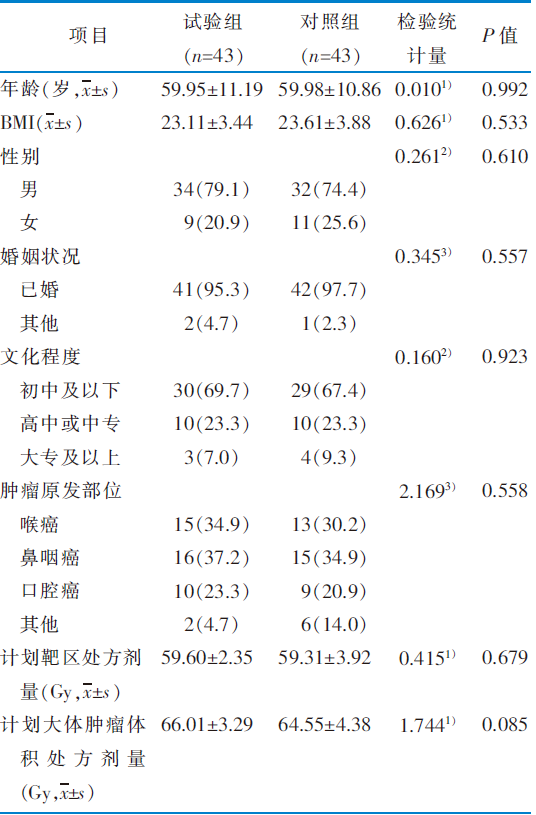 |
表1 两组一般资料的比较
Table 1 Comparison of general data of 2 groups
| |
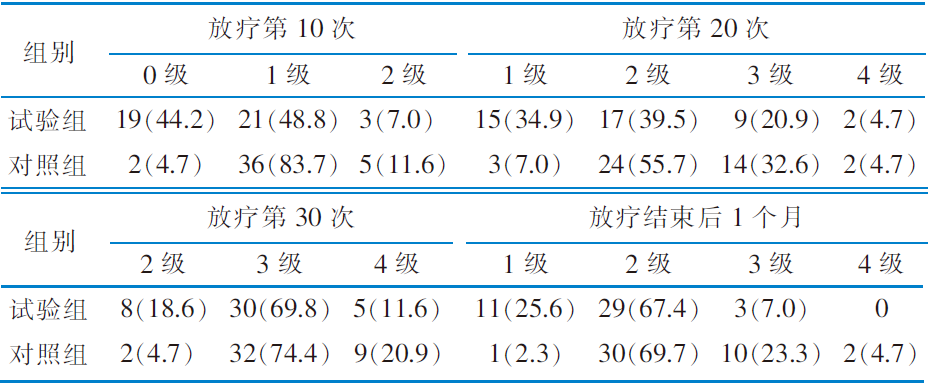 |
表2 两组不同时间点口干程度的比较[例(百分比,%)]
Table 2 Comparison of dry mouth severity of 2 groups at different time points[cases(percentage,%)]
| |
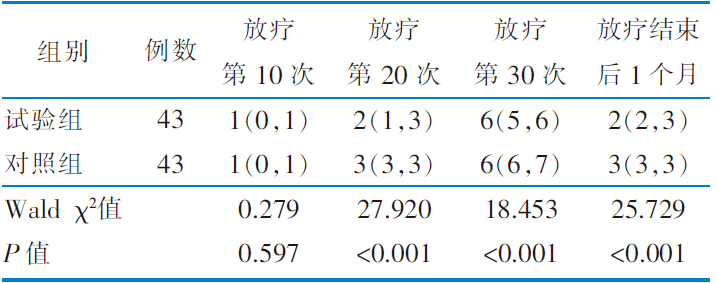 |
表3 两组不同时间点口腔疼痛程度的比较[分,M(P25,P75)]
Table 3 Comparison of oral pain severity of 2 groups at different time points[score,M(P25,P75)]
| |
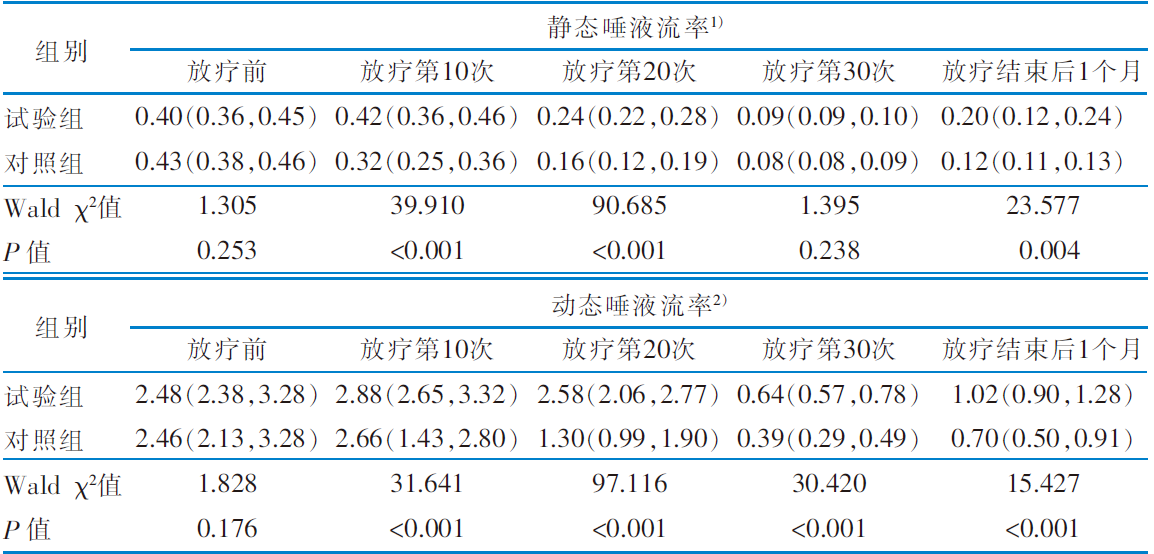 |
表4 两组不同时间点唾液流率的比较[mL/min,M(P25,P75)]
Table 4 Comparison of saliva flow rate levels of 2 groups at different time points[mL/min,M(P25,P75)]
| |
| [1] |
杨雯雯, 王嘉煜, 李素芳, 等. 头颈部肿瘤放化疗患者症状演变及护理启示[J]. 中华护理杂志, 2026, 61(10):1371-1378.
DOI |
|
Yang WW, Wang JY, Li SF, et al. Dynamic evolution of symptom networks in head and neck cancer patients undergoing chemoradiotherapy and nursing implications[J]. Chin J Nurs, 2026, 61(10):1371-1378.
DOI |
|
| [2] | Bray F, Laversanne M, Sung H, et al. Global cancer statistics 2022:GLOBOCAN estimates of incidence and mortality worldwide for 36 cancers in 185 countries[J]. CA Cancer J Clin, 2024, 74(3):229-263. |
| [3] | 中国抗癌协会放射治疗整合护理专业委员会, 浙江省护理学会肿瘤专业委员会. 放射性口腔干燥症护理专家共识[J]. 中华现代护理杂志, 2024, 30(34):4621-4627. |
| Integrated Nursing Professional Committee for Radiotherapy of China Anti-cancer Association,Cancer Professional Committee of Zhejiang Nursing Society. Expert consensus on nursing of radiation-induced xerostomia[J]. Chin J Mod Nurs, 2024, 30(34):4621-4627. | |
| [4] |
曾佳琳, 符冰, 杨泠韵, 等. 头颈癌患者自我报告结局评估工具的评价及护理启示[J]. 中华护理杂志, 2026, 61(7):986-994.
DOI |
| Zeng JL, Fu B, Yang LY, et al. Evaluation of patient-reported outcome assessment tools for head and neck cancer patients and nursing im-plications[J]. Chin J Nurs, 2026, 61(7):986-994. | |
| [5] | 张睿领, 罗秋月, 江娟. 大黄芪汤治疗头颈部肿瘤放射性口干的临床研究[J]. 中华中医药学刊, 2025, 43(7):104-107. |
| Zhang RL, Luo QY, Jiang J. Clinical study of dahuangqi decoction in treating radioactive xerostomia in head and neck tumors[J]. Chin Arch Tradit Chin Med, 2025, 43(7):104-107. | |
| [6] |
刘美子, 安然, 吴子童, 等. 头颈部肿瘤患者核心症状及症状群的网络分析与护理对策[J]. 中华护理杂志, 2024, 59(7):828-834.
DOI |
|
Liu MZ, An R, Wu ZT, et al. A network analysis and nursing implications of core symptoms and symptom clusters in head and neck cancer patients[J]. Chin J Nurs, 2024, 59(7):828-834.
DOI |
|
| [7] |
Villa A, Sonis ST. Radiotherapy-induced severe oral mucositis:pharmacotherapies in recent and current clinical trials[J]. Expert Opin Investig Drugs, 2023, 32(4):301-310.
DOI URL |
| [8] | 王玉洁, 路潜, 金三丽, 等. 头颈部癌症患者放射治疗期间口咽部症状管理的研究进展[J]. 中国护理管理, 2021, 21(6):936-940. |
| Wang YJ, Lu Q, Jin SL, et al. A review of the management of oropharyngeal symptoms in patients with head and neck cancer undergoing radiotherapy[J]. Chin Nurs Manag, 2021, 21(6):936-940. | |
| [9] |
吴先琴, 谌曦, 刘磊, 等. 养阴清热中药雾化联合穴位按摩对干燥综合征患者口干症状的影响[J]. 护理学报, 2023, 30(9):75-78.
DOI |
| Wu XQ, Chen X, Liu L, et al. Aerosol inhalation of Chinese medicine combined with acupoint massage on xerostomia of patients with sjogren’s syndrome[J]. J Nurs(China), 2023, 30(9):75-78. | |
| [10] | 陈晓敏, 杨柳, 陈秀梅, 等. 余甘子溶液口腔喷雾对鼻咽癌放射性口干症患者的干预效果[J]. 护理学杂志, 2024, 39(18):53-56. |
| Chen XM, Yang L, Chen XM, et al. Effects of phyllanthifructus spray intervention on radiation-induced xerostomia in pa- tients with nasopharyngeal carcinoma[J]. J Nurs Sci, 2024, 39(18):53-56. | |
| [11] | 李茁, 孟艺欣, 李金声, 等. 高压氧治疗在肿瘤放射性损伤中的临床应用进展[J]. 中华航海医学与高气压医学杂志, 2021, 28(5):552-561. |
| Li Z, Meng YX, Li JS, et al. Clinical progress of hyperbaric oxygen therapy in radiation-induced injuries of tumors[J]. Chin J Naut Med Hyperb Med, 2021, 28(5):552-561. | |
| [12] | 黄露露, 丁劲, 周巧玲, 等. “赤龙搅海”运动处方对MHD患者口渴程度的改善效果[J]. 护理实践与研究, 2023, 20(8):1209-1213. |
| Huang LL, Ding J, Zhou QL, et al. Effect of “tongue and mouth” exercise prescription on improving the degree of thirst in MHD patients[J]. Nurs Pract Res, 2023, 20(8):1209-1213. | |
| [13] | 段莉, 何玉婷, 李园. 芦根泡水联合“赤龙搅海”缓解剖宫产术后产妇口渴感的临床观察[J]. 中国医学创新, 2024, 21(35):79-82. |
| Duan L, He YT, Li Y. Clinical observation of Lugen in water combined with “chilong Jiaohai” in alleviating the thirst sensation of parturients after cesarean section[J]. Med Innov China, 2024, 21(35):79-82. | |
| [14] | 许睿, 邹炎铃, 朱凯丽, 等. 穴位按摩联合叩齿咽津对胃癌术后化疗患者消化道症状群的影响[J]. 护理学杂志, 2025, 40(9):55-58,64. |
| Xu R, Zou YL, Zhu KL, et al. Impact of acupoint massage combined with tooth tapping and saliva swallowing on digestive symptom clusters in patients undergoing chemotherapy after gastric cancer surgery[J]. J Nurs Sci, 2025, 40(9):55-58,64. | |
| [15] | 张敏, 黄晓钰, 许可慧, 等. 叩齿咽津法对腹腔镜胃癌根治术后患者实施早期肠内营养的效果观察[J]. 中国护理管理, 2024, 24(9):1298-1302. |
| Zhang M, Huang XY, Xu KH, et al. Clinical efficacy of the tooth-tapping and saliva-swallowing method on early enteral nutrition implementation after laparoscopic gastric cancer surgery[J]. Chin Nurs Manag, 2024, 24(9):1298-1302. | |
| [16] | 王媛媛, 孙瑞华. PASS软件实现临床试验中非劣效、等效和优效性检验的样本量估算[J]. 中华流行病学杂志, 2016, 37(5):741-744. |
|
Wang YY, Sun RH. Application of PASS in sample size estimation of non-inferiority,equivalence and superiority design in clinical trials[J]. Chin J Epidemiol, 2016, 37(5):741-744.
DOI PMID |
|
| [17] | 张小云, 山惠萍, 奚兰花, 等. 咀嚼运动联合穴位按摩在鼻咽癌放疗患者放射性口干症中的应用[J]. 护理实践与研究, 2023, 20(22):3394-3399. |
| Zhang XY, Shan HP, Xi LH, et al. Application of chewing exercise combined with acupoint massage in radiation therapy for nasopharyngeal carcinoma in patients with radiation induced xerostomia[J]. Nurs Pract Res, 2023, 20(22):3394-3399. | |
| [18] | 尤海玲, 陈源. 叩齿咽津合透营转气治疗鼻咽癌放疗后口干症疗效观察[J]. 中医临床研究, 2018, 10(4):53-54. |
| You HL, Chen Y. Observation on treating xerostomia after radiotherapy of nasopharyngeal carcinoma by clicking teeth,swallow plus Touying Zhuanqi[J]. Clin J Chin Med, 2018, 10(4):53-54. | |
| [19] | 杨慎峭, 陈婷, 周奇志, 等. 电针合谷穴对正常人唾液腺分泌功能影响的研究[J]. 中国康复医学杂志, 2014, 29(7):677-678. |
| Yang SQ, Chen T, Zhou QZ, et al. Effect of electroacupuncture at acupoint Hegu on salivary gland function in healthy adults[J]. Chin J Rehabil Med, 2014, 29(7):677-678. | |
| [20] | 王迪, 李伟杰, 张利侠. 针灸、穴位贴敷配合干预措施治疗卒中后流涎的疗效观察[J]. 国际老年医学杂志, 2014, 35(1):19-21. |
| Wang D, Li WJ, Zhang LX. Efficacy observation of acupuncture,acupoint with interventions in the treatment of salivation after stroke[J]. Int J Geriatr, 2014, 35(1):19-21. | |
| [21] | 吕景山. 单穴治病选萃[M]. 北京: 人民卫生出版社, 1995. |
| Lü JS. Essentials of single-acupoint treatments[M]. Beijing: People’s Medical Publishing House,1995. | |
| [22] | 林丽玉, 许丽春, 张鑫, 等. 头颈癌患者放射性口腔干燥症预防与管理的最佳证据总结[J]. 护士进修杂志, 2022, 37(21):1961-1965. |
| Lin LY, Xu LC, Zhang X, et al. Summary of the best evidence for prevention and management of radiation xerostomia in patients with head and neck cancer[J]. J Nurses Train, 2022, 37(21):1961-1965. | |
| [23] | T/CNAS 15—2020 放化疗相关口腔黏膜炎预防及护理[S/OL]. https://hltb.kxj.org.cn/index/tuanti/standard.html?team_standard_id=15. |
| T/CNAS15—2020 Prevention and nursing of radio/chemotherapy induced oral mucositis[S/OL]. https://hltb.kxj.org.cn/index/tuanti/standard.html?team_standard_id=15. | |
| [24] |
王婷, 侯冉, 常杲杲, 等. 头颈部肿瘤放疗患者吞咽功能训练的最佳证据总结[J]. 中华护理杂志, 2023, 58(14):1712-1718.
DOI |
|
Wang T, Hou R, Chang GG, et al. Summary of the best evidence for swallowing function training in patients with head and neck cancer undergoing radiotherapy[J]. Chin J Nurs, 2023, 58(14):1712-1718.
DOI |
|
| [25] |
Karbach J, Walter C, Al-Nawas B. Evaluation of saliva flow rates,Candida colonization and susceptibility of Candida strains after head and neck radiation[J]. Clin Oral Investig, 2012, 16(4):1305-1312.
DOI URL |
| [26] |
Lou JJ, Huang P, Ma CS, et al. Parotid gland radiation dose-xerostomia relationships based on actual delivered dose for nasopharyngeal carcinoma[J]. J Applied Clin Med Phys, 2018, 19(3):251-260.
DOI URL |
| [27] | 徐亮, 赵丹蕾, 田野, 等. 两种不同味觉刺激物刺激后MR扩散加权成像评价涎腺功能的对比研究[J]. 中华放射学杂志, 2016, 50(2):81-85. |
| Xu L, Zhao DL, Tian Y, et al. Comparative study on quantitative evaluation of normal salivary glands function by diffusion-weighted MR imaging after gustatory stimulation using two different stimuli[J]. Chin J Radiol, 2016, 50(2):81-85. | |
| [28] | 范铭, 许佳敏, 张烨, 等. 放射性唾液腺损伤的研究进展[J]. 中华放射肿瘤学杂志, 2025, 34(9):867-873. |
| Fan M, Xu JM, Zhang Y, et al. Research progress in radiation-induced salivary gland dysfunction[J]. Chin J Radiat Oncol, 2025, 34(9):867-873. | |
| [29] | 中国抗癌协会肿瘤放射防护专业委员会, 中华预防医学会放射卫生专业委员会. 放射性口腔黏膜炎辐射防护专家共识[J]. 中华放射肿瘤学杂志, 2024, 33(4):296-306. |
| The Cancer Radiation Protection Committee of China Anti-Cancer Association,the Radiation Health Committee of Chinese Preventive Medicine Association. Expert consensus on prevention and treatment of radiotherapy-induced oral mucositis[J]. Chin J Radiat Oncol, 2024, 33(4):296-306. | |
| [30] |
Liu SY, Zhao Q, Zheng ZZ, et al. Status of treatment and prophylaxis for radiation-induced oral mucositis in patients with head and neck cancer[J]. Front Oncol, 2021, 11:642575.
DOI URL |
| [1] | 曾佳琳, 符冰, 杨泠韵, 江庆华. 头颈癌患者自我报告结局评估工具的评价及护理启示[J]. 中华护理杂志, 2026, 61(7): 986-994. |
| [2] | 郭晓贝, 王颖, 郭月, 崔梦影, 鲁志卉, 黄子菁. 方步运动在老年人运动认知风险综合征预防中的应用进展[J]. 中华护理杂志, 2026, 61(6): 852-857. |
| [3] | 中华医学会骨科学分会护理学组 执笔:梅迎雪, 韩梦月, 潘韩丽, 韩冰, 杨旭. 骨科大手术患者静脉血栓栓塞症预防专家共识[J]. 中华护理杂志, 2026, 61(4): 437-441. |
| [4] | 刘凤春, 孟茜, 宋晓萌, 穆东帅, 王艳, 王雪, 常红. 择时穴位贴敷对帕金森病患者夜间尿频的护理效果研究[J]. 中华护理杂志, 2026, 61(3): 347-352. |
| [5] | 余城飞, 马姚静, 盛少英, 余群飞, 叶群, 王曼曼, 王国强. 择时耳穴贴压在颈椎前路术后吞咽困难患者中的应用研究[J]. 中华护理杂志, 2026, 61(18): 2453-2460. |
| [6] | 刘姝兰, 蒋运兰, 康静, 张越, 周群. 择时穴位贴敷联合热熨法对椎体融合术后患者胃肠功能的影响研究[J]. 中华护理杂志, 2026, 61(18): 2469-2477. |
| [7] | 中华护理学会肿瘤护理专业委员会, 上海市抗癌协会肿瘤护理专业委员会 (执笔:王心茹, 张晓菊, 陆宇晗, 陆宇晗, 陆箴琦, 杨瑒). 抗肿瘤药物所致中性粒细胞减少患者感染预防指导专家共识[J]. 中华护理杂志, 2026, 61(17): 2345-2350. |
| [8] | 曹云, 孙国珍, 陈凤, 季学丽, 闫梦婉, 敬雷, 钱堃. 改良式踝泵运动在脑卒中患者中的应用研究[J]. 中华护理杂志, 2025, 60(9): 1068-1074. |
| [9] | 何梦欣, 陈德凤, 李蓓, 董旭辉, 李佳宝, 杨扬, 徐要凯, 梁悦语. 智能化交互式认知运动干预在老年人跌倒预防中应用的范围综述[J]. 中华护理杂志, 2025, 60(7): 884-889. |
| [10] | 杨婷, 魏慧, 柳妙妙, 吴旻昊, 童芳芳, 蒋璐亚, 杨红燕. 五音配五色音乐疗法在脑卒中后阈下抑郁患者中的应用研究[J]. 中华护理杂志, 2025, 60(21): 2648-2653. |
| [11] | 谢睿, 章启秀, 陈丽丽, 李颖, 宁丽. 择时芳香疗法联合平衡火罐对围绝经期失眠患者的干预效果研究[J]. 中华护理杂志, 2025, 60(21): 2654-2661. |
| [12] | 邵雪英, 裴晓丹, 李艳娟, 董玉红, 常立阳, 金静芬. 基于脑-肠轴理论的足部推拿在脾肾阳虚型血液透析失眠患者中的应用研究[J]. 中华护理杂志, 2025, 60(18): 2203-2209. |
| [13] | 万艳, 贾青, 白姣姣. 足部减压护理预防糖尿病足复发的最佳证据总结[J]. 中华护理杂志, 2025, 60(16): 2033-2039. |
| [14] | 中华护理学会眼科护理专业委员会(执笔:任永霞 王之惠 沈丹 霍平颖 白晓温 王梦頔). 暴露性角膜病变预防及管理的专家共识[J]. 中华护理杂志, 2025, 60(14): 1705-1708. |
| [15] | 杜云红, 荣文丽, 孙莉莉, 王玉, 王淑君, 王莉. 结直肠癌患者“互联网+中医护理服务”选择偏好的研究[J]. 中华护理杂志, 2025, 60(12): 1413-1419. |
| 阅读次数 | ||||||
|
全文 |
|
|||||
|
摘要 |
|
|||||
