

中华护理杂志 ›› 2025, Vol. 60 ›› Issue (22): 2798-2804.DOI: 10.3761/j.issn.0254-1769.2025.22.018
王文爽( ), 靳瑾, 刘夏, 杨洋, 王欣然()
收稿日期:2025-04-28
出版日期:2025-11-20
发布日期:2025-11-13
通讯作者:
王欣然,E-mail:xwgsd2017@hotmail.com作者简介:王文爽:女,硕士,护师,E-mail:1660713624@qq.com
基金资助:
WANG Wenshuang(), JIN Jin, LIU Xia, YANG Yang, WANG Xinran()
Received:2025-04-28
Online:2025-11-20
Published:2025-11-13
摘要:
目的 对高甘油三酯血症性急性胰腺炎患者复发的风险预测模型进行范围综述,为临床决策提供参考。方法 检索PubMed、Web of Science、Embase、CINAHL、Cochrane Library、中国知网、万方数据库、维普数据库及中国生物医学文献数据库中与高甘油三酯血症性急性胰腺炎患者复发风险预测的相关文献,检索时限为建库至2025年7月。由2名研究人员筛选文献、提取数据,并对文献进行质量评价及内容总结分析。结果 共纳入13篇文献,包含13个风险预测模型,7个模型报告了受试者操作特征曲线下面积(0.656~0.962),9个模型进行了模型校准。年龄(年轻化)、合并糖尿病、合并高脂血症、急性胰腺炎严重程度、随访(12个月)甘油三酯水平≥5.6 mmol/L、持续使用降甘油三酯药物(≥3个月)是高甘油三酯血症性急性胰腺炎复发风险预测模型中的主要预测因子。结论 高甘油三酯血症性急性胰腺炎复发风险预测模型尚处于发展阶段,模型预测能力较好,但偏倚风险较高。未来研究应对模型的开发及验证做进一步的规范,为医护人员提供高质量、实用性强的临床决策依据。
王文爽, 靳瑾, 刘夏, 杨洋, 王欣然. 高甘油三酯血症性急性胰腺炎复发风险预测模型的范围综述[J]. 中华护理杂志, 2025, 60(22): 2798-2804.
WANG Wenshuang, JIN Jin, LIU Xia, YANG Yang, WANG Xinran. Scoping review of risk prediction models for recurrence of hypertriglyceridemic acute pancreatitis[J]. Chinese Journal of Nursing, 2025, 60(22): 2798-2804.
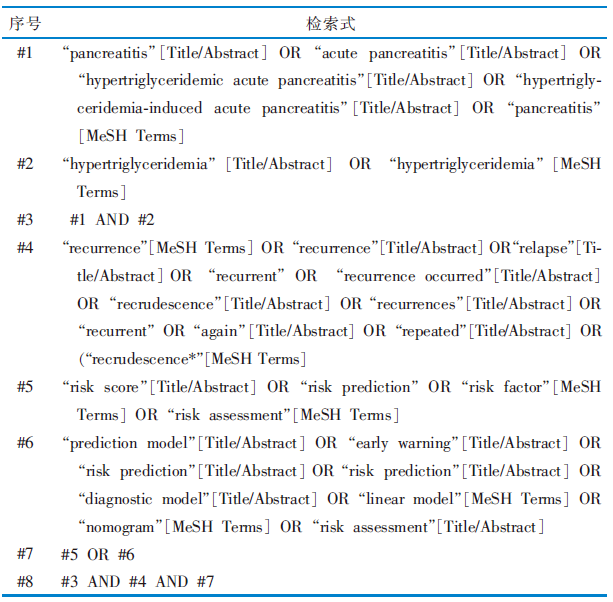 |
表1 PubMed 检索策略
Table 1 PubMed search strategy
| |
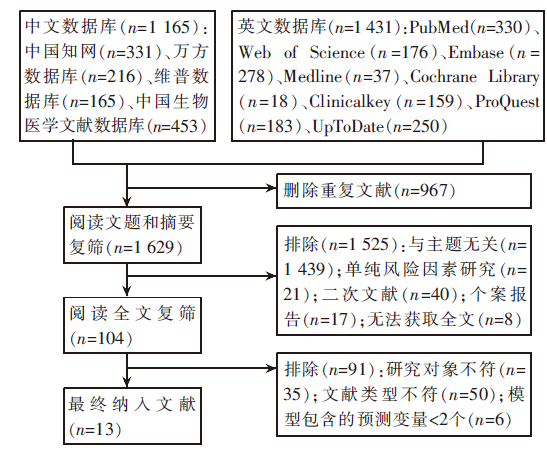
图1 文献筛选流程
Figure 1 Literature screening flow chart
 |
表2 纳入文献基本特征(n=13)
Table 2 Basic characteristics of included literature(n=13)
| |
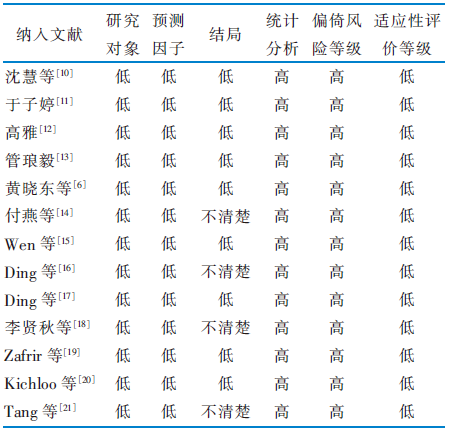 |
表3 预测模型的偏倚风险评价(n=13)
Table 3 Risk of bias assessment for included prediction models(n=13)
| |
| [1] |
Cao LX, Chen YJ, Liu SY, et al. Early plasmapheresis among patients with hypertriglyceridemia-associated acute pancreatitis[J]. JAMA Netw Open, 2023, 6(6):e2320802.
DOI URL |
| [2] |
Yao W, Xie ZQ, Li M, et al. Hypertriglyceridemic acute panc-reatitis:a bibliometric analysis from 2002 to 2023[J]. Int J Surg, 2025, 111(1):1484-1487.
DOI URL |
| [3] |
Lin XY, Zeng Y, Zhang ZC, et al. Incidence and clinical chara-cteristics of hypertriglyceridemic acute pancreatitis:a retros-pective single-center study[J]. World J Gastroenterol, 2022, 28(29):3946-3959.
DOI URL |
| [4] |
何红梅, 喻芳, 林丽华, 等. 急性胰腺炎患者再喂养综合征风险预测模型的构建及护理启示[J]. 中华护理杂志, 2024, 59(13):1608-1615.
DOI |
| He HM, Yu F, Lin LH, et al. Construction of a risk prediction model for refeeding syndrome in patients with acute pancrea-titis and its nursing implications[J]. Chin J Nurs, 2024, 59(13):1608-1615. | |
| [5] |
Liu YX, Ding L, Xu X, et al. Readmission of patients with hyper-triglyceridemia-induced acute pancreatitis:a prospective cohort study[J]. BMC Gastroenterol, 2025, 25(1):167.
DOI |
| [6] | 黄晓东, 黄贤伟, 杨成彬, 等. 复发性高脂血症性急性胰腺炎列线图预测模型[J]. 中华急诊医学杂志, 2023, 32(10):1346-1349. |
| Huang XD, Huang XW, Yang CB, et al. Nomogram prediction model for recurrent hyperlipidemic acute pancreatitis[J]. Chin J Emerg Med, 2023, 32(10):1346-1349. | |
| [7] |
《高甘油三酯血症性急性胰腺炎诊治急诊专家共识》专家组. 高甘油三酯血症性急性胰腺炎诊治急诊专家共识:高甘油三酯血症性急性胰腺炎的治疗策略[J]. 中国全科医学, 2021, 24(30):3781-3793.
DOI |
| Expert group of emergency expert consensus on diagnosis and treatment of hypertriglyceridemic acute pancreatitis. Emergency expert consensus on diagnosis and treatment of hypertriglyceri-demic acute pancreatitis[J]. Chin Gen Pract, 2021, 24(30):3781-3793. | |
| [8] |
Moons KGM, de Groot JAH, Bouwmeester W, et al. Critical ap-praisal and data extraction for systematic reviews of prediction modelling studies:the CHARMS checklist[J]. PLoS Med, 2014, 11(10):e1001744.
DOI URL |
| [9] | 陈香萍, 张奕, 庄一渝, 等. PROBAST:诊断或预后多因素预测模型研究偏倚风险的评估工具[J]. 中国循证医学杂志, 2020, 20(6):737-744. |
| Chen XP, Zhang Y, Zhuang YY, et al. PROBAST:a tool for assessing risk of bias in the study of diagnostic or prognostic multi-factorial predictive models[J]. Chin J Evid Based Med, 2020, 20(6):737-744. | |
| [10] | 沈慧, 白杨, 梁凤. 基于Logistic回归分析高脂血症性急性胰腺炎患者复发的因素[J]. 肝胆外科杂志, 2023, 31(2):140-144. |
| Shen H, Bai Y, Liang F. To analyze the recurrence factors of hyperlipidemic acute pancreatitis based on Logistic regression[J]. J Hepatobiliary Surg, 2023, 31(2):140-144. | |
| [11] | 于子婷. 高甘油三酯血症性急性胰腺炎复发的危险因素[D]. 济南: 山东大学, 2020. |
| Yu ZT. Risk factors of recurrence of hypertriglyceridemia acute pancreatitis[D]. Jinan: Shandong University, 2020. | |
| [12] | 高雅. 高甘油三酯血症性急性胰腺炎复发的临床特征及危险因素分析[D]. 唐山: 华北理工大学, 2023. |
| Gao Y. Clinical characteristics and risk factors of recurrent hypertriglyceridemia acute pancreatitis[D]. Tangshan: North China University of Science and Technology, 2023. | |
| [13] | 管琅毅. 高甘油三酯血症性急性胰腺炎复发危险因素的评估及风险预测模型的建立[D]. 南昌: 南昌大学, 2022. |
| Guan LY. Evaluation of risk factors for recurrence of hyper-triglyceridemia acute pancreatitis and establishment of risk prediction model[D]. Nanchang: Nanchang University, 2022. | |
| [14] | 付燕, 刘雪, 崔北辰, 等. 2型糖尿病合并高甘油三酯血症性急性胰腺炎患者临床特点及危险因素分析[J]. 中国急救医学, 2022, 42(2):149-153. |
| Fu Y, Liu X, Cui BC, et al. Clinical characteristics and risk factors of hypertriglyceridemic pancreatitis in type 2 diabetes mellitus patients[J]. Chin J Crit Care Med, 2022, 42(2):149-153. | |
| [15] |
Wen SY, Zhang Y, Zhao GJ, et al. Development and validation of a clinical predictive nomogram for assessing the risk of recurrence of acute pancreatitis in combined hypertriglyceri-demia[J]. Dig Dis Sci, 2024, 69(9):3426-3435.
DOI |
| [16] |
Ding L, Guan LY, Li XY, et al. Recurrence for patients with first episode of hypertriglyceridemia-induced acute pancreati-tis:a prospective cohort study[J]. J Clin Lipidol, 2023, 17(1):94-102.
DOI URL |
| [17] |
Ding L, Li S, Cao LX, et al. Recurrence of hypertriglyceride-mia-associated acute pancreatitis:a multicenter,prospective cohort study[J]. Eur J Intern Med, 2024, 125:98-103.
DOI URL |
| [18] | 李贤秋, 刘慧, 肖春桃, 等. 代谢综合征对高脂血症急性胰腺炎患者复发的影响[J]. 临床肝胆病杂志, 2020, 36(11):2515-2520. |
| Li XQ, Liu H, Xiao CT, et al. Influence of metabolic syndrome on patients with recurrence of hypertriglyceridemic acute pancreatitis[J]. J Clin Hepatol, 2020, 36(11):2515-2520. | |
| [19] |
Zafrir B, Saliba W, Jubran A, et al. Severe hypertriglyceride-mia-related pancreatitis:characteristics and predictors of re-currence[J]. Pancreas, 2019, 48(2):182-186.
DOI URL |
| [20] |
Kichloo A, El-Amir Z, Aucar M, et al. Clinical outcomes and predictors of thirty-day readmissions of hypertriglyceridemia-induced acute pancreatitis[J]. Gastroenterology Res, 2022, 15(1):19-25.
DOI URL |
| [21] |
Tang LL, Jia Q, Liu N, et al. Lipid metabolism for predicting the recurrence of hypertriglyceridemic acute pancreatitis[J]. Heliyon, 2023, 9(6):e17443.
DOI URL |
| [22] |
周淼, 陈星, 彭飞, 等. ICU患者中心静脉导管相关血流感染风险预测工具的系统评价[J]. 中华护理杂志, 2025, 60(9):1132-1139.
DOI |
|
Zhou M, Chen X, Peng F, et al. Systematic review of risk prediction instruments for central line associated bloodstream infections in ICU patients[J]. Chin J Nurs, 2025, 60(9):1132-1139.
DOI |
|
| [23] |
Zhou J, Wang ZZ, Liu QH, et al. Triglyceride-lowering therapies in hypertriglyceridemia-associated acute pancreatitis in China:a multicentre prospective cohort study[J]. BMC Med, 2024, 22(1):535.
DOI |
| [24] | 芮晨辉, 周大臣, 孙昀, 等. 老年急性胰腺炎患者严重程度的评估:一种新的临床预测模型[J]. 肝胆外科杂志, 2024, 32(3):172-177. |
| Rui CH, Zhou DC, Sun Y, et al. Key risk factors leading to the development of severe acute pancreatitis(AP) in elderly patients and to establish a prediction model for accurately assessing the severity of AP in the elderly[J]. J Hepatobiliary Surg, 2024, 32(3):172-177. | |
| [25] |
Hassanloo J, Béland-Bonenfant S, Paquette M, et al. Prevalence,severity and management of hypertriglyceridemia-associated pancreatitis:a 7-year retrospective cohort study at Canadian quaternary care hospitals[J]. J Clin Lipidol, 2022, 16(4):455-462.
DOI PMID |
| [26] |
Rajalingamgari P, Khatua B, Summers MJ, et al. Prospective ob-servational study and mechanistic evidence showing lipolysis of circulating triglycerides worsens hypertriglyceridemic acute pancreatitis[J]. J Clin Invest, 2024, 135(1):e184785.
DOI URL |
| [27] |
Zhang GF, Yang Q, Mao WJ, et al. GPIHBP1 autoantibody is an independent risk factor for the recurrence of hypertrigly-ceridemia-induced acute pancreatitis[J]. J Clin Lipidol, 2022, 16(5):626-634.
DOI URL |
| [28] |
Ariza MJ, Coca-Prieto I, Rioja J, et al. Pathogenicity assessment of genetic variants identified in patients with severe hyper-triglyceridemia:novel cases of familial chylomicronemia syn-drome from the Dyslipidemia Registry of the Spanish Athe-rosclerosis Society[J]. Genet Med, 2025, 27(5):101365.
DOI URL |
| [29] |
Perera SD, Hegele RA. Genetic variation in apolipoprotein A-V in hypertriglyceridemia[J]. Curr Opin Lipidol, 2024, 35(2):66-77.
DOI URL |
| [30] |
王欣然, 钟丽霞, 张晓雪. 急性胰腺炎患者胰腺外分泌功能不全识别及护理的研究进展[J]. 中华护理杂志, 2020, 55(12):1871-1875.
DOI |
| Wang XR, Zhong LX, Zhang XX. The identification and cli-nical nursing care of pancreatic exocrine insufficiency in patients with acute pancreatitis[J]. Chin J Nurs, 2020, 55(12):1871-1875. | |
| [31] |
Chen H, Wen Y, Li XY, et al. Integrating CT-based radiomics and clinical features to better predict the prognosis of acute pancreatitis[J]. Insights Imaging, 2025, 16(1):8.
DOI |
| [32] | 赵蕊, 范文琪, 刘晓夏, 等. 基于机器学习的3种妇产科护士共情疲劳风险预测模型的构建与比较[J]. 中华护理杂志, 2025, 60(3):347-354. |
| Zhao R, Fan WQ, Liu XX, et al. Establishment and compari-son of 3 compassion fatigue risk prediction models for obste-trics and gynaecology nurses based on machine learning[J]. Chin J Nurs, 2025, 60(3):347-354. | |
| [33] | Ning CH, Ouyang H, Xiao J, et al. Development and validation of an explainable machine learning model for mortality predi-ction among patients with infected pancreatic necrosis[J]. ECli-nicalMedicine, 2025, 80:103074. |
| [1] | 曾妃, 兰美娟, 顾培培, 梁江淑渊, 王衍蝶, 蔡凌云. 儿童双肺移植术后肺康复护理方案的构建及初步验证[J]. 中华护理杂志, 2025, 60(9): 1029-1035. |
| [2] | 阎寅至, 闻芳, 王敏, 周雪梅, 马金玲, 吴惠芳, 姚文英. 造血干细胞移植患儿运动康复分级护理方案的构建与应用研究[J]. 中华护理杂志, 2025, 60(9): 1036-1042. |
| [3] | 刘曦璇, 刘玉琳, 刘莎, 杨帆, 谢晓虹, 王紫娟, 刘丽芳, 魏红雨. 学龄期支气管哮喘患儿呼吸康复操的研制及效果评价[J]. 中华护理杂志, 2025, 60(9): 1043-1049. |
| [4] | 黄盼盼, 李丽玲, 胡晓静. 先天性心脏病婴儿早期运动康复的研究进展[J]. 中华护理杂志, 2025, 60(9): 1050-1055. |
| [5] | 陈丽鸥, 张文婷, 刘俊其, 王允琮, 王振霖, 齐赛, 杨娜. 肺叶体表投影定位结合肺段引流排痰技术对吸入性肺炎患者气道廓清的效果研究[J]. 中华护理杂志, 2025, 60(9): 1056-1061. |
| [6] | 杨娜娜, 程传丽, 曾慧, 符丹丹, 王燕, 陈悦, 冉宏敏, 范红静, 龙霞. 分级运动康复对慢性阻塞性肺疾病急性加重期患者的效果评价[J]. 中华护理杂志, 2025, 60(9): 1062-1067. |
| [7] | 曹云, 孙国珍, 陈凤, 季学丽, 闫梦婉, 敬雷, 钱堃. 改良式踝泵运动在脑卒中患者中的应用研究[J]. 中华护理杂志, 2025, 60(9): 1068-1074. |
| [8] | 谢敏, 漆文凯, 殷玲, 张旋, 赵如琴. 腹膜透析患者恐动症潜在剖面分析及影响因素研究[J]. 中华护理杂志, 2025, 60(9): 1080-1086. |
| [9] | 陈冰倩, 赵彬, 孙佳蓉, 郝四芳, 侯晓丽. 慢性牙周炎种植义齿患者口腔健康管理困境的质性研究[J]. 中华护理杂志, 2025, 60(9): 1087-1092. |
| [10] | 秦春兰, 吴振云, 钱红英, 赵茜, 孙锦庭. 慢性阻塞性肺疾病患者疾病自我控制体验的质性研究[J]. 中华护理杂志, 2025, 60(9): 1093-1098. |
| [11] | 李子崴, 冯丽娟, 陈旭升, 黄毅, 杨洁. PICC置管患者运动恐惧评估量表的编制及应用[J]. 中华护理杂志, 2025, 60(9): 1099-1106. |
| [12] | 程志强, 张宝珍, 汤利萍, 李静, 夏娇云, 魏雪岩, 龚智娴, 张美珍, 黎露思. 尿失禁患者疾病认知与态度量表的汉化及初步应用[J]. 中华护理杂志, 2025, 60(9): 1107-1112. |
| [13] | 杨静, 王华芬, 卢芳燕, 鲍瑞洁, 朱莉. 肝移植患儿术后营养状况变化的影响因素分析及护理启示[J]. 中华护理杂志, 2025, 60(9): 1113-1119. |
| [14] | 石美琴, 吴建芳, 张铎, 吴春萍, 陈玲, 陶磊. 1例全喉切除辅助发音管Ⅰ期植入患者术后喉功能康复的护理[J]. 中华护理杂志, 2025, 60(9): 1120-1123. |
| [15] | 谷茜, 黄玺, 施伟雄, 吴静, 谭若铭, 王枫. 1例T细胞免疫治疗后并发细胞因子释放综合征患者的护理[J]. 中华护理杂志, 2025, 60(9): 1124-1127. |
| 阅读次数 | ||||||
|
全文 |
|
|||||
|
摘要 |
|
|||||
